
光热发电

Search documents
浙江可胜技术股份有限公司(H0063) - 申请版本(第一次呈交)
2026-03-23 16:00
本申請版 本乃根據 香港聯合 交易所有 限公司(「聯 交所」)及證券 及期貨事 務監察委 員會 (「證監會」)的要求而刊發,僅用作提供資訊予香港公眾人士。 本申 請 版本 為草 擬 本, 其 內所 載資 訊 並不 完 整, 亦可 能 會作 出重 大 變動 。 閣 下閱 覽 本 文 件 , 即 代表 閣 下 知悉 、 接 納 並 向 本 公 司 、 其獨 家 保 薦 人 、 整 體 協 調人 、 顧 問 及 包 銷 團成員表示同意: 香港聯合交易所有限公司與證券及期貨事務監察委員會對本申請版本的內容概不負責,對其準確 性或完整性亦不發表任何聲明,並明確表示概不就因本申請版本全部或任何部分內容而產生或因 倚賴該等內容而引致的任何損失承擔任何責任。 Cosin Solar Technology Co., Ltd. 浙 江 可 勝 技 術 股 份 有 限 公 司 (「本公司」) ( 於中華人民共和國註冊成立的股份有限公司) 的申請版本 警告 倘於 適 當時 候向 香 港公 眾 人士 提出 要 約或 邀請 , 準投 資 者務 請僅 依 據於 香港 公 司註 冊 處 處 長 註 冊 的 本 公 司 招 股 章 程 作 出 ...
全国政协委员杨长利:在能源强国建设中担重任锻长板
中国能源报· 2026-03-04 07:45
Core Viewpoint - The article emphasizes the strategic importance of building an energy powerhouse in China, highlighting the role of state-owned energy enterprises in achieving this goal and the need for green development and technological innovation [2][4]. Group 1: Characteristics of Energy Powerhouse - The five main characteristics of an energy powerhouse are supply security, safety, green and low-carbon development, economic efficiency, and self-reliance [4]. - Current challenges in China's energy development include an imbalanced supply structure, regional disparities in energy development, and the need for improved power system regulation capabilities [4]. Group 2: Strategies for Overcoming Challenges - The company advocates for green development, emphasizing the importance of advancing clean energy sources such as wind, solar, hydro, and nuclear power [5]. - Technological innovation is crucial, with plans to enhance efficient power generation methods and develop advanced nuclear technologies like the "Hualong One" [5]. - Digital transformation is essential, focusing on smart power plants and integrating digital technologies to improve operational efficiency and safety [5]. Group 3: Nuclear Energy Development - The period of the 14th Five-Year Plan is critical for China's nuclear power sector, with a focus on high-quality and safe development [7]. - The company operates 28 nuclear units and has 20 under construction, with a total installed capacity exceeding 56 million kilowatts [7]. - The "Hualong One" project aims for mass production and has led to significant domestic equipment localization [7][8]. Group 4: Solar Thermal Energy Initiatives - The company is actively developing large-scale solar thermal projects, particularly in resource-rich areas, to address the challenges posed by the rapid expansion of renewable energy [10]. - Solar thermal power offers both peak-shaving and energy storage capabilities, providing stable power generation to support the new energy system [10]. - The company has established significant solar thermal projects in Qinghai, including the largest operational tower solar project in China [10][11]. Group 5: Future Directions - The company plans to leverage its leadership in the solar thermal industry to drive technological advancements and cost reductions [11][12]. - Continuous R&D efforts will focus on improving the economic indicators of solar thermal technology and enhancing system efficiency [12]. - The integration of solar thermal with other renewable sources is a priority, aiming to create a "pure green" energy base and improve overall clean energy utilization [12].



政策+市场双加持——光热发电站上规模化新风口
大公信用· 2026-03-01 00:45
Investment Rating - The report indicates a positive investment outlook for the concentrated solar power (CSP) industry, highlighting its potential for large-scale development driven by policy support and market demand [1]. Core Insights - CSP technology integrates power generation and energy storage, offering unique advantages such as stable output and wide-area peak shaving capabilities. Despite its slower development compared to photovoltaic (PV) power, the increasing penetration of renewable energy and high peak shaving demand are driving market needs for CSP [1][6]. - The release of the "Opinions on Promoting the Large-Scale Development of CSP" in December 2025 marks a critical policy milestone, providing clear goals and pathways for the industry's growth [1][19]. - CSP is positioned as a key component in the transition to a low-carbon energy system and energy security, with significant implications for the future of energy supply [1][24]. Summary by Sections 1. Core Characteristics and Technical Pathways of CSP - CSP operates by converting solar radiation into thermal energy, which is then used to generate electricity, inherently combining power generation and energy storage without the need for additional storage systems [2]. - The carbon footprint of CSP is significantly lower than that of PV, with a carbon footprint factor of 0.0312 kgCO2e/kWh, making it one of the most environmentally friendly power generation methods [2]. 2. Current Development Status and Existing Challenges - CSP has seen significant growth, with global installed capacity reaching 8,800.2 MW by the end of 2025, a year-on-year increase of 11.4%. China accounts for approximately 20% of this capacity, with a notable growth rate of 107% [7]. - The report identifies a substantial gap in achieving China's strategic goal of 15 million kW of total installed capacity by 2030, indicating a need for continued development and project construction [8]. - Despite advancements, challenges remain in cost, market positioning, and technology, which need to be addressed through policy guidance and market mechanisms [11]. 3. Demand Driven by Peak Shaving Needs and Insufficient Storage - The current energy supply structure in China is still heavily reliant on thermal power, but the rapid growth of renewable energy is creating a pressing need for stable power sources to balance supply and demand [13]. - CSP's unique ability to provide continuous and stable power generation positions it as a critical solution to the challenges posed by the intermittency of wind and solar power [18]. 4. Policy Framework and Future Outlook - The report outlines a comprehensive policy framework that supports the large-scale development of CSP, emphasizing its role in the new energy system and setting clear targets for capacity and cost reduction [19][21]. - The policy aims to enhance project economics through compensation mechanisms and encourage technological innovation to overcome existing barriers [22]. - The CSP industry is expected to enter a window of large-scale development, driven by both market demand and supportive policies, positioning it as a vital player in the transition to a low-carbon energy system [27].
突破高温密封瓶颈 光热发电关键部件技术获国际领先鉴定
Xin Hua Wang· 2026-02-11 06:50
Core Insights - The dual functionality of solar thermal power generation as both a peak-shaving power source and long-term energy storage is crucial for accelerating the construction of a new power system under the "dual carbon" goals [1] - The recent authoritative identification of the "flexible connection planar rotary joint for high-temperature molten salt trough solar collectors" technology marks a significant advancement, with experts recognizing its overall technical level as internationally leading [1][2] Group 1 - The technology developed by Changzhou Longteng Solar Thermal Technology Co., Ltd. addresses key challenges in molten salt trough solar power generation, achieving three major breakthroughs [2] - The first breakthrough involves the development of an injectable sealing filler using expanded vermiculite, hexagonal boron nitride, and mineral fibers, which overcomes the industry bottleneck for sealing at 560℃ [2] - The second breakthrough introduces a "slope-curved" composite sealing structure that enhances pressure self-augmentation and optimizes maintenance design, significantly improving operational efficiency and reducing maintenance costs [2] - The third breakthrough is the development of a composite surface treatment process combining laser cladding and chemical plating, effectively addressing issues of metal hardness reduction and friction coefficient increase at high temperatures [2] Group 2 - Trough solar thermal technology, due to its high maturity and stable operation, accounts for 79.97% of global installed capacity, while China's share is only 10.93% [3] - The low main steam temperature and high initial investment costs of traditional heat transfer oil trough power plants are significant barriers to their popularity among owners [3] - The breakthrough in high-temperature molten salt flexible connections fills a gap in commercial solutions within the solar thermal industry, facilitating the commercialization process of molten salt trough technology [3] - The successful development of this technology not only strengthens China's self-sufficiency in core solar thermal equipment but also positions the country at the forefront of international solar thermal technology research [3]
以技术突破提升光热产业核心竞争力
Xin Lang Cai Jing· 2026-02-09 19:16
Core Insights - The "14th Five-Year Plan" period will focus on supporting enterprises to tackle key technological challenges in solar thermal energy, including ultra-large aperture heat collectors and ultra-low heat loss heat pipes, to ensure the construction of 100 MW integrated solar thermal projects and promote a complete "salt lake - molten salt - solar thermal" industrial chain [1] Group 1: Industry Development - The city of Delingha will leverage its resource endowment and focus on breakthroughs in molten salt large aperture trough solar thermal power generation technology as a key strategy to enhance the core competitiveness of the solar thermal industry [1] - The provincial government's approval of land for solar thermal project construction will support the establishment of benchmark demonstration projects, enhancing collaboration between government and enterprises to build a complete industrial ecosystem [1] Group 2: Technological Advancements - The CGN Delingha 300 MW molten salt trough solar thermal power project has successfully applied independently developed 8.6-meter large aperture collectors, achieving a collection efficiency exceeding 60% and a 100% localization rate of core equipment [2] - The technological breakthrough is expected to significantly reduce costs, with the levelized cost of electricity for a 350 MW plant potentially dropping to 0.523 CNY/kWh, and further to 0.464 CNY/kWh with expanded collection scale, approaching the cost of peak-load coal-fired power [2]
光热发电如何破解成本难题?
Ke Ji Ri Bao· 2026-02-04 00:35
Core Viewpoint - The development of concentrated solar power (CSP) in China is gaining momentum, with a target of reaching 15 million kilowatts of installed capacity by 2030, while addressing challenges such as high initial investment and market competitiveness [1][6]. Group 1: Current Projects and Developments - The Qinghai Energy Group's Qingyu DC Phase II 100,000 kW CSP project is continuously supplying electricity to the grid, showcasing the ongoing advancements in CSP technology [1]. - The Hami "Solar (Thermal) Storage" 1500 MW base project integrates 150 MW of CSP with 1350 MW of photovoltaic (PV) capacity, demonstrating the synergy between CSP and PV technologies [2]. - As of the end of 2025, China's operational CSP capacity is expected to reach approximately 1.62 million kW, ranking third globally, with 2.7 million kW under construction, accounting for over 90% of global CSP construction [3]. Group 2: Technological Advancements - China has successfully mastered various CSP technologies, including tower, trough, and Fresnel systems, with ongoing innovations such as the 800 MW PV + 100 MW CSP integrated project in Tibet [4]. - The development of the "four towers and one machine" supercritical 350 MW unit is underway, aiming for over 3000 hours of annual electricity generation [5]. - The domestic production rate of equipment and materials for CSP is nearing 100%, positioning China as a leader in the global CSP market [5]. Group 3: Cost Challenges and Policy Support - The average total investment for CSP projects of 100 MW and above is approximately 15,000 yuan per kW, which is about three times that of equivalent PV projects, leading to financial losses under current pricing conditions [6]. - The recent policy document proposes compensation for reliable capacity of qualifying CSP projects, which could significantly enhance the cost competitiveness of CSP [6]. - Qinghai Province has set a fixed grid price of 0.55 yuan per kWh for CSP projects included in its development plan from 2024 to 2028, providing a degree of certainty for the industry [6]. Group 4: Future Outlook and Strategic Recommendations - The industry is exploring various avenues for cost reduction, including expanding unit sizes, developing new types of molten salts, and optimizing mirror field designs, with potential cost reductions of 0.13 yuan per kWh in the next 3-5 years [7]. - To achieve the target of 15 million kW, efforts must focus on planning, implementation, and ensuring support for land, finance, and policy [7]. - CSP is expected to transition from a backup option to a key support role in the energy system, contributing to carbon reduction in conjunction with coal power and providing green electricity for various industries [7].

光热发电如何破解成本难题?
Ke Ji Ri Bao· 2026-02-03 23:30
Core Viewpoint - The article discusses the development and challenges of solar thermal power generation in China, highlighting the government's goal to reach a total installed capacity of approximately 15 million kilowatts by 2030, with the cost of electricity per kilowatt-hour aiming to be comparable to coal power [1][9]. Group 1: Current Developments - The Qinghai Energy Group's solar thermal project is actively supplying electricity to the grid, showcasing the ongoing advancements in solar thermal technology [1]. - The "Several Opinions on Promoting the Large-Scale Development of Solar Thermal Power Generation" outlines ambitious targets for the industry, emphasizing the need for cost reduction and market competitiveness [1][9]. - As of 2025, China's operational solar thermal power capacity is expected to reach approximately 1.62 million kilowatts, ranking third globally, with a significant portion of the world's ongoing projects [5][8]. Group 2: Technical Aspects - Solar thermal power generation involves three main steps: concentrating sunlight, heating and storing energy, and generating electricity, which allows for stable and continuous power supply [4]. - The technology has evolved to include various methods such as tower, trough, and Fresnel systems, with significant advancements in efficiency and cost reduction [7][8]. - The integration of solar thermal with photovoltaic systems is being explored to enhance energy storage and conversion efficiency [4][7]. Group 3: Economic Considerations - Despite the promising outlook, the high initial investment remains a significant barrier, with costs for large-scale projects being approximately three times that of equivalent photovoltaic systems [9]. - The government has proposed compensation for reliable capacity in solar thermal projects, which could significantly improve the economic viability of these projects [9]. - Technological innovations and optimization strategies are expected to further reduce the cost of electricity generated from solar thermal power, potentially lowering it to around 0.53 yuan per kilowatt-hour for larger plants [10]. Group 4: Future Outlook - The article emphasizes the importance of policy support and technological advancements in expanding the application of solar thermal power, positioning it as a critical component in China's energy transition [9][10]. - The development of solar thermal power is seen as a key strategy for achieving a stable and reliable new energy system in China [10].
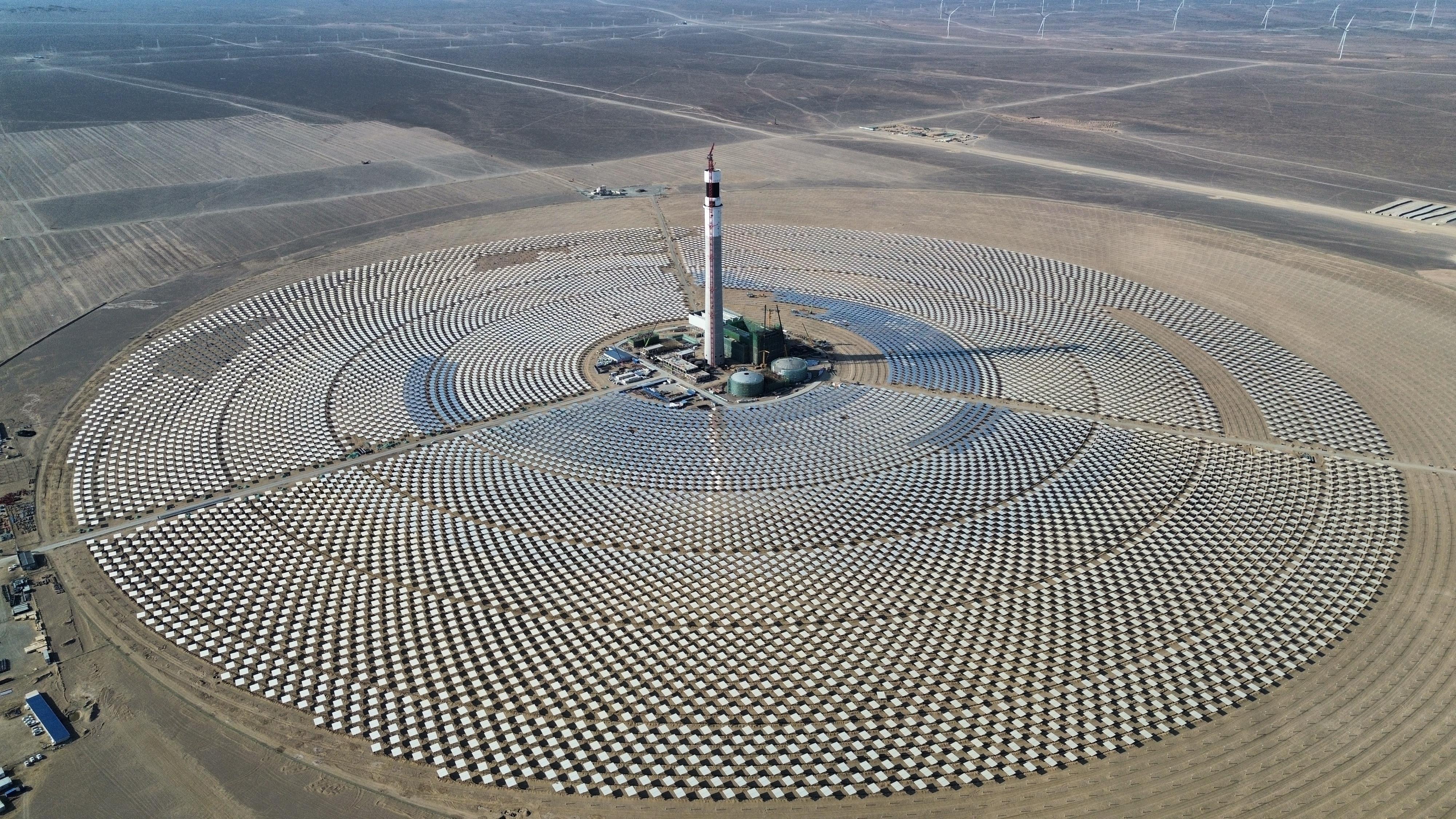
新疆若羌县科学推进高原项目冬季施工
Zhong Guo Jing Ji Wang· 2026-02-03 09:03
Core Insights - The project in Xinjiang, which includes a 100 MW solar thermal (with storage) and a 900 MW photovoltaic power generation system, is progressing rapidly despite harsh winter conditions [1][2] - The project utilizes tower-type molten salt technology and features a large-capacity thermal storage system of 1988 MWh, aiming to significantly contribute to energy structure optimization and the achievement of carbon neutrality goals [2] Group 1 - The construction site is characterized by busy and orderly operations, with automated equipment working alongside construction personnel [1] - The project is the highest tower-type molten salt solar thermal project in Xinjiang, with the heliostat system being a core component affected by extreme weather [1] - The project team emphasizes precision control throughout the construction process to overcome technical challenges posed by low temperatures and strong winds [1] Group 2 - A technical task force has been established to create a closed-loop control system covering the entire process from component storage to assembly, installation, and debugging [2] - The project has completed the assembly and installation of a batch of heliostats, with debugging of the mirror field progressing steadily [2] - Upon completion, the project is expected to generate approximately 1.96 billion kWh annually, reducing standard coal consumption by 690,000 tons each year [2]
2025年度能源行业十大科技创新成果
国家能源局· 2026-01-29 11:21
Core Viewpoint - The article highlights ten significant technological innovations in the energy sector for 2025, showcasing advancements in various energy generation and storage technologies that enhance efficiency, safety, and sustainability. Group 1: Solar and Thermal Energy Innovations - The 100 MW multi-tower solar thermal power generation system introduces a new architecture for concentrated solar power, improving system integration and resource utilization, applied in a 700,000 kW project in Gansu [3] Group 2: Hydropower Innovations - The 500 MW large impact water turbine generator set represents a breakthrough in high-head, large-capacity hydropower technology, featuring the world's largest 6.23-meter turbine and supporting the construction of hydropower bases in Tibet [5] Group 3: Nuclear Energy Innovations - The 2 MW liquid fuel thorium molten salt experimental reactor technology demonstrates the feasibility of using thorium resources, achieving thorium-uranium fuel conversion for the first time [7] Group 4: Coal and Clean Energy Innovations - The 700 MW high-efficiency ultra-supercritical circulating fluidized bed boiler technology significantly reduces coal consumption by approximately 20 grams per kilowatt-hour compared to traditional systems, supporting new coal power projects [9] Group 5: Power Transmission Innovations - The ultra-high voltage direct current transformer with on-load tap changer technology enhances voltage regulation without power interruption, achieving the highest global parameters and supporting large-scale clean energy transmission [11] Group 6: Smart Mining Innovations - The large open-pit coal mine unmanned transportation system addresses key challenges in autonomous operation, filling a technological gap in 300-ton mining trucks for large-scale applications [15] Group 7: Oil and Gas Pipeline Innovations - The large-diameter oil and gas pipeline welding robot technology advances the intelligent transformation of pipeline construction, enhancing efficiency and adaptability in complex field conditions [17] Group 8: Energy Storage Innovations - The large-capacity solid-liquid hybrid lithium-ion battery storage system, with a capacity of 314 amp-hours, enhances performance and safety, applied in a 200 MW/400 MWh energy storage project in Guangdong [19] Group 9: Green Hydrogen and Ammonia Innovations - The large-scale green hydrogen and ammonia integrated flexible synthesis technology supports the non-electric consumption of renewable energy, with demonstration projects in Jilin set to operate in 2025 [21]

建睿智之言 尽务实之力为谱写中国式现代化青海篇章贡献更多聪明才智
Xin Lang Cai Jing· 2026-01-28 21:00
Group 1 - The core message emphasizes the importance of implementing the spirit of the 20th Central Committee's Fourth Plenary Session and the Central Economic Work Conference, focusing on contributing to the modernization of Qinghai through practical efforts and intelligent discourse [1] - Discussions at the meeting included topics such as the high-quality development of the solar thermal power industry, enhancing the private economy, releasing the value of the green computing power industry, and upgrading the deep processing of agricultural and livestock products [1] - The provincial government aims to create a first-class business environment to promote high-quality development, addressing challenges such as policy implementation, market expansion, and rights protection for enterprises [2] Group 2 - The past year saw significant contributions from the Provincial Political Consultative Conference in areas like developing new productive forces and creating a legal business environment, fostering a collaborative atmosphere for high-quality development in Qinghai [2] - The "14th Five-Year Plan" period is identified as crucial for Qinghai to achieve modernization in sync with the rest of the country, emphasizing the need for confidence in development and the importance of aligning macro and micro policies [2] - The government encourages enterprises to focus on their core business, strengthen their operations, and fulfill social responsibilities, aiming for new advancements in their development [2]