特高压技术

Search documents
未来货币是“瓦特”?
Ren Min Ri Bao· 2026-02-05 13:02
Core Insights - China's electricity consumption has surpassed 10 trillion kilowatt-hours, equivalent to more than double the annual electricity consumption of the United States and exceeding the total consumption of the EU, Russia, India, and Japan combined [2] - The growth in electricity consumption from approximately 5.5 trillion kilowatt-hours in 2015 to over 10 trillion kilowatt-hours by 2025 represents nearly a doubling in just ten years, indicating a steep growth curve [3] Infrastructure and Energy System - The substantial electricity consumption is supported by robust infrastructure, establishing China's competitive advantage in the energy sector [4] - China has built the world's most comprehensive and largest energy system, with over 20% of global energy production, maintaining an energy self-sufficiency rate of over 80% since the 14th Five-Year Plan [4] Planning and Coordination - The success is attributed to "advanced planning" and "unified scheduling," with investments in power grid construction based on a principle of moderate foresight [5] - The State Grid has announced a fixed asset investment of 4 trillion yuan for the 15th Five-Year Plan, a 40% increase from the previous plan, to meet future electricity demand growth [5] Unified Power Market - China's unified electricity market, covering over 1.4 billion people, allows for efficient transmission of clean energy from resource-rich western and northern regions to load centers in the east and central areas [6] High Voltage Transmission - China has established 24 ultra-high voltage direct current transmission projects, with a capacity of 340 million kilowatts for "West-to-East Power Transmission" [7] - Predictions indicate significant growth in ultra-high voltage transmission channels by 2050, highlighting the importance of electricity in supporting future intelligent civilization [7] Technological Advancements - Breakthroughs in ultra-high voltage technology, including insulation materials and equipment standardization, position China at the forefront of energy technology [8][9] - Over one-third of electricity consumed in China is generated from renewable sources, with expectations that wind and solar power will surpass thermal power by 2025 [9] Future Development - The advanced and stable green electricity system is not only a guarantee for current economic development but also lays the foundational physical conditions for future growth [10] - Despite significant advantages, challenges remain in profitability, structural optimization, and sustained investment in innovation [10]

未来货币是“瓦特”?
Ren Min Ri Bao· 2026-02-05 00:36
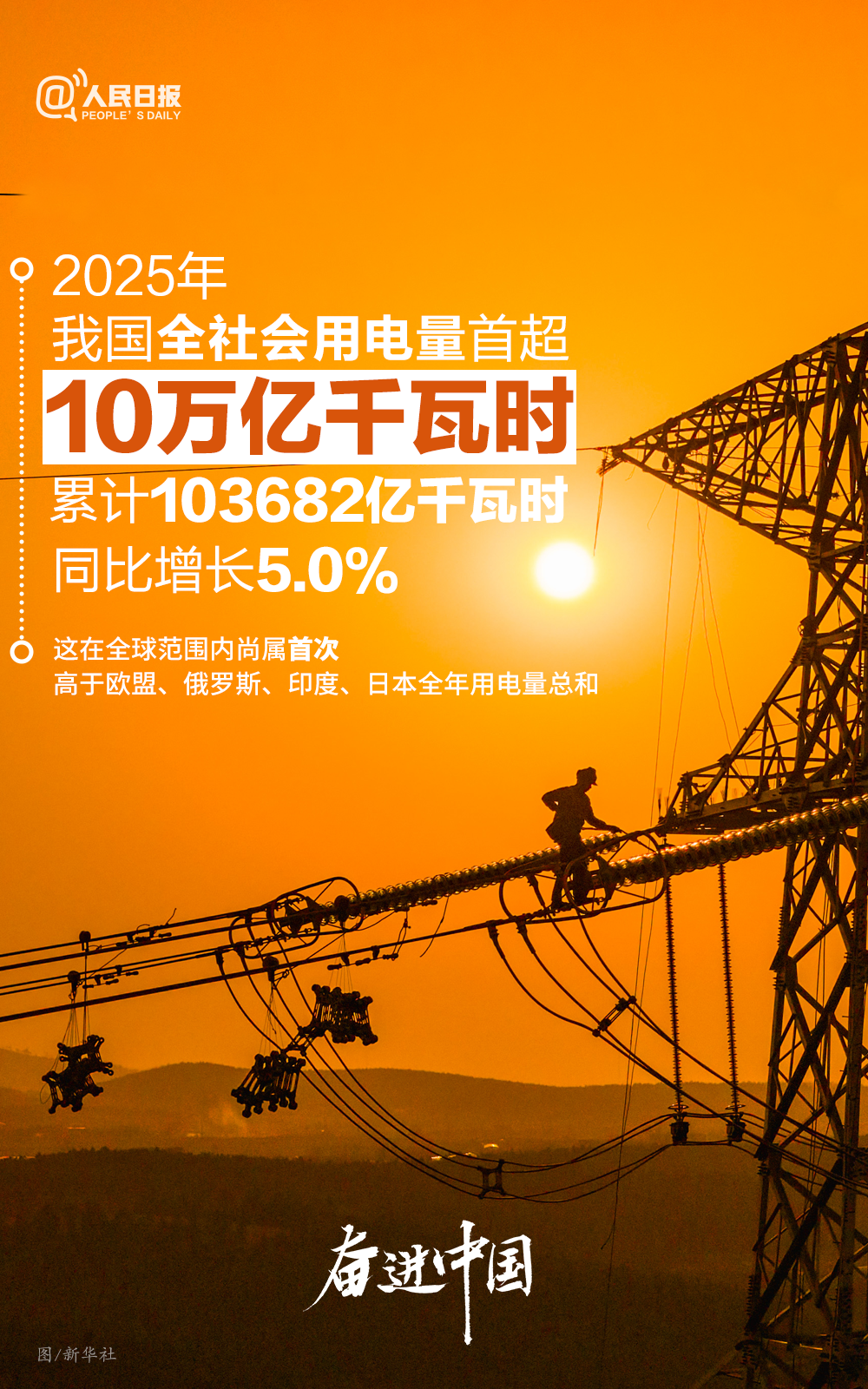
Core Insights - China's total electricity consumption is projected to exceed 10 trillion kilowatt-hours by 2025, marking a historic milestone for a single country globally, which is more than double the annual electricity consumption of the United States and higher than the combined total of the EU, Russia, India, and Japan [1][2] Group 1: Electricity Consumption Growth - The electricity consumption in China has nearly doubled from approximately 5.5 trillion kilowatt-hours in 2015 to over 10 trillion kilowatt-hours in 2025, illustrating a steep growth curve [2] - This significant increase in electricity demand is driven by advancements in infrastructure and a robust energy production system, which accounts for over 20% of global energy production [3] Group 2: Infrastructure and Planning - The growth in electricity consumption is supported by proactive planning and unified scheduling, with investments in the power grid expected to reach 4 trillion yuan during the 14th Five-Year Plan, a 40% increase from the previous plan [4] - China's unified electricity market, covering over 1.4 billion people, allows for efficient distribution of clean energy from resource-rich western and northern regions to the eastern and central load centers [5] Group 3: Technological Advancements - China's advancements in ultra-high voltage (UHV) technology have positioned it as a leader in the energy sector, with significant breakthroughs in insulation materials and equipment standardization [6] - The integration of artificial intelligence with the power grid is transforming the coordination of energy sources, networks, loads, and storage, enhancing the overall efficiency of the electricity system [6] Group 4: Future Outlook - The established strong, stable, and green electricity system is not only a foundation for current economic development but also accumulates essential physical conditions for future growth [7] - Despite the progress, challenges remain in profitability for power generation companies, the pace of green transformation, and the sustainability of innovation investments [7]
未来货币是“瓦特”?(读数)
Ren Min Ri Bao· 2026-02-04 22:05
Core Insights - China's total electricity consumption is projected to exceed 10 trillion kilowatt-hours by 2025, marking a historic milestone for a single country globally, which is more than double the annual electricity consumption of the United States and higher than the combined total of the EU, Russia, India, and Japan [1][2]. Group 1: Electricity Consumption Growth - The electricity consumption in China has nearly doubled from approximately 5.5 trillion kilowatt-hours in 2015 to over 10 trillion kilowatt-hours in 2025, illustrating a steep growth curve [2]. Group 2: Infrastructure and Energy Security - The substantial electricity demand is supported by robust infrastructure, establishing China's competitive edge in the energy sector, with over 20% of global energy production [3]. - Since the 14th Five-Year Plan, China's energy self-sufficiency rate has remained above 80%, with over 90% of the increase in energy consumption being domestically secured [3]. Group 3: Strategic Planning and Investment - The success is attributed to "proactive planning" and "unified scheduling," with investments in the power grid being made based on a 5 to 10-year forward-looking layout [4]. - The State Grid has announced a fixed asset investment of 4 trillion yuan for the 15th Five-Year Plan, a 40% increase from the previous plan, to meet future electricity demand [4]. Group 4: Unified Power Market - China's unified electricity market, supported by the world's largest power transmission network, allows for efficient distribution of clean energy from resource-rich western and northern regions to the eastern and central load centers [5]. - The "West-to-East Power Transmission" capacity has reached 340 million kilowatts, with expectations for significant growth in high-voltage direct current transmission channels by 2050 [5]. Group 5: Technological Advancements - China's advancements in ultra-high voltage technology are pivotal, achieving breakthroughs in insulation materials and equipment weight, along with the localization and standardization of core devices [6]. - Over one-third of electricity consumed in China is generated from renewable sources, with wind and solar power installations expected to surpass thermal power by 2025 [6]. Group 6: Future Outlook - The strong, stable, and green electricity system built through proactive planning is not only a guarantee for current economic development but also lays the foundational physical conditions for future growth [7]. - Despite the advantages in scale among power generation companies, challenges remain in profitability, structural optimization for green transition, and sustained innovation investment [7].

高旭东:把“能力培养”放在企业战略最核心位置
Sou Hu Cai Jing· 2026-01-28 08:15
Core Insights - The article emphasizes that the core capabilities of enterprises, such as technological innovation, leadership, talent development, coordination, and dynamic capabilities, are essential for navigating the current complex business environment [2][4] Group 1: Challenges Facing Chinese Enterprises - Chinese enterprises are currently facing multiple challenges, including geopolitical tensions, technological blockades, and structural contradictions within organizations [2][3] - The shift from a high-growth era to a more competitive and demanding market requires companies to focus on building core capabilities rather than merely relying on strategic planning [3][4] Group 2: Importance of Core Capabilities - High Xudong argues that the effectiveness of a strategy is highly dependent on the underlying capabilities of the enterprise, making capability development a priority [4][5] - The five core capabilities identified are: technological innovation, leadership, talent development, coordination and integration, and dynamic capabilities [4][5] Group 3: Misconceptions About Digital Transformation - There is a prevalent misconception that digital technology alone can solve business challenges; however, the true value of digital transformation lies in the enterprise's ability to integrate technology with its operational capabilities [5][6] - Companies must develop the ability to discern effective digital solutions and ensure that technology aligns with their specific business needs [6][7] Group 4: Leadership and Organizational Structure - Leadership capability is deemed the most critical among the five core capabilities, with a focus on evolving leadership styles to adapt to changing market conditions [9][10] - High Xudong suggests that leaders should embrace a distributed leadership model to enhance decision-making and foster collective intelligence within the organization [12][13] Group 5: Learning and Adaptation - Continuous learning is highlighted as a vital quality for leaders, especially in a rapidly changing environment where traditional business practices may no longer apply [13][14] - Companies must cultivate a culture of learning and adaptability to navigate uncertainties and leverage new opportunities effectively [13][14]

人民日报丨去年中国用了超10万亿度电,意味着什么?
国家能源局· 2026-01-23 07:50
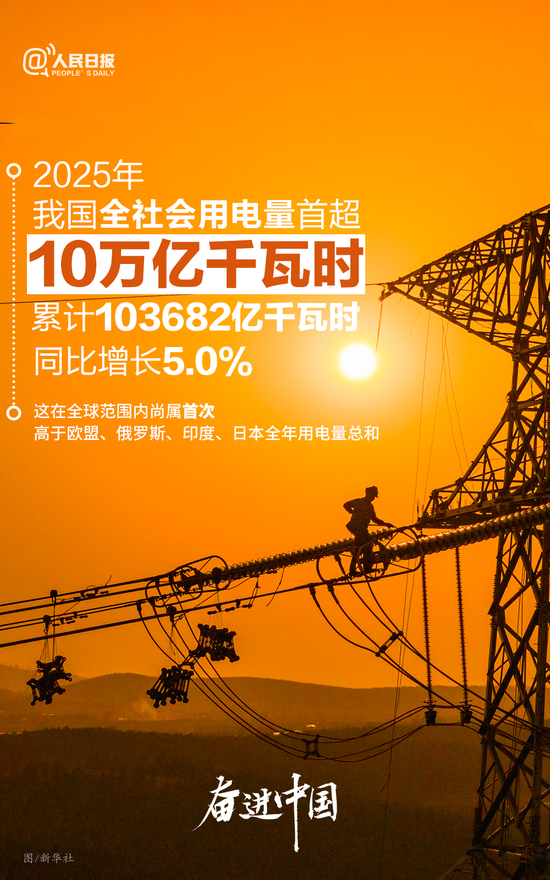
Core Viewpoint - The article highlights China's unprecedented electricity consumption, projected to exceed 10 trillion kilowatt-hours by 2025, which is more than double the annual electricity consumption of the United States and surpasses the total consumption of the EU, Russia, India, and Japan combined [2][6]. Group 1: Electricity Consumption Growth - China's electricity consumption is expected to grow from approximately 5.5 trillion kilowatt-hours in 2015 to over 10 trillion kilowatt-hours in 2025, indicating nearly a doubling in a decade [6]. - The rapid increase in electricity demand is exemplified by a recent surge of 150 million kilowatts over three days due to a cold wave, equivalent to Japan's maximum annual electricity load [6]. Group 2: Energy Self-Sufficiency and Infrastructure - Since the 14th Five-Year Plan, China's energy self-sufficiency rate has increased from around 80% to over 84%, establishing the world's largest renewable energy system [6]. - The article describes China's electricity infrastructure as a "powerful moat," built on strong foundational facilities and strategic planning, which has led to its recognition as a "power nation" [6]. Group 3: Planning and Coordination - China's electricity development model emphasizes "appropriate foresight," with planning cycles typically spanning 5-10 years, as evidenced by the State Grid's projected fixed asset investment of 4 trillion yuan for the 15th Five-Year Plan [7]. - The unified dispatch capability across a national electricity market allows for efficient energy resource allocation, addressing the challenge of energy distribution [9]. Group 4: Comparison with the U.S. and Europe - The U.S. faces significant challenges with aging infrastructure, where 70% of transformers are beyond their expected lifespan, leading to difficulties in updating facilities due to lengthy approval processes and high costs [11]. - The fragmented nature of the U.S. electricity grid, divided into three independent systems, hampers inter-regional electricity distribution [13]. - Europe also struggles with aging infrastructure, as highlighted by a major blackout affecting over 50 million people, revealing deep-seated issues within the European grid [14]. Group 5: Future of Electricity and AI - The article posits that electricity is becoming a strategic resource, essential for the development of artificial intelligence, with the competition for energy resources reflecting broader national capabilities [18]. - China's advancements in ultra-high voltage technology and renewable energy sources position it favorably in the global energy landscape, with over one-third of its electricity coming from green sources by 2025 [22]. Group 6: Challenges Ahead - Despite significant achievements, challenges remain for China's electricity sector, including insufficient profitability, ongoing structural optimization needs, and the necessity for sustained innovation investment [23].
去年中国用了超10万亿度电,意味着什么?
Xin Lang Cai Jing· 2026-01-22 13:49
Core Insights - China's electricity consumption is projected to exceed 10 trillion kilowatt-hours by 2025, which is more than double the annual electricity consumption of the United States and higher than the total consumption of the EU, Russia, India, and Japan combined [1][14][18] - This significant increase in electricity demand reflects a nearly doubling from approximately 5.5 trillion kilowatt-hours in 2015, indicating a steep growth curve in electricity consumption [18] - The achievement of becoming the world's largest renewable energy system and increasing energy self-sufficiency from around 80% to over 84% since the 14th Five-Year Plan showcases China's strategic planning and infrastructure development in the energy sector [18][19] Electricity Infrastructure and Planning - China's electricity grid construction follows a principle of "appropriate advance," with planning cycles typically spanning 5-10 years, allowing for proactive infrastructure development [19][20] - The State Grid Corporation of China has announced a fixed asset investment of 4 trillion yuan for the 14th Five-Year Plan period to meet future electricity demand growth [19] - The unified national electricity market enables efficient energy resource distribution across regions, addressing the challenge of energy resource imbalance [22] High Voltage Transmission and Global Comparison - China has built 42 ultra-high voltage projects, with cross-province and cross-region transmission capacity reaching 370 million kilowatts, and predictions suggest that the number of ultra-high voltage transmission channels could double by 2050 [23] - In contrast, the U.S. faces significant challenges with aging infrastructure, lengthy approval processes, and a fragmented electricity market, leading to frequent power outages during extreme weather events [23][24] Challenges in the U.S. and Europe - The U.S. electricity grid is criticized for being outdated, with 70% of transformers exceeding their expected lifespan, and a lack of unified national strategy complicates infrastructure upgrades [23][24] - Europe also faces challenges, as evidenced by a major blackout affecting over 50 million people in 2025, highlighting the aging infrastructure and cross-national conflicts within the EU [24] Future of Electricity and AI Integration - The integration of artificial intelligence with the electricity grid is seen as a transformative step, with China launching its first power IoT operating system and a billion-level multimodal power model [29] - The competition for electricity is not merely an energy race but a strategic resource battle that will determine the future of AI development and technological advancement [27][29] - China's advancements in ultra-high voltage technology and renewable energy sources position it favorably in this global competition, with over one-third of its electricity coming from green sources by 2025 [27]

引爆全球危机!美国停电时长暴涨80%,中国却早已布局47年
Sou Hu Cai Jing· 2025-12-17 13:42
Group 1 - The average power outage duration for U.S. users is projected to increase by 80% in 2024, reaching approximately 662.6 minutes, or nearly 11 hours, compared to the previous year [3][6] - In Virginia and Texas, the outage durations have increased by 228% and 176% respectively, with Texas experiencing a more than 700% increase compared to a decade ago [3][6] - The average retail electricity price in the U.S. is expected to rise by 13% from 2022 to 2025, with typical household electricity costs increasing from $1,683 to $1,902 annually [6][8] Group 2 - Nearly 80 million Americans are now forced to choose between paying electricity bills and other essential expenses, making electricity costs the second-largest energy expenditure after vehicle fuel [8][11] - The aging U.S. power grid is a significant issue, with an average service life of about 40 years and 70% of transformers exceeding their 25-year design life [8][11] - AI is projected to consume nearly 11.7% of U.S. electricity by 2030, up from 4% in 2023, with significant energy demands from data centers [11][13] Group 3 - The U.S. is facing challenges in power generation, with a rapid exit from coal, aging nuclear plants, and insufficient growth in renewable energy sources [13][21] - By 2030, the U.S. is expected to retire 94 GW of power generation capacity, while only adding 260 GW of new sources, leading to a dangerous gap in supply [13][21] - In contrast, China's power generation capacity has surged to 3.35 billion kilowatts by the end of 2024, a 58-fold increase since 1978 [21][26] Group 4 - China has implemented a systematic approach to power generation and distribution, including the "East Data West Computing" initiative, which directs data centers to energy-rich western regions [23][31] - The average electricity price in China is approximately $0.08 per kilowatt-hour, significantly lower than the U.S. average of $0.13 [26][31] - China's renewable energy capacity is projected to exceed 1.4 billion kilowatts by the end of 2024, with significant investments in wind and solar power [21][33] Group 5 - The differences in the energy landscape between the U.S. and China stem from varying development models and institutional designs, with the U.S. lacking a unified national energy strategy [26][31] - China's centralized planning allows for large-scale projects like ultra-high voltage transmission lines, while the U.S. struggles with fragmented state policies [31][35] - The U.S. faces inefficiencies in its power system due to outdated regulatory frameworks, while China has maintained continuous investment in modernizing its grid [35][41]

我国已建成世界规模最大的清洁能源供应体系
Ke Ji Ri Bao· 2025-11-27 00:57
Core Insights - China has established the world's largest clean energy supply system, with a total installed power generation capacity of 3.65 billion kilowatts as of June 2025, of which 2.2 billion kilowatts (60%) is from clean energy sources [1][2] Group 1: Energy Consumption and Economic Growth - Over the past decade, China's energy consumption has grown at an average rate of 3.1%, supporting an average GDP growth of 6.7% [1] - The energy consumption per unit of GDP has decreased by 27%, and carbon emission intensity has dropped by 34% [1] Group 2: Renewable Energy Capacity - Since the 14th Five-Year Plan, China has added an average of 22 million kilowatts of new energy capacity annually, contributing over 80% of the world's new installed capacity [1] - Renewable energy capacity accounts for 41% of the global total, with over 96% of coal-fired power units completing ultra-low emission upgrades [1] Group 3: Technological Innovations - China has built 44 ultra-high voltage transmission channels, with annual electricity transmission from the "West to East" exceeding 700 billion kilowatt-hours [2] - The country has the world's largest single-unit capacity hydropower generator at 1 million kilowatts, and onshore and offshore wind power units have reached capacities of 11 megawatts and 26 megawatts, respectively [2] Group 4: Energy Storage and Electric Vehicles - The operational capacity of new energy storage in China is 95 million kilowatts, accounting for over 40% of the global total [2] - The number of electric vehicles in China exceeds 25.5 million, with 17 million charging facilities and a total rated power of 196 million kilowatts [2] Group 5: Regional Developments - Hunan province has accelerated the construction of a new power system, establishing the first provincial-level research center for new power system development in China [2] - Demonstration projects such as the Hunan New Power System Innovation Center and the Orange Isle Zero Carbon Energy Experience Hall have significantly improved energy supply efficiency in the province [2]
两部门发文分类引导新能源消纳和调控,储能、海上风电、光伏等领域或受益(附概念股)
Zhi Tong Cai Jing· 2025-11-11 00:01
Core Insights - The recent policy guidance from the National Development and Reform Commission and the National Energy Administration aims to promote high-quality development in the renewable energy sector in China [1][2] - The guidance outlines key tasks such as enhancing the adaptability of new power systems to renewable energy and improving the national unified electricity market system [1][2] - By 2030, a multi-level renewable energy consumption and regulation system is expected to be established, with a focus on meeting the annual demand for 200 million kilowatts of new renewable energy [1][3] Offshore Wind Power - The guidance emphasizes the orderly development and consumption of offshore wind power, including the construction of deep-sea wind power bases and pilot projects for ultra-large deep-sea wind turbines [2] - The central government has elevated the marine economy to a strategic level, with expectations for China's marine production value to exceed 10 trillion yuan in 2024, reflecting a year-on-year growth of 5.9% [2] Solar and Hydropower - Solar and hydropower are highlighted as the most mature forms of renewable energy, with a focus on enhancing efficient and low-cost technology development [2] - The guidance suggests optimizing the configuration of renewable energy based on the characteristics of hydropower, particularly in the southwestern regions [2] Energy Storage Technology - The guidance stresses the importance of advancing new energy storage technologies, including liquid flow batteries and compressed air storage, to enhance the adaptability of new power systems [2] - There is a push to explore the potential of energy storage in conjunction with renewable energy generation [2] Market Outlook - The increasing pressure for renewable energy consumption is noted, with a shift in focus from insufficient installed capacity to systemic consumption and market survival capabilities [3] - Analysts express optimism about the steady increase in China's electrification rate, which is expected to drive demand for new power systems and related infrastructure [3] Related Companies - Huadian International Power (01071) reported a total revenue of 59.953 billion yuan for the first half of 2025, a decrease of 8.98% year-on-year, while net profit increased by 13.15% to 3.904 billion yuan [4] - Datang Power (00991) reported a revenue of 89.345 billion yuan for the first three quarters of 2025, a decline of 1.82%, but net profit rose by 51.48% to 6.712 billion yuan [5] - Huaneng International Power (00902) maintained a "outperform" rating, with a third-quarter revenue of 60.94 billion yuan, down 7.1%, but net profit surged by 89% to 5.58 billion yuan [5] - Xinyi Energy (00968) achieved a revenue of 1.21 billion yuan in the first half of 2025, a year-on-year increase of 7.67%, with net profit rising by 23.43% to 450 million yuan [6]
中美英资源对比:英国有煤矿,美国有石油,中国有什么?
Sou Hu Cai Jing· 2025-09-21 14:07
Group 1 - The article emphasizes the importance of controlling accessible and affordable energy as a key factor in global power dynamics, particularly in the context of the energy networks between Russia and Europe [2][5][30] - Historical examples illustrate that energy resource allocation and transportation efficiency have been critical to the rise and fall of powers, with the UK and the US leveraging their energy resources effectively [4][11][12] - China's energy strategy is highlighted as a response to historical lessons, focusing on building infrastructure to ensure energy security and efficiency in resource distribution [14][20][22] Group 2 - The article discusses China's energy challenges, particularly its reliance on imported oil and gas, and the risks associated with geopolitical instability in supplier regions [16][18] - China's investment in high-voltage direct current (HVDC) technology is presented as a strategic move to enhance energy security by enabling efficient energy transmission from resource-rich western regions to industrial eastern areas [20][22] - The development of renewable energy sources in western China is framed as a means to not only address energy needs but also to stimulate local economies and create jobs, thereby transforming the region's economic landscape [24][26][28] Group 3 - The article argues that China's renewable energy strategy is not merely a reaction to global trends but a comprehensive approach to overcoming past energy challenges while fostering sustainable development [30] - By leveraging renewable energy, China aims to maintain its competitive edge in manufacturing, countering the labor cost advantages of countries like India and Vietnam through lower energy costs [28][30] - The narrative concludes with the assertion that China's approach to energy is a model for sustainable progress, moving away from traditional energy conflicts towards a more stable and innovative energy future [30]