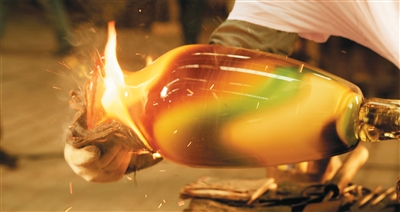
琉璃瓶

Search documents
炉火不息 琉光万里
Ren Min Ri Bao Hai Wai Ban· 2025-12-12 22:00
Core Viewpoint - The article highlights the resurgence of Zibo's glass craftsmanship, particularly through the promotion of its unique cultural heritage and the recent popularity of "Zibo Barbecue," which has drawn attention to the region's glass-making techniques and products [11][14]. Group 1: Historical Significance - Zibo's glass-making history dates back 3,000 years, with significant artifacts like the "Suihou Pearl" and blue glass inlays on swords from the Warring States period [12]. - The discovery of ancient glass kiln sites in 1982 confirmed Zibo's long-standing tradition of glass production, establishing its unique position in China's glass industry [12][13]. - The Ming and Qing dynasties marked the peak of Zibo glass production, with notable contributions to royal court items and the development of intricate painting techniques [13]. Group 2: Current Industry Landscape - Currently, there are 28 glass production and supporting enterprises and 65 art studios in the Boshan district, with 32 national-level art masters [14]. - The daily glass bottle production capacity in Zibo ranks first in China, showcasing the region's industrial strength [14]. - The integration of cultural tourism has provided a broader platform for showcasing Zibo glass, with initiatives like the micro-drama "Glass Destiny" increasing public awareness and interest [14][15]. Group 3: Cultural Promotion and Internationalization - The micro-drama "Glass Destiny" has been recognized for its innovative approach to promoting intangible cultural heritage, receiving support from the Beijing Radio and Television Bureau [15]. - The Boshan district has revitalized its historical sites, attracting over 33,000 visitors during the 2025 National Day and Mid-Autumn Festival, emphasizing the living heritage of glass craftsmanship [15][16]. - Zibo glass has gained international recognition, with products showcased at events like the Milan Expo and the Louvre, and plans for overseas exhibitions are set to resume in 2026 [19][20].

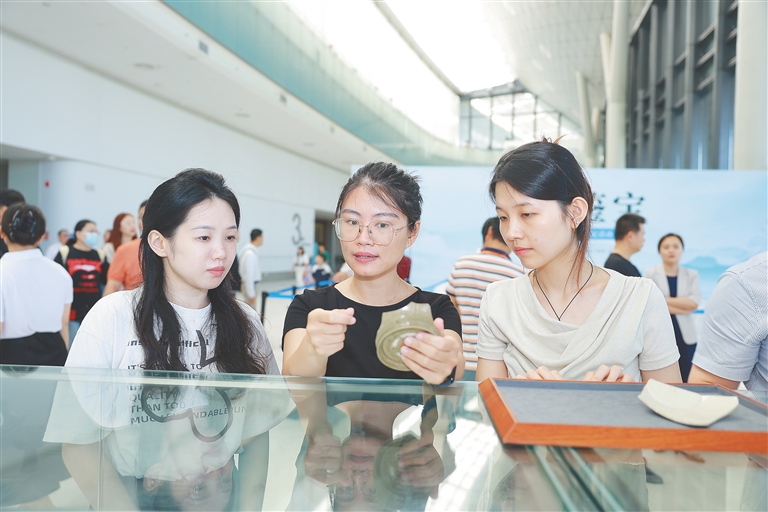
“琼州鉴宝”民间收藏文物公益鉴定活动举办 生动科普提升民众文物鉴赏水平
Hai Nan Ri Bao· 2025-05-19 01:21
Core Viewpoint - The "Qiongzhou Treasure Appraisal" event held at the Nanhai Museum of China (Hainan) attracted significant public participation, highlighting the importance of cultural heritage and public engagement in the appreciation and protection of artifacts [3][4]. Group 1: Event Overview - The event was organized by the Hainan Management Office for the Examination of Cultural Relics and the Nanhai Museum, featuring expert teams providing authoritative appraisal services [3]. - Attendees brought various collectibles for expert evaluation, creating a lively atmosphere with long queues at the appraisal booths [3]. - The event combined knowledge dissemination, fun, and interactivity, making it a cultural feast for participants [3]. Group 2: Educational Aspects - Experts provided detailed appraisals and shared insights on the historical background, artistic value, and appreciation techniques of the artifacts [3]. - A physical exhibition showcased selected ceramics and jade artifacts, allowing for direct comparison and deeper understanding of the characteristics and differences of relics from various periods and regions [3]. Group 3: Cultural Significance - The event emphasized the importance of scientific recognition of artifact value as a prerequisite for protection, research, display, and circulation of cultural relics [4]. - The Hainan Management Office aims to guide the public in establishing correct collection concepts and to encourage the exploration and promotion of the cultural value of folk collections [4].