琥珀

Search documents
首届广西桂林国际珠宝展启幕
Sou Hu Cai Jing· 2025-12-25 08:15
Core Viewpoint - The first Guangxi Guilin International Jewelry Exhibition, organized by the Guangdong Jade Association, aims to expand the Guangdong jewelry market into the southwest region and connect with ASEAN, leveraging the advantages of the Greater Bay Area's jewelry industry [2]. Group 1: Event Overview - The exhibition is held from December 23, 2025, to January 3, 2026, coinciding with peak consumer periods such as New Year's [6]. - Over 300 jewelry enterprises from across the country are participating, showcasing more than 10,000 jewelry items including diamonds, jade, and pearls [6]. - The event features a direct supply model, reducing intermediaries and implementing a "one piece is also factory price" strategy [6]. Group 2: Strategic Importance - The event serves as a practical implementation of the Guangdong Jade Association's strategy to explore new markets in the southwest and build a diversified platform for government-business interaction and cross-industry cooperation [4]. - The association plans to use this exhibition as a foundation to deepen cooperation between Guangdong and Guangxi, creating a regular exchange and display platform for jewelry enterprises [4]. Group 3: Cultural Integration - The exhibition aims to integrate jade culture as a cultural element in Guilin, enhancing the city's tourism appeal beyond its natural scenery [2]. - Various cultural activities are planned, including a rock music festival, intangible cultural heritage performances, and traditional costume parades, creating a "jewelry consumption + cultural experience" model [6].

宝石与光的奇幻恋歌,远不止火彩
Qi Lu Wan Bao· 2025-12-19 17:18
Core Viewpoint - The article explores various optical phenomena in gemstones, highlighting their unique visual effects and the science behind them. Group 1: Color Change Effect - The color change effect is described as the "color magician" of gemstones, where the surface displays varying colors and shades depending on the light source and viewing angle [1] - Opal is identified as a typical representative of the color change effect, particularly the Australian Lightning Ridge opal, which showcases a spectrum of colors when rotated [1] - The unique visual effect of opal is attributed to the regular arrangement of tiny silica spheres inside, which diffract and interfere with light [1] Group 2: Cat's Eye Effect - The cat's eye effect is characterized by a bright band of light appearing on the surface of certain gemstones when cut into a cabochon shape [2] - The golden cat's eye stone is noted as a prime example, with a famous specimen found in an ancient mine in Sri Lanka, displaying a golden light band [2] - The effect is caused by numerous parallel needle-like inclusions within the gemstone that reflect light [2] Group 3: Star Effect - The star effect is likened to stars shining in the night sky, where gemstones containing multiple sets of parallel inclusions or fibers exhibit intersecting bright lines under light [2] - Rubies and sapphires are highlighted for their "six-ray star effect," with a notable large ruby discovered in Myanmar displaying six bright star lines [2] Group 4: Fluorescence and Phosphorescence - Phosphorescence and fluorescence are categorized under photonic effects in gemstones, where internal electrons shift to produce light [2] - Phosphorescence allows gemstones to continue glowing after the external energy source is removed, exemplified by "night pearls" like fluorite [2] - Fluorescence occurs only while the gemstone is under a specific light source, with diamonds, rubies, and amber being notable examples, serving as important identification information in gemology [2]

最古老海啸有何记录?国际最新研究发现逾亿年前琥珀或保存痕迹
Huan Qiu Wang Zi Xun· 2025-05-16 08:26
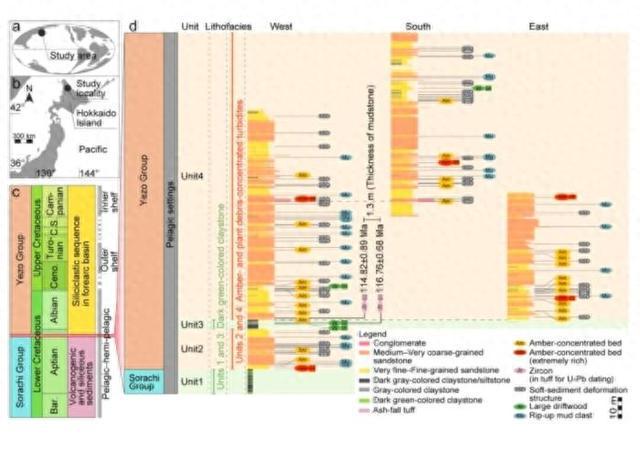
Core Insights - The research published in the open-access journal "Scientific Reports" suggests that amber deposits found in ancient deep-sea sediments may represent one of the oldest tsunami records known to date [1][3] Group 1: Research Findings - The study indicates that large amber deposits discovered in Hokkaido, Japan, may have been transported into the ocean by one or more tsunamis occurring approximately 116 to 114 million years ago [1][3] - The authors highlight the difficulty in identifying ancient tsunami traces due to the ability of waves to reshape coastlines, making it challenging to distinguish tsunami deposits from those caused by other high-energy events like storms [3][4] - The research team analyzed silica sediments rich in amber from the Nakagawa quarry, which formed around 115 million years ago during the Early Cretaceous period when the area was deep-sea seabed [3][4] Group 2: Methodology and Observations - Using fluorescence imaging technology, the authors observed significant deformation in the amber samples, exhibiting a "flame structure," which indicates that the amber was still in a softened state during deposition and underwent deformation before fully hardening [4] - This deformation suggests that a large amount of amber was likely washed into the sea by one or more tsunamis, briefly exposed to air before sinking and being covered by sediment, thus preserving it [4][7] Group 3: Implications - The authors conclude that amber and other terrestrial sediments transported to open waters may hold significant value for investigating ancient large-scale destructive events such as tsunamis [7]