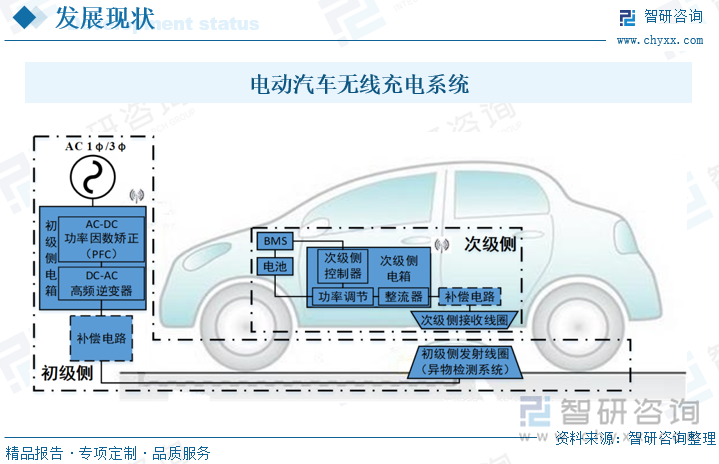
电动汽车无线充电技术

Search documents
这一地首条无线充电公路测试成功,边走边充能带来什么?
Zhong Guo Qi Che Bao Wang· 2025-11-20 03:27
Core Viewpoint - The successful testing of wireless charging for electric vehicles on the A10 highway near Angervilliers, France, presents a promising solution to the "charging anxiety" and "range anxiety" faced by electric vehicle users [2][3]. Group 1: Technology and Implementation - The test road features a complex energy transmission network with approximately 900 high-power induction coils powered by the grid, allowing electric vehicles to charge wirelessly while in motion, even at speeds exceeding 100 km/h [3]. - France plans to deploy dynamic wireless charging lanes on 75% of its highways, potentially allowing electric vehicles to operate with smaller battery packs, thus reducing costs and improving energy efficiency [3][4]. - The dynamic wireless charging technology can significantly benefit commercial vehicles, enabling continuous charging during transit, which enhances operational efficiency and reduces costs [4]. Group 2: Challenges and Limitations - Despite the promising outlook, wireless charging technology faces technical challenges, including lower charging efficiency compared to traditional wired methods, with static wireless charging at around 90% efficiency and dynamic wireless charging at approximately 85% [5]. - High costs associated with wireless charging infrastructure, which can be about twice the cost of traditional charging stations, pose a significant barrier to widespread adoption [5][6]. - The need for effective grid load management and road reconstruction to accommodate wireless charging systems presents additional challenges, including potential disruptions to traffic and high construction costs [6]. Group 3: Future Prospects - The development of metamaterial coil technology and AI algorithms is expected to enhance the efficiency of wireless charging systems, enabling smarter energy distribution and reducing energy waste [7]. - Industry forecasts suggest that high-end vehicles will be the primary adopters of wireless charging technology between 2025 and 2030, with a gradual increase in static wireless charging stations in public areas [8]. - By 2035, wireless charging is anticipated to become a mainstream energy replenishment method, integrating with renewable energy sources to support the goal of "zero-carbon travel" [8][9].


研判2025!中国电动汽车无线充电行业发展背景、相关政策、市场动态及规模分析:技术不断突破,商业化应用尚需时日【图】
Chan Ye Xin Xi Wang· 2025-04-27 01:18
Group 1: Overview of Electric Vehicle Wireless Charging - Electric vehicle wireless charging technology transmits power through underground power rails using high-frequency alternating magnetic fields, allowing vehicles to receive energy without large battery packs, thus extending their range and enhancing safety and convenience [1][2][25] - The wireless charging technology is categorized into static and dynamic charging, with static charging allowing vehicles to charge automatically when parked, while dynamic charging enables vehicles to receive energy while in motion, significantly reducing range anxiety [4][10] Group 2: Market Development and Trends - The global electric vehicle wireless charging market reached a scale of $100 million in 2023 and is expected to exceed $200 million in 2024, indicating a growing market potential as the number of new energy vehicles increases and core technologies advance [25] - The development trends in wireless charging technology focus on achieving multi-vehicle charging capabilities, optimizing power transmission efficiency, and enhancing stability and safety during the charging process [27] Group 3: Industry Background and Policies - China's automotive industry has embraced electric and intelligent transformation, with significant achievements in the new energy vehicle sector, leading to a robust supply chain and a competitive international market presence [10][12] - The Chinese government has supported the exploration of wireless charging technology through various policies, emphasizing the need for new charging technologies to improve convenience and reliability [16][18] Group 4: Current Status and Key Players - Several automotive companies, including BMW, Tesla, and domestic brands like SAIC and BYD, have been actively developing and commercializing wireless charging technologies, with notable advancements in both static and dynamic charging solutions [21][23] - As of 2024, the number of electric vehicles in China is projected to reach 31.4 million, with a significant portion being pure electric vehicles, highlighting the increasing demand for charging infrastructure [12][14]