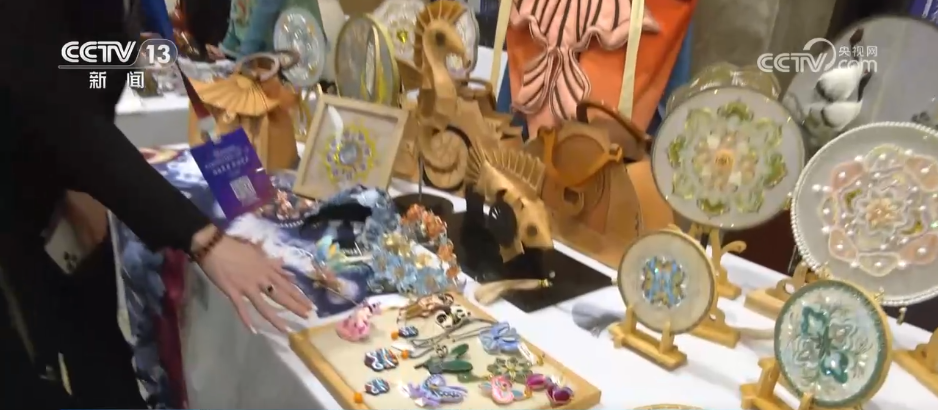
盘扣饰品

Search documents
盘出“十二花神” “扣住”万户新春
Xin Lang Cai Jing· 2026-02-19 07:37
Core Viewpoint - The article highlights the journey of Li Qiang, a young creator from Shanghai, who has successfully integrated traditional craftsmanship with modern design, particularly through her work with the non-heritage craft of Chinese knot buttons, showcasing the potential for cultural heritage to generate economic value [1][4]. Group 1: Background and Inspiration - Li Qiang hails from Shanxi, where traditional customs and craftsmanship are deeply rooted, influenced by her mother's skills in creating festive decorations and clothing [2]. - After marrying into a family with a tailoring background, Li Qiang was inspired by the craftsmanship passed down through generations, leading her to explore the potential of these skills in her career [2]. Group 2: Business Development - Three years ago, Li Qiang established her studio in Yuyuan and launched the "Qiangqing" brand, focusing on the non-heritage craft of sea-style Chinese knot buttons [3]. - She has developed a range of products including decorative items, crafts, and artworks that incorporate traditional techniques with modern elements, such as embroidery and silk flower making [3]. Group 3: Recognition and Impact - Li Qiang's work gained recognition when her button designs were featured in the Shanghai Fashion Week's Eastern New Chinese Style 2025 Autumn series and exhibited at the Shanghai History Museum [3]. - Her latest piece, the "Twelve Flower Gods" brooch, was selected as part of the "Huangpu Has Gifts" initiative for the New Year, showcasing the beauty and utility of her designs [3][4].
用现代生活美学打开非遗 传统技艺也能“潮”起来
Yang Shi Wang· 2025-11-27 22:00
Core Viewpoint - The 9th China Textile Intangible Cultural Heritage Conference held in Chengdu focused on the theme of protection, inheritance, and innovative development of textile intangible cultural heritage, with a consensus on talent cultivation being "people-oriented" [1] Group 1: Innovative Development and Education - A transformation in the inheritance of intangible cultural heritage is taking place across many universities in China, integrating ancient skills with modern vitality [3] - New designs of Shu brocade clothing showcased on the runway combine modern craftsmanship and creative tailoring, highlighting the vibrant colors and rich layers of Shu brocade while merging tradition with modernity [4] - Over 100 universities in China have established programs related to the protection of intangible cultural heritage, shifting from "rescue protection" to "activation inheritance and innovative development" [6] Group 2: Teaching Models and Challenges - The average age of national-level intangible cultural heritage representatives exceeds 65 years, indicating a significant challenge in the inheritance of these skills [7] - The Chengdu Textile College employs a "dual-teacher" system, combining academic teachers with heritage inheritors to enhance students' theoretical and aesthetic foundations while focusing on skill transmission [9] - The college has established a digital laboratory for intangible heritage, exploring modern methods like AI-assisted design to promote the active utilization of heritage in the digital age [11]