知微大模型

Search documents
2025年中国AI+互联网媒体行业研究报告
艾瑞咨询· 2026-03-07 08:38
Core Viewpoint - The article emphasizes that AI technology is fundamentally transforming the internet media industry by enhancing content production, distribution, and consumption processes, leading to a more efficient and innovative media ecosystem [1][2]. Group 1: Industry Overview - The Chinese internet media industry is transitioning into an AI-enabled intelligent ecosystem, with user growth slowing and competition shifting towards existing markets [2][6]. - Generative AI is accelerating the integration of multimodal applications, reshaping the content ecosystem and user experience, and driving the industry towards quality and efficiency [2][4]. Group 2: Deep Empowerment of AI - AI technology is deeply empowering the internet media industry, promoting intelligent transformation across the entire value chain, from production to consumption [2][24]. - Major media and social platforms in China, such as People's Daily and Weibo, are actively applying AI technology to enhance content creation, review, and distribution processes [2][36]. Group 3: Challenges and Opportunities - The internet media industry faces challenges such as content authenticity issues, high technical costs, and privacy risks, which need to be addressed for sustainable growth [3][46][54]. - Opportunities exist for media platforms to build competitive advantages through self-developed technologies, data governance, and intelligent recommendations [3][54]. Group 4: AI's Role in Content Production - Generative AI is reshaping the content production landscape by enabling users to create diverse content forms from simple text prompts, highlighting a trend towards mass user-generated content [24][28]. - AI technologies are optimizing content review processes, enhancing efficiency and accuracy in identifying complex violations [26][28]. Group 5: AI's Impact on Content Distribution and User Engagement - AI technology enhances content distribution efficiency by analyzing user behavior and optimizing recommendation paths, thereby increasing user engagement and platform stickiness [28][31]. - The integration of AI in user operations allows for personalized content matching and improved customer service, expanding commercial opportunities for media platforms [28][31]. Group 6: AI's Influence on Content Consumption - The shift from one-way communication to interactive engagement is facilitated by AI, allowing consumers to evolve into co-creators in the content cycle [31][46]. - AI technologies lower barriers to content access and enhance user understanding through intelligent summarization and dialogue-based services [31][46]. Group 7: Technological Evolution and Historical Context - The internet media industry has undergone significant transformations over the past three decades, driven by technological advancements from early portals to the current AI-enabled ecosystem [4][21]. - The evolution of AI technology has progressed from symbolic logic to data-driven models, culminating in the current era of generative AI applications [10][11]. Group 8: Case Studies of AI Implementation - The People's Daily has utilized generative AI to enhance video content creation and streamline the media production process [36]. - The Paper has integrated AI tools to improve content production efficiency and establish a robust content safety framework [38][39]. - Douyin (TikTok) has embedded AIGC technology throughout its content lifecycle, creating a comprehensive ecosystem for content creation and monetization [40].


2025年中国AI+互联网媒体行业研究报告
艾瑞咨询· 2026-01-03 00:03
Core Viewpoint - The article emphasizes that AI technology is fundamentally transforming the internet media industry by enhancing content production, distribution, and consumption processes, leading to a more efficient and innovative media ecosystem [1][2]. Group 1: Industry Overview - The Chinese internet media industry is transitioning into an AI-enabled intelligent ecosystem, with user growth slowing and competition shifting towards existing markets [2][6]. - Generative AI is accelerating the integration of multimodal applications, reshaping the content ecosystem and user experience, and driving the industry towards quality and efficiency [2][4]. Group 2: Deep Empowerment of AI - AI technology is deeply empowering the internet media industry, promoting intelligent transformation across the entire value chain, from production to consumption [2][24]. - Major media and social platforms in China, such as People's Daily and Weibo, are actively applying AI technology to enhance content creation, review, and distribution processes [2][36]. Group 3: Challenges and Opportunities - The internet media industry faces challenges such as content authenticity issues, high technical costs, and privacy risks, which need to be addressed for sustainable growth [3][46][54]. - Opportunities exist for media platforms to build competitive advantages through self-developed technologies, data governance, and intelligent recommendations [3][54]. Group 4: AI's Role in Content Production - Generative AI is reshaping the content production landscape by breaking down professional barriers and enabling user-generated content (UGC) creation [24][28]. - The integration of AI in content review processes enhances efficiency and accuracy, allowing for automated initial screenings and human-AI collaboration [26][28]. Group 5: AI's Impact on Content Distribution and User Engagement - AI technology enhances content distribution efficiency by analyzing user behavior and optimizing recommendation paths, thereby increasing user engagement and retention [28][31]. - The use of AI in user operations allows for personalized content matching and intelligent customer service, further enhancing user experience [28][31]. Group 6: AI's Influence on Content Consumption - The shift from one-way communication to interactive engagement allows consumers to evolve into co-creators, fostering a cycle of creation and consumption [31][46]. - AI technologies facilitate seamless access to content through translation and voice conversion, lowering barriers to information consumption [31][46]. Group 7: AI Applications in Media Platforms - Major platforms like Douyin and Weibo are embedding AI technologies throughout their content lifecycle, from production to marketing, creating a comprehensive ecosystem [40][42]. - Weibo's self-developed multimodal model supports various AI products that enhance the entire content production and distribution chain [42][44]. Group 8: Future Trends and Developments - The generative AI landscape is expected to evolve towards specialized models and applications, focusing on scene-based usage rather than merely scaling up [18][40]. - The industry is exploring cost optimization strategies, including embracing open-source models and developing proprietary vertical models to ensure competitive advantages [51][54].

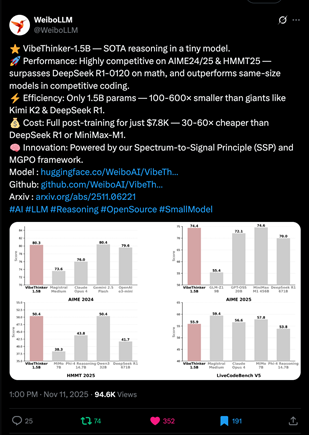
微博自研VibeThinker开源模型:15亿参数超越千亿级对手,训练成本仅7800美元
Xin Lang Ke Ji· 2025-11-17 11:40
Core Insights - Weibo AI has introduced its self-developed open-source large model, VibeThinker, which has only 1.5 billion parameters but outperformed models with hundreds of times more parameters in benchmark tests [1][2][3] - The training cost for VibeThinker is only $7,800, significantly lower than competitors, indicating a shift from a "scale competition" to an "efficiency revolution" in the AI industry [1][5][6] Model Performance - VibeThinker achieved impressive results in high-difficulty mathematical tests, surpassing models like DeepSeek-R1 with 671 billion parameters and MiniMax-M1 with 456 billion parameters [2][3] - The model's performance in LiveCodeBench v6 matched or exceeded that of larger models, demonstrating the potential of smaller models in complex reasoning tasks [3] Cost Efficiency - The total training cost for VibeThinker was approximately $7,800, which is 30 to 60 times more cost-effective than other models that require hundreds of thousands of dollars for similar performance [6][7] - This cost advantage allows smaller companies and research institutions to participate in AI innovation, promoting a more inclusive AI research environment [7][8] Application and Ecosystem - Weibo is actively integrating AI technology across various business scenarios, launching features like Weibo Smart Search and AI Interaction Accounts to enhance user experience [8][9] - The development of VibeThinker marks a new phase in Weibo's AI strategy, focusing on leveraging unique data assets to create a model that better understands public sentiment and social needs [9][10] Future Prospects - VibeThinker is expected to drive the growth of Weibo's AI applications, enhancing user experience and potentially creating a new "social super-ecosystem" that combines social attributes with intelligent services [10][11] - The technological advancements of VibeThinker are anticipated to significantly reduce the operational costs of AI applications on the Weibo platform, allowing for scalable AI capabilities without excessive resource burdens [11]