硼钢钢卷

Search documents
港口高质量发展为外贸添活力
Xin Hua Wang· 2025-12-29 23:37
Core Viewpoint - The opening of the "QianKai-Shanghai" shipping route has significantly enhanced trade efficiency between China and Latin America, with a total import and export value of 5.57 billion yuan and 205,000 tons of goods traded in one year, indicating a strong economic connection between the regions [1][2]. Group 1: Shipping Route Development - The "QianKai-Shanghai" shipping route has reduced the shipping time from over a month to approximately 23 days, allowing for increased exports and improved competitiveness for small and medium-sized enterprises in Peru [2]. - The opening of new shipping routes, such as "Qingdao-Aqaba" and a Southeast Asia route from Tianjin, enhances trade connections and reduces transit times, thereby improving overall shipping efficiency [3][4]. Group 2: Port Efficiency and Technological Advancements - The automation and smart technology integration at Chinese ports, such as Ningbo-Zhoushan, has led to a significant increase in container throughput, surpassing 40 million standard containers annually [5]. - New customs inspection methods, including real-time video connections, have improved inspection efficiency by over 40%, facilitating faster export processes for perishable goods [5][6]. Group 3: Economic Integration and Growth - The development of ports is closely linked to local economic growth, with initiatives in Jiangsu and Hebei promoting a "supply chain + park" model to create a virtuous cycle of port and industry development [8]. - Experts emphasize the need for ports to play a crucial role in connecting markets and resources, enhancing foreign trade cooperation, and driving new economic growth in China [8].
港口高质量发展为外贸添活力(锐财经)
Ren Min Wang· 2025-12-29 22:23
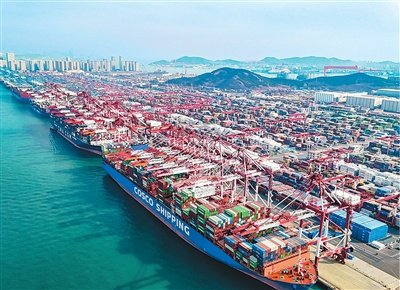
Core Insights - The article highlights the significant growth and development of China's port industry, emphasizing the increasing cargo throughput and the optimization of shipping routes to enhance international trade efficiency [2][3][4]. Group 1: Port Development and Trade Growth - Shandong Port is projected to exceed 1.9 billion tons in cargo throughput and over 47 million TEUs by 2025, indicating robust growth in port operations [2]. - The "QianKai-Shanghai" shipping route has facilitated trade between China and Latin America, with a total import and export value of 5.57 billion yuan and 205,000 tons of goods in one year [2]. - The Ministry of Transport forecasts a 9.6% increase in foreign trade container throughput by 2025, driven by new technologies and improved customs efficiency [2]. Group 2: Shipping Route Optimization - The opening of the "Qingdao-Aqaba" international trade route enhances trade connections between Qingdao and the Middle East, focusing on the transportation of machinery and textiles [3]. - A new Southeast Asia shipping route from Tianjin Port has reduced shipping times to Vietnam, Thailand, and Indonesia by over one-third, demonstrating efficiency improvements in maritime logistics [3]. - The "US West-Middle East" route will facilitate direct shipping services to the Middle East, promoting exports of chemical products and machinery from Dalian Port and the Northeast region [3]. Group 3: Technological Advancements in Port Operations - China's automated terminal scale and technology remain at the forefront globally, with Ningbo-Zhoushan Port surpassing 40 million TEUs in annual container throughput [5]. - The integration of 5G and digital twin technologies is accelerating the development of smart terminals, enhancing operational efficiency [5]. - New customs inspection models, such as real-time video connections, have improved inspection efficiency by over 40%, benefiting perishable goods exporters [5]. Group 4: Economic Integration and Local Development - The synergy between port development and local economies is evident, with cities like Lianyungang and Huanghua promoting industrial clusters and infrastructure improvements to support port activities [7][8]. - The concept of "port-driven industry" is evolving, with ports becoming integral to the economic ecosystem, facilitating trade and industrial growth [8]. - Experts suggest that ports should enhance their role in connecting markets and resources, fostering deeper international trade cooperation to inject new momentum into China's economic development [8].