
神舟八号

Search documents
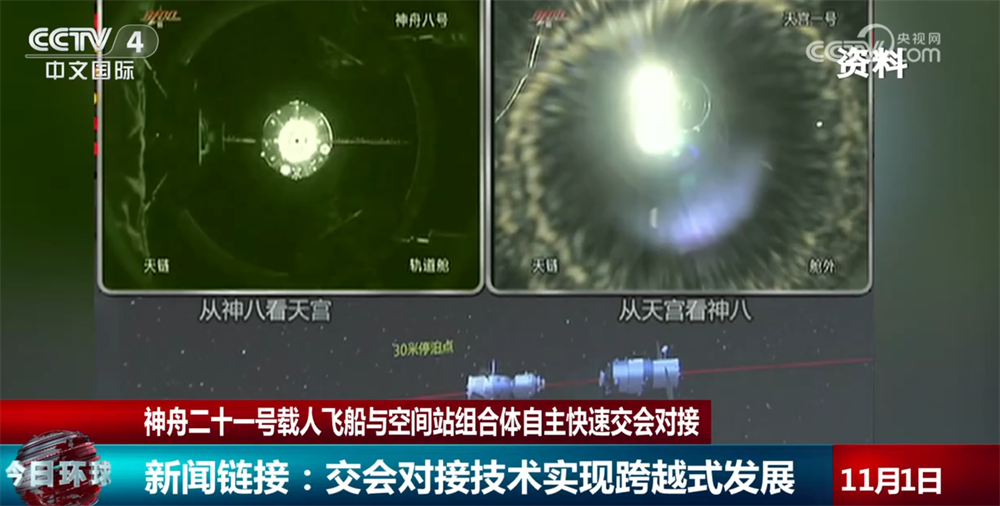
“从无到有、从慢到快、从试验到应用” 中国空间交会对接技术实现跨越式发展
Yang Shi Wang· 2025-11-01 06:47
Core Insights - The development of China's space rendezvous and docking technology has progressed significantly from initial trials to practical applications, marking a transformative leap in capabilities [1][3]. Group 1: Technological Progress - The first successful unmanned docking occurred in November 2011 between Shenzhou 8 and Tiangong 1, taking two days to complete [1]. - By June 2021, the Shenzhou 12 mission achieved docking with the Tianhe core module in just 6.5 hours, indicating a shift from experimental to operational status [1]. - The latest docking by Shenzhou 21 on November 1, 2025, was completed in only 3.5 hours, showcasing further optimization of the docking technology [1]. Group 2: Implications for Manned Spaceflight - The reduction in docking time to 3.5 hours enhances astronaut comfort and safety, while also improving overall mission efficiency [3]. - This advancement signifies a comprehensive breakthrough in the entire chain of technologies related to space launch, control, navigation, and communication [3]. Group 3: Future Prospects - Rendezvous and docking technology is not only fundamental for the construction of the space station but also serves as a core support for future manned lunar missions and Mars exploration [5].

一名“90后”航天人的成长记:一路“敲螺丝”,望“玉兔二号”上月球
Zhong Guo Xin Wen Wang· 2025-05-03 05:43
Core Viewpoint - The article highlights the journey of a young aerospace technician, Zhao Jie, who has been involved in China's lunar exploration missions, showcasing the importance of skilled labor in the aerospace industry and the personal growth of individuals within this field [1][2]. Group 1: Background of the Technician - Zhao Jie, born in 1990, works as an assembly technician at the China Aerospace Science and Technology Corporation's 149 Factory, participating in the assembly of significant lunar missions including Chang'e 3, 4, 5, and 6 [2][3]. - The assembly process involves intricate components, such as the docking mechanism known as the "space matchmaker lock," which is crucial for connecting spacecraft in orbit [4][5]. Group 2: Assembly Process and Challenges - The assembly environment is described as organized, with technicians using both digital tools and their own knowledge to assemble components, reflecting a shift towards digitalization in the assembly process [6]. - Zhao Jie emphasizes the complexity of assembly, comparing it to building with LEGO, where precision is critical, and mistakes can lead to significant issues during testing [6]. Group 3: Personal Growth and Experience - Zhao Jie progressed from a novice to a skilled technician, initially feeling overwhelmed by the precision required in aerospace work, but gradually gaining confidence and expertise [8][9]. - He recalls pivotal moments in his career, particularly during the successful deployment of the Yutu-2 rover on the moon, which marked significant achievements in China's lunar exploration efforts [7]. Group 4: Coping with Pressure - The article discusses the high-pressure environment in the aerospace sector, especially during rapid model iterations, and how Zhao Jie manages stress through hobbies like cycling, which also fosters team cohesion [10]. - Zhao Jie highlights the importance of continuous learning and adaptation to new technologies, indicating a shift in the skill set required for modern aerospace workers [10].