福船

Search documents
一片福海荫八闽
Xin Lang Cai Jing· 2026-01-22 23:18
Core Perspective - The article emphasizes the historical and cultural significance of the sea to Fujian, highlighting how maritime trade and exploration have shaped the identity and prosperity of the region and its people [1][2][3][4][5][6]. Group 1: Historical Context - Fujian has a long-standing relationship with the sea, described as a "福海" (blessed sea), which has been integral to the survival and development of its people [1][2]. - The region's maritime activities date back over 2000 years, with early inhabitants adept at shipbuilding and trade, establishing Fujian as a center for maritime commerce [2][5]. - Historical figures such as Marco Polo and Indian monk Kumarajiva have noted Fujian's significance as a trading hub, showcasing its role in cultural exchanges between East and West [3][4]. Group 2: Economic Development - Fujian's ports, including Quanzhou and Fuzhou, have been pivotal in establishing trade relations with over 57 countries and regions during the Southern Song Dynasty, marking it as a major maritime trade center [5]. - The article highlights the evolution of Fujian's maritime economy, with local merchants expanding their influence and establishing a unique merchant culture that thrives on maritime trade [6]. - The "Jinjiang Experience" is cited as a successful example of how Fujian's maritime culture has fostered economic development and innovation, reflecting the spirit of entrepreneurship among its people [6]. Group 3: Cultural Significance - The sea has not only provided economic opportunities but has also fostered a rich cultural heritage, with Fujian's people embodying traits of resilience and a pioneering spirit [1][6]. - The article notes the presence of diverse communities, including Arab and Persian merchants, who settled in Fujian, contributing to its multicultural fabric and trade dynamics [4]. - The legacy of Fujian's maritime history continues to influence its identity, with a strong emphasis on community, education, and philanthropy among the overseas Chinese population [6].
与文物“对话”探究古人征服海洋的智慧 “数字+文博”助推“文博热”持续火爆
Yang Shi Wang· 2025-07-11 06:59
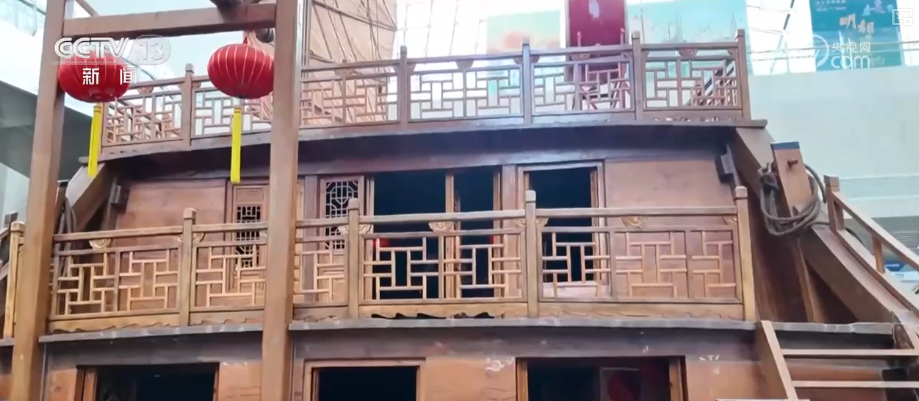
Group 1 - The exhibition "Commemorating the 620th Anniversary of Zheng He's Voyages to the West" opened at the China Maritime Museum, highlighting Zheng He's significant maritime journey that began 620 years ago [1] - A large model of the treasure ship, based on Zheng He's original vessels, is displayed prominently, showcasing its impressive four-story height and intricate internal structure [5][7] - The exhibition features over a hundred precious artifacts from the early Ming Dynasty, including a complete set of jewelry worn by noblewomen, which reflects the trade of valuable gems during Zheng He's voyages [9][10] Group 2 - Zheng He's fleet, which was the largest in the world at the time, made seven voyages between 1405 and 1433, reaching over thirty countries and regions, including East Africa [7] - The exhibition emphasizes the cultural exchange and trade relationships established through Zheng He's voyages, showcasing gifts like Ming Dynasty porcelain given to foreign dignitaries [10] - Interactive experiences allow visitors to engage with the history of Zheng He's voyages, including a digital display of the different routes taken during the expeditions [11][13] Group 3 - The museum also features various experiential spaces, such as a submarine simulation and a sailor's rest area, enhancing visitor engagement with maritime history [16] - The museum director highlights the importance of Zheng He's voyages in demonstrating China's advanced maritime technology and its contributions to global trade and openness today [18]