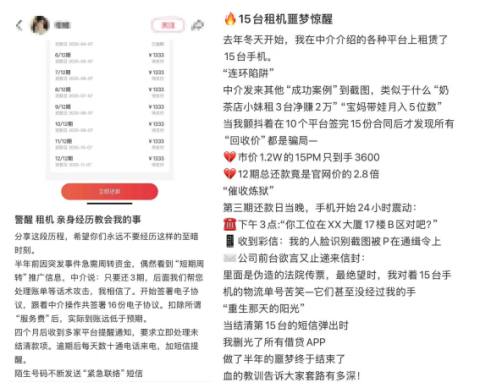
租机贷

Search documents
年化利率超300%!租赁平台建议“直接报警”,手机租赁如何异化为“高息贷”?
Xin Lang Cai Jing· 2026-02-02 02:11
Core Viewpoint - The emergence of "rent-to-loan" schemes, characterized by extremely high annual interest rates exceeding 300%, is a growing concern in the market following new lending regulations [1][20]. Group 1: Rent-to-Loan Mechanism - "Rent-to-loan" refers to a process where users rent phones from platforms, which are then sent to third parties designated by loan intermediaries, who provide cash in return, while users bear the rental and buyout costs [1][20]. - Users often face annualized interest rates above 100%, with some reports indicating rates as high as 360% for certain transactions [2][22]. Group 2: User Experiences and Financial Implications - A case study revealed that a user, after renting two iPhones, ended up with a total debt of approximately 23,000 yuan for a cash advance of 5,000 yuan, leading to a calculated annualized interest rate of 360% [2][22]. - Users are often misled about the total repayment amounts, with intermediaries promising lower figures that do not reflect the actual costs incurred [26][30]. Group 3: Marketing and Target Audience - Intermediaries utilize social media and targeted marketing strategies to attract users, particularly those with existing debts, to engage in rent-to-loan schemes [30][31]. - The low entry barriers for renting phones attract a demographic of lower credit quality, often referred to as "subprime" customers [31][32]. Group 4: Regulatory and Market Response - The lack of oversight in the rent-to-loan market has led to its operation in a gray area, with financial institutions warning against such practices disguised as legitimate rental services [36][37]. - Recent updates to regulatory guidelines explicitly prohibit the use of rental agreements for non-rental financial services, highlighting the need for stricter enforcement [32][36].

支付机构开始切断24%以上产品支付通道
21世纪经济报道· 2026-01-16 02:25
Core Viewpoint - The article discusses the increasing regulatory pressure on third-party payment institutions regarding high-interest loan products, particularly those with annualized rates exceeding 24%, leading to compliance checks and potential business model changes in the industry [1][5][12]. Group 1: Regulatory Environment - A third-party payment institution in Hangzhou has been required to stop providing payment services for a high-interest loan product, "Yuexi Rongdan," due to regulatory scrutiny [1]. - The implementation of the "New Loan Regulations" in October 2022 has triggered a series of strong regulatory signals targeting high-interest loan products, affecting the entire loan issuance chain [1][5]. - Regulatory guidance has led to compliance self-checks among payment institutions, particularly in East China, focusing on risk management for existing financial clients [5][6]. Group 2: Compliance and Self-Inspection - Payment institutions are conducting comprehensive compliance inspections across all business lines to identify potential risks in existing operations [5][6]. - The focus of these inspections includes ensuring that payment channels are not used for high-interest loan products and that business practices align with regulatory standards [6][10]. - The "Non-Bank Payment Institution Classification Rating Management Measures" has been introduced to further regulate the payment industry, emphasizing compliance and risk management [9][10]. Group 3: Impact on Business Models - The self-inspection wave is partly driven by the emergence of new high-interest loan models, such as "Yuexi Rongdan" and "Installment Mall," which have raised compliance concerns [12][14]. - Payment institutions are expected to cut off payment channels for high-interest products, but this will not necessarily affect compliant business operations [6][10]. - The classification rating results for payment institutions will influence their operational scope and regulatory scrutiny, with potential downgrades for those involved in non-compliant activities [9][10].

年利率440%、60多个马甲......助贷新规之后,月系融担产品浮出水面
Xin Lang Cai Jing· 2025-10-16 02:23
Core Insights - The implementation of new lending regulations has led to the emergence of "monthly system financing guarantee" products, which are characterized by short borrowing periods and high annualized interest rates, often exceeding legal limits [1][16] - Users of these products are primarily those engaged in multiple borrowing, often to repay previous debts, indicating a cycle of high-risk borrowing behavior [1][20] - The market is witnessing a shift as demand for high-interest loans persists despite regulatory restrictions, leading to the rise of alternative lending models [1][18] Group 1: Product Characteristics - Monthly system financing guarantee products typically have borrowing periods of one month or less, with annualized interest rates reaching as high as 440% when including guarantee fees [4][1] - These products are often marketed under various aliases to evade regulatory scrutiny, with over 60 different names reported in the market [15][6] - The operational structure of these products is complex, often involving multiple parties such as small loan companies and financing guarantee firms, which can obscure the true cost of borrowing [19][8] Group 2: Regulatory Impact - The new lending regulations, effective from October 1, 2025, impose a cap on annualized interest rates at 24%, significantly affecting the pricing of existing loan products [16][17] - As a result of these regulations, many users have been pushed out of traditional lending channels, creating a vacuum that new high-interest products are filling [18][17] - The regulations aim to protect consumers by ensuring transparency in the total cost of loans, but the demand for credit remains, leading to the emergence of potentially riskier lending practices [16][20] Group 3: Consumer Risks - There is a growing concern about the rise of illegal lending practices, such as "black online loans," which involve coercive lending and aggressive collection tactics [21][24] - Users have reported experiences of forced lending and high-pressure tactics, indicating a troubling trend in the lending landscape [21][23] - The phenomenon of "rent-to-own" loans is also emerging, where consumers face exorbitant costs disguised as rental agreements, leading to significant debt burdens [26][28]

租机套现14万,三个月后要还42万?公安部揭露“租机贷”真相
Xin Lang Cai Jing· 2025-07-10 00:22
Core Viewpoint - The "rent machine loan" model is revealed to be a high-interest loan scam disguised as a technology rental service, with annual interest rates reaching up to 400% or more, far exceeding legal limits [1][13]. Group 1: Scam Mechanism - The "rent machine loan" involves users renting phones from platforms that do not legally transfer ownership, leading to hidden fees and exorbitant interest rates [7][9]. - Users are often misled into believing they are making a profitable transaction, only to find themselves in severe debt due to high rental costs and fees [6][12]. - A case study of a user named Ms. Jiang illustrates the deceptive nature of this scheme, where she ended up owing 420,000 yuan after initially receiving only 59,000 yuan [5][6]. Group 2: Legal and Social Implications - The scam not only results in financial loss but also poses threats to personal privacy, as some platforms illegally collect users' contact information, leading to harassment and potential fraud [13]. - The issue of violent debt collection practices has become increasingly serious, disrupting social order and endangering public safety [13]. - A recent court case in Shanghai highlighted the legal ramifications of such scams, with a perpetrator sentenced to over a year in prison and fined 1 million yuan for operating this fraudulent scheme [14].