
素纱襌衣

Search documents
一方残帛,一部无字书
Ren Min Ri Bao· 2025-10-31 22:32
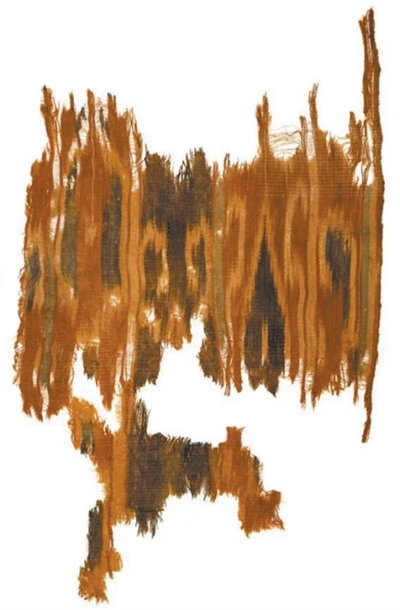
Core Insights - The discovery of a dyed woven fabric from the 2018 excavation at the Qaidam Basin's Dulan Hot Water Tombs provides significant evidence of ancient textile technology in China, dating back over 1200 years to the Tang Dynasty [3][4] - The fabric's primary component is mulberry silk, with dye materials including Sichuan yellow bark, indicating a complex trade and cultural exchange along the ancient Silk Road [4][5] - Advanced digital techniques such as 3D modeling and virtual simulation are being utilized to reconstruct ancient garments, enhancing public understanding and preservation efforts [5] Textile Archaeology - Textiles are one of humanity's earliest materials, used in various cultural practices, reflecting social structures, identity, and technological capabilities [2] - Significant archaeological finds, such as the "plain gauze robe" from the Mawangdui Han Tomb and the "five-star brocade armguard" from the Minfeng Niyah site, provide crucial insights into ancient Chinese material culture [2] Research Techniques - Researchers employ optical microscopes, infrared spectrometers, and chromatography-mass spectrometry to analyze excavated textiles, identifying fiber types and dye components [2][3] - The study of dye components aids in tracing the origins of colors and their cultural significance, contributing to a deeper understanding of historical textile production [2][4] Cultural Exchange - The Dulan region, as a historical Silk Road node, facilitated the circulation of dyed woven fabrics, particularly "banbu," which were primarily produced in the Sichuan Basin [4] - The ancient Silk Road played a crucial role in the dissemination of high-quality textiles and advanced techniques across Eurasia, enriching material cultural heritage [4] Digital Preservation - The integration of digital methods in textile research allows for the reconstruction of garments and their wearing states, supporting educational and research initiatives [5] - A systematic approach to data collection has been established, utilizing anthropometric and ancient DNA techniques to gather comprehensive information on ancient textiles [5]

数字化,让文物迸发丰沛的生命力
Ren Min Ri Bao· 2025-05-16 22:12
Core Insights - Hunan Museum is leveraging digital technology to enhance the accessibility and engagement of cultural heritage, creating a "digital twin" of artifacts through advanced scanning and modeling techniques [1][4] - The museum is set to launch an immersive digital exhibition titled "Life Art - The Mawangdui Han Culture Immersive Digital Exhibition" in June 2024, celebrating the 50th anniversary of the Mawangdui Han Tomb excavation [2] - The exhibition will utilize a combination of visual and auditory technologies to create an engaging experience that connects visitors with ancient cultural narratives [3] Group 1: Digital Transformation in Museums - Hunan Museum collaborates with Mango Digital Art Technology Co., Ltd. to establish a digital laboratory that employs multi-spectral scanning to create "digital gene maps" of artifacts [1] - As of January this year, 570 artifacts from the Mawangdui Han Tomb have been digitally scanned, with a goal to digitize approximately 27,000 artifacts within the next year [1] - The museum's digital initiatives aim to support the revitalization and utilization of cultural relics, allowing for interactive 3D models and AI-generated content [1] Group 2: Upcoming Exhibition and Cultural Engagement - The upcoming exhibition will transform the Mawangdui Han Tomb into a sophisticated "cosmic model," showcasing the intricate designs and patterns that reflect natural laws [2] - The exhibition will feature a panoramic acoustic system that integrates traditional music with natural sounds, enhancing the immersive experience for visitors [3] - Hunan Museum is expanding its reach by opening its brand and digital resources to universities and quality enterprises, fostering collaboration with over 30 art teams to create new cultural products [4] Group 3: Cultural Innovation and Public Participation - The museum is developing various cultural IPs, including holographic performances and interactive games, to engage a broader audience and promote cultural heritage [4] - The integration of academic rigor, technological innovation, and public participation is seen as a way to weave a rich cultural narrative that resonates with contemporary audiences [4] - The digital transformation is viewed as a means to grant artifacts a form of eternal existence, enhancing their significance in the modern world [4]