纺织考古

Search documents
万年农业、最早杨梅、史前治水等6项考古领域重大成果发布
Xin Jing Bao· 2026-01-14 12:26
Core Insights - The Chinese Academy of History and the Key Laboratory of Technological Archaeology and Cultural Heritage Protection of the Chinese Academy of Social Sciences announced six significant achievements in archaeological research [1] Group 1: Major Achievements - Achievement 1: Establishment of a globally leading technological archaeological resource standard database, specifically the China Animal Resource Specimen Database [1] - Achievement 2: Innovation in field archaeology excavation and cultural relic protection paradigms, exemplified by the 2018 Xuewei No. 1 Tomb laboratory protection project [1] - Achievement 3: Restoration and research of Tang Dynasty woven fabrics dyed with zha jing, marking a new advancement in textile archaeology experimental research [1] Group 2: New Discoveries - Achievement 4: New findings in the technological archaeology of the agricultural cultural history in northern China, detailing three stages of early dry farming in the Yanshan region [1] - Achievement 5: Archaeological discovery of the earliest ancient bayberry tree in China, focusing on the research of ancient bayberry remains from the Liangzhu culture period at the Shian site [1] - Achievement 6: Digital archaeology revealing China's water conservancy projects from around 5000 years ago, contributing to the study of prehistoric water management civilization [1]
时光里的经纬
Ren Min Ri Bao· 2025-12-05 22:03
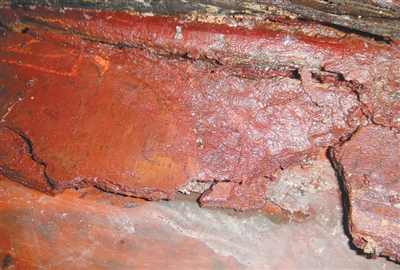
Core Insights - The archaeological excavation of the Haihunhou Tomb, which began in 2015, has revealed a significant number of textile artifacts, although most are in poor condition due to various factors such as theft and natural degradation [1] - The excavation team has identified five main categories of textile artifacts, including lacquered silk, embroidered silk, woven bands, square hole silk, and plain silk [1] - The preservation and extraction of these textiles are critical, as they are at risk of further deterioration due to the humid and waterlogged conditions of the burial site [1][2] Group 1: Archaeological Findings - The excavation has uncovered a variety of textile artifacts, with the most notable being lacquered silk, which was used in the Han Dynasty [3] - The lacquered silk artifacts exhibit three different specifications, with fabric densities of 5×6, 10×12, and 18×29 threads per square centimeter, the highest density being unprecedented among similar artifacts from the same period [3][4] - The thickness of the lacquer layer on these textiles is approximately 0.1 millimeters, showcasing advanced craftsmanship in the production of these items [3][4] Group 2: Preservation Techniques - The extraction process involves careful techniques to minimize damage, including the use of high molecular sponges to absorb excess moisture and the insertion of bamboo sticks to separate the textiles from the surrounding mud [2] - Once extracted, the textiles undergo emergency cleaning to remove contaminants and stabilize them for further restoration [2] - The ongoing restoration efforts highlight the importance of preserving these artifacts, which are seen as cultural treasures that convey historical narratives [4]

一方残帛,一部无字书
Ren Min Ri Bao· 2025-10-31 22:32
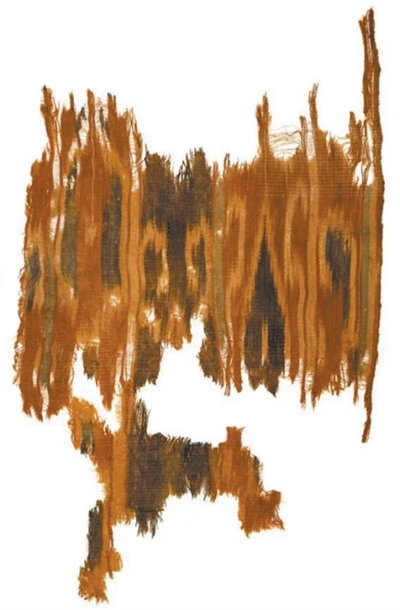
Core Insights - The discovery of a dyed woven fabric from the 2018 excavation at the Qaidam Basin's Dulan Hot Water Tombs provides significant evidence of ancient textile technology in China, dating back over 1200 years to the Tang Dynasty [3][4] - The fabric's primary component is mulberry silk, with dye materials including Sichuan yellow bark, indicating a complex trade and cultural exchange along the ancient Silk Road [4][5] - Advanced digital techniques such as 3D modeling and virtual simulation are being utilized to reconstruct ancient garments, enhancing public understanding and preservation efforts [5] Textile Archaeology - Textiles are one of humanity's earliest materials, used in various cultural practices, reflecting social structures, identity, and technological capabilities [2] - Significant archaeological finds, such as the "plain gauze robe" from the Mawangdui Han Tomb and the "five-star brocade armguard" from the Minfeng Niyah site, provide crucial insights into ancient Chinese material culture [2] Research Techniques - Researchers employ optical microscopes, infrared spectrometers, and chromatography-mass spectrometry to analyze excavated textiles, identifying fiber types and dye components [2][3] - The study of dye components aids in tracing the origins of colors and their cultural significance, contributing to a deeper understanding of historical textile production [2][4] Cultural Exchange - The Dulan region, as a historical Silk Road node, facilitated the circulation of dyed woven fabrics, particularly "banbu," which were primarily produced in the Sichuan Basin [4] - The ancient Silk Road played a crucial role in the dissemination of high-quality textiles and advanced techniques across Eurasia, enriching material cultural heritage [4] Digital Preservation - The integration of digital methods in textile research allows for the reconstruction of garments and their wearing states, supporting educational and research initiatives [5] - A systematic approach to data collection has been established, utilizing anthropometric and ancient DNA techniques to gather comprehensive information on ancient textiles [5]