红利低波指数(H30269.CSI)

Search documents
险资新年首次举牌!近两年举牌频次创近十年新高!
Mei Ri Jing Ji Xin Wen· 2026-01-14 07:28
Group 1 - The core viewpoint of the article highlights the increasing trend of insurance capital stake acquisitions, with a notable example being Taiping Asset's acquisition of a 5% stake in Shanghai Airport, marking the first instance of such activity in 2026 [1] - In 2025, the number of stake acquisitions by insurance capital reached 41, a significant increase from 20 in 2024, setting a near ten-year high, second only to the historical peak in 2015 [1] - The current wave of stake acquisitions differs from previous ones, primarily driven by two considerations: the emphasis on high dividend stocks in a low-interest-rate environment and the strategy of long-term equity investments in high-quality targets with stable ROE to optimize asset structure [1] Group 2 - The trend of frequent stake acquisitions by insurance capital is expected to continue in 2026, driven by the same two investment logic considerations [1] - Other funds are focusing more on low-volatility dividend strategies, as exemplified by the low-volatility dividend index (H30269.CSI), which selects securities with stable dividends, high dividend yields, and low volatility [1] - As of January 13, the one-year dividend yield of the low-volatility dividend index was 4.45%, with the Huaxia low-volatility dividend ETF (159547) being the lowest fee ETF tracking this index [1]

红利指数,今年平平无奇?
Xin Lang Ji Jin· 2025-07-16 00:37
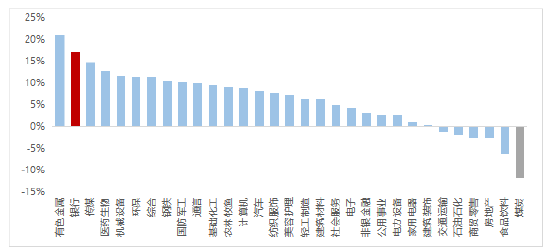
Core Viewpoint - The performance of dividend assets has shown significant divergence in 2025, with the dividend yield index experiencing a modest increase of 2.62%, while the low volatility dividend index surged by 9.72, highlighting the contrasting trends within the sector [2][5]. Group 1: Performance Analysis - The banking sector has emerged as a strong performer, with a year-to-date increase of 17.19%, ranking second among all 31 Shenwan first-level industry indices, while the coal sector has declined by 11.75%, placing it at the bottom of the industry indices [2][5]. - The weight of the banking sector in the dividend indices has significantly influenced their performance, with the banking sector accounting for 46.44% of the low volatility dividend index and 28.6% of the dividend index at the end of 2024 [5][6]. - The disparity in performance is attributed to the low interest rate environment enhancing the appeal of high dividend assets, while the coal sector faces pressure due to low coal prices [5][6]. Group 2: Market Outlook - The current market environment may continue to exhibit this trend of divergence, with potential profit-taking in certain sectors and a shift towards mid-year performance evaluations [6][7]. - The second half of 2025 may present opportunities for previously underperforming sectors to recover, particularly with potential improvements in the supply structure of cyclical resources like coal [6][7]. - The weight of sectors within the dividend indices is subject to change based on performance, with the banking sector's weight increasing to 33.58% and coal's decreasing to 17.73% as of mid-July 2025 [7]. Group 3: Long-term Investment Strategy - The long-term value of dividend strategies remains clear despite short-term internal divergence, suggesting that focusing on long-term value is a better perspective for evaluating dividend strategies [8][15]. - Historical data indicates that the dividend index has outperformed the Shanghai Composite Index in seven out of the last ten years, demonstrating resilience in down markets and adaptability to various market conditions [8][10]. - The dividend strategy is characterized by a low timing risk, making it suitable for long-term buy-and-hold investment strategies [13][14]. Group 4: Fund Performance - The Hongtai Baorui Dividend ETF (510880) has been a benchmark product in the dividend strategy ETF space, with a total scale of 184.95 billion as of mid-July 2025 and a profit of 33.94 billion in 2024 [15][16]. - The fund has consistently generated profits over the past six years, accumulating a total profit of 76.43 billion since 2019 [15][16]. - The ETF has also distributed over 40 billion in dividends since its inception, indicating strong performance in terms of returns to investors [15].