
红利策略

Search documents
险资如何看当下市场
2026-03-24 01:27
Summary of Key Points from Conference Call Records Industry Overview - The records focus on the insurance industry, particularly the investment strategies and asset allocation of insurance companies in response to market conditions and regulatory changes. Core Insights and Arguments 1. **Investment Strategy Shift**: Under new accounting standards, insurance companies are shifting their equity allocation towards a "barbell" strategy, focusing on dividend blue chips to smooth profit volatility while also timing growth stocks. The proportion of stocks in the OCI (Other Comprehensive Income) account of listed insurance companies is expected to rise from less than 25% at the end of 2023 to about 40% by the end of 2025 [1][8]. 2. **Interest Rate Impact**: The decline in interest rates has intensified the risk of asset-liability duration mismatch. Insurance companies are increasing their allocation to 30-year local government bonds (yielding over 2.4%-2.5%) to extend duration and hedge against pressures on net assets and solvency [1][5]. 3. **Market Forecast and Strategy**: The annualized return target for 2026 is approximately 10%, with a strategic bottom range for the market index set between 3,700 and 3,800 points. If the 10-year government bond yield reaches 1.9%-2.0%, insurance funds will increase their allocation to long-duration assets [1][10]. 4. **ETF Utilization**: During market downturns, insurance companies prefer broad-based ETFs (such as A50 and CSI 300) as a core tool to absorb drawdowns. As the market recovers, they tend to reduce ETF holdings and shift towards individual stocks to capture alpha returns [1][9]. 5. **Investment Lines for 2026**: Seven key investment themes have been identified for 2026, including: - Dividend strategy (dividend yield > 4%) - Cyclical recovery (betting on PPI turning positive) - Resource and energy security - Anti-involution (sectors like photovoltaics and chemicals) - Emerging industries from the 14th Five-Year Plan - AI across the entire industry chain - High-quality overseas manufacturing [1][13]. Additional Important Content 1. **Seasonal Premium Income**: The first quarter typically accounts for 30%-50% of annual premium income, leading insurance companies to leverage financing to achieve early allocation and lock in cross-year returns [2][10]. 2. **Impact of Market Adjustments**: Recent stock market pullbacks have pressured the net profits and solvency of insurance companies. While some smaller firms may reduce equity positions to alleviate capital adequacy pressures, a systemic reduction across the industry is unlikely. Instead, a structural adjustment towards dividend and defensive styles is expected [3][10]. 3. **New Financial Instruments**: Starting in 2026, non-listed insurance companies will implement new financial instrument standards, necessitating careful planning of equity asset classification between TPL (Total Profit and Loss) and OCI [4][5]. 4. **Bond and Equity Strategy**: In a low-interest and high-volatility environment, insurance companies are advised to prioritize high-yield bonds and adjust their asset duration to better match liabilities. The strategy emphasizes taking advantage of every 10 to 20 basis point rebound in bond yields for reallocation [6][10]. 5. **Geopolitical Considerations**: There is a divergence of opinions among investment committees regarding the impact of geopolitical conflicts on the A-share market. However, the consensus is that the recent market volatility may have already priced in much of the pessimism, suggesting limited downside potential [12][10]. 6. **Focus on High Dividend Assets**: To mitigate performance pressure from high base effects in 2026, insurance companies are increasing their allocation to high-dividend assets, particularly those classified under OCI, to smooth profit fluctuations [7][8]. 7. **Long-term Investment Philosophy**: The investment decision-making process will adhere to the principles of "good direction, good stocks, good prices," ensuring strategic allocations when all three criteria align [15].
与其押注单一策略,不如构建适应不同环境的全天候组合
雪球· 2026-03-12 13:01
Group 1 - The article discusses the core confusion faced by investors in the A-share market regarding which index can achieve long-term stable growth through bull and bear markets [4] - It emphasizes the underlying logic of a steadily rising A-share index, focusing on the "representativeness" and "passive tracking" of traditional broad-based indices [5] - The article highlights the potential risks of broad-based indices during economic transitions, where they may inadvertently lead to "buy high, sell low" scenarios due to their weight adjustments based on market trends [6] Group 2 - The article introduces alternative strategies such as dividend and free cash flow indices, which are designed to identify undervalued stocks based on objective financial rules rather than chasing market trends [8] - Dividend strategy focuses on selecting companies with the highest dividend yields, creating a dynamic balance that encourages buying undervalued stocks and selling overvalued ones [9] - Free cash flow strategy emphasizes the importance of cash generation over accounting profits, using free cash flow yield to select stocks, thus avoiding inflated valuations [10] Group 3 - The micro-cap stock index strategy is described as an aggressive approach that targets the lowest market cap stocks, benefiting from market inefficiencies and emotional trading by retail investors [11] - The article notes that while reverse strategies excel in bear or volatile markets, they may underperform during bull markets when growth stocks dominate [13] - It suggests that rational investors should not allocate their entire portfolio to reverse strategy indices but rather balance them with broad-based indices for optimal asset allocation [15]


中金:如何判断小盘策略配置时点
中金点睛· 2026-03-04 23:50
Core Insights - The multi-strategy rotation model (Strategy Configuration 1.0) has outperformed the benchmark of equity mixed funds by approximately 5 percentage points in 2025, although it has shown significant volatility since June 2025, underperforming compared to single strategies like growth and small-cap strategies [1][7][31] - The model has been optimized across four levels, including enhancing the timing indicators, increasing observation frequency to daily, and conducting stability tests on the effectiveness of timing indicators [1][8][14] Strategy Configuration 1.0 Model Performance - The model has demonstrated a total annualized return of 40.2% since 2015, with an annualized excess return of 30.0% compared to the equity mixed fund index, and a monthly win rate of 68.7% [3][31] - The model's performance in the validation set for 2024 and 2025 showed annualized returns of 13.4% and 78.9%, respectively, significantly outperforming the benchmark [3][31] Factors Influencing Future Style Returns - For small-cap style, attention should be paid to the willingness of capital inflows, as the active inflow rate is significantly positively correlated with future returns [2][30] - For growth style, the valuation deviation from the market is crucial, as significant deviations indicate a strong mean-reversion characteristic [2][24] - The internal differentiation degree of styles can monitor the crowding level in small-cap and growth styles, with low differentiation indicating potential systemic risk [2][30] Strategy Configuration 2.0 Model - The new model aims for an annualized return of 40%, focusing on the rotation of small-cap, growth, value, and dividend strategies based on the insights from the timing models [3][26] - The model has shown strong performance in both the training and validation sets, confirming its robustness and transferability [31] Performance of Active Quantitative Strategies - The small-cap strategy has shown exceptional performance, with an annualized return of 90.5% in 2025, while the growth strategy also performed well with a return of 48.5% [4][31] - The model's annualized returns and risk control have been validated through backtesting, demonstrating its effectiveness in various market conditions [3][31] Style Timing Model - The style timing model has effectively improved the Sharpe ratio across various styles, with the small-cap style achieving an annualized return of 16.7% and a Sharpe ratio increase from 1.66 to 2.28 [2][28]

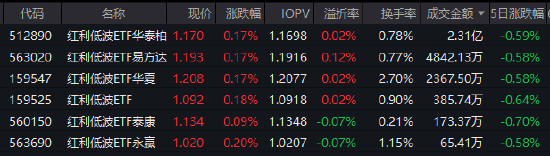
逆市上涨+资金长期涌入!红利低波ETF华泰柏瑞(512890)半日成交2.31亿领跑同类
Xin Lang Cai Jing· 2026-02-27 04:13
Core Viewpoint - The report indicates mixed performance among the top ten holdings of the Huatai-PB Low Volatility ETF (512890), with some stocks rising while others fell, reflecting a volatile market environment [1][5][7]. Group 1: Stock Performance - As of midday, the following stocks showed gains: Hu'nong Commercial Bank up 0.60%, Shen'gu Power up 0.60%, Nanjing Bank up 0.45%, Changsha Bank up 0.31%, China Resources Sanjiu up 0.20%, and Ping An Bank up 0.09% [1][5]. - Conversely, Shanghai Bank fell by 0.10%, Gree Electric Appliances by 0.16%, COFCO Sugar by 0.70%, and Minsheng Bank remained flat [1][5]. Group 2: Fund Flow and Investment Strategy - The Huatai-PB Low Volatility ETF (512890) experienced a net outflow of 28.62 million in the last five trading days, but a net inflow of 240 million over the last ten days, 1.43 billion over the last twenty days, and 4.46 billion over the last sixty days, indicating sustained accumulation in a volatile market [2][9]. - Institutions are generally optimistic about the banking sector and dividend strategies, with expectations for improved revenue in 2026 due to stable credit growth and support for net interest margins from the central bank [4][11]. Group 3: ETF Performance and Historical Returns - The Huatai-PB Low Volatility ETF was established on December 19, 2018, and has outperformed its benchmark with a five-year return of 76.88%, ranking 51st among 909 funds as of February 13, 2026 [6][12]. - The ETF is positioned as a stable investment tool in a volatile market, with options for investors to participate through regular investment plans or through off-market linked funds [12].
拥有稳定现金流的类黄金“安全资产”获关注,现金流500ETF(560120)冲击4连涨
Xin Lang Cai Jing· 2026-02-27 02:07
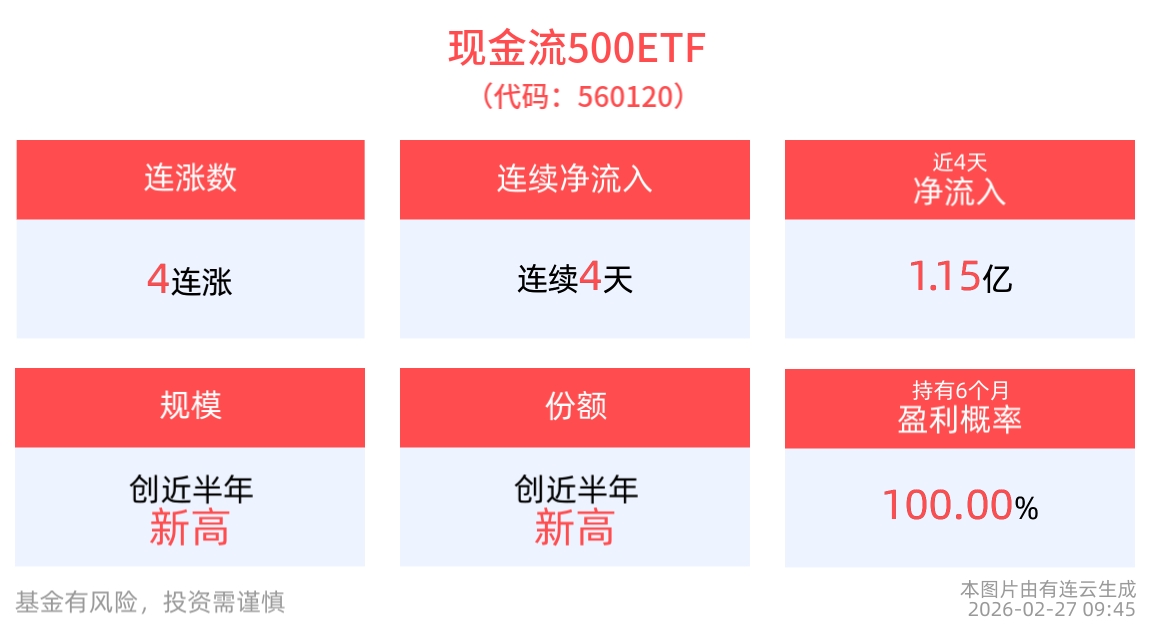
Group 1 - The core viewpoint of the news highlights the performance of the CSI 500 Free Cash Flow Index and its related ETF, indicating a positive trend in cash flow strategies amid changing market conditions [1][4]. - As of February 27, 2026, the CSI 500 Free Cash Flow Index increased by 0.41%, with notable gains from constituent stocks such as Xiyuan Co. (+7.09%) and Yongtai Energy (+2.34%) [1]. - The Cash Flow 500 ETF has seen a net inflow of 115 million yuan over the past four days, reflecting strong investor interest [1]. Group 2 - The Cash Flow 500 ETF has achieved a net value increase of 34.12% over the past six months, showcasing its strong performance [4]. - Historical data indicates that the ETF has a maximum monthly return of 18.04% since its inception, with a winning probability of 90% for monthly returns [4]. - The CSI 500 Free Cash Flow Index is composed of 50 listed companies with high free cash flow rates, with the top ten stocks accounting for 48.63% of the index [5].
震荡市场中,红利策略表现突出,国企红利ETF(159515)早盘上涨0.34%
Sou Hu Cai Jing· 2026-02-26 02:10
Core Viewpoint - The performance of the dividend strategy is highlighted as particularly strong in a volatile market, driven by the certainty premium of high dividend assets [1]. Group 1: Market Performance - As of February 26, 2026, the CSI State-Owned Enterprises Dividend Index rose by 0.21%, with notable increases in stocks such as CITIC Special Steel (+2.68%) and Shaanxi GuoDian (+1.60%) [1]. - The National Enterprise Dividend ETF (159515) increased by 0.34% [1]. Group 2: Investment Strategy - Longjiang Securities emphasizes that the current macroeconomic environment, characterized by a downward shift in growth and declining interest rates, enhances the value of stable cash-returning assets [1]. - The pursuit of certainty in investment styles is expected to continue, maintaining the focus on the allocation value of dividend assets [1]. Group 3: Index Composition - The CSI State-Owned Enterprises Dividend Index comprises 100 listed companies selected for their high and stable cash dividend yields, reflecting the overall performance of high dividend yield securities among state-owned enterprises [1]. - As of January 30, 2026, the top ten weighted stocks in the index accounted for 16.61% of the total index weight, including companies like COSCO Shipping and Shanxi Coking Coal [2].
什么信号?节后36只基金本周齐发!公募新发规模已狂飙至2095亿,创近四年新高
Sou Hu Cai Jing· 2026-02-26 01:17
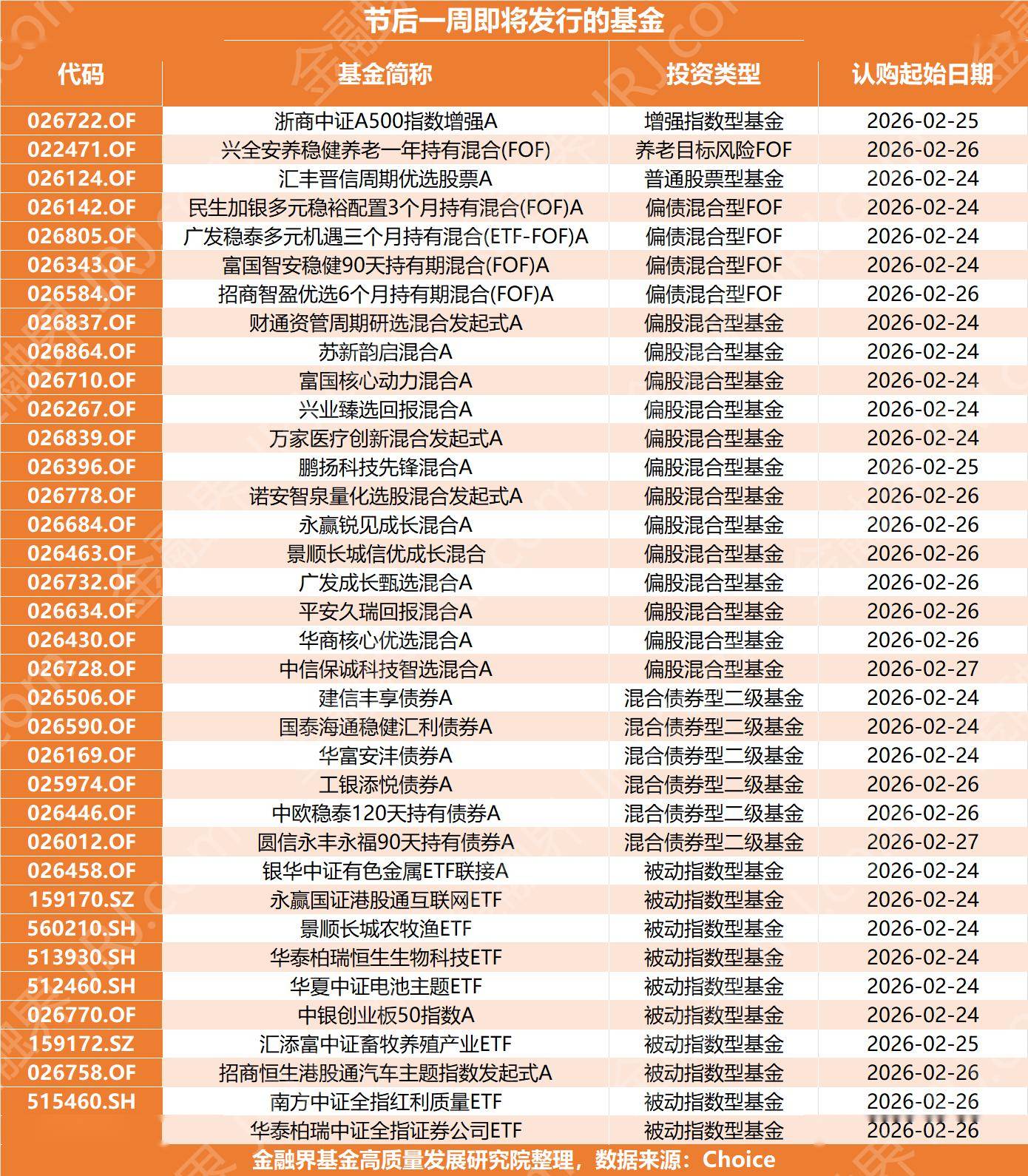
Core Viewpoint - The public fund issuance market has officially commenced after the Spring Festival holiday, with a significant increase in the number of new funds launched and the total issuance scale reaching a four-year high [1] Group 1: Fund Issuance Statistics - On February 24, 18 new funds were launched, and a total of 36 new funds are expected to be issued in the first trading week after the holiday [1] - As of February 24, 227 new funds have been established in 2026, with a total issuance scale of 209.5 billion yuan, marking a nearly doubled year-on-year increase [1] - In January, 169 new funds were launched, representing a month-on-month increase of 26.12% and a year-on-year increase of 106.10% due to a low base effect from the previous year [1] Group 2: Fund Types and Strategies - Among the newly issued funds, equity mixed funds dominate with 13 new offerings, followed by 10 passive index funds and 5 FOF funds [3] - The equity mixed funds typically employ a multi-asset allocation strategy with equity positions ranging from 60% to 75% in their performance benchmarks [3] - The newly launched stock products focus on themes such as technological innovation, consumption upgrades, Hong Kong stock opportunities, and dividend strategies, providing investment tools for structural opportunities throughout the year [3] Group 3: Fixed Income Products - Six new mixed bond and secondary bond funds have started subscription, utilizing a "fixed income plus" strategy with bond positions ranging from 83% to 96% in their performance benchmarks [3]
国泰海通 · 晨报260226|银行、有色
国泰海通证券研究· 2026-02-25 14:22
Group 1: Core Insights - The article highlights a significant increase in short-term loans from large banks, while credit growth in small and medium-sized banks is slowing down [1][4]. - The article discusses the impact of the Spring Festival on deposit fluctuations, noting a year-on-year increase of 3.5 trillion yuan in unit deposits, with a notable shift of personal deposits from small to large banks [2][4]. - The investment strategy for the banking sector in 2026 focuses on identifying targets with potential for growth, banks with convertible bond expectations, and maintaining a dividend strategy [5]. Group 2: Liability Side - Unit deposits saw a year-on-year increase of 3.5 trillion yuan, with demand for current deposits rising by 2.5 trillion yuan and a decrease in time deposits by 912 billion yuan, attributed to the Spring Festival's timing [2]. - Personal deposits experienced a year-on-year increase of only 3.3 trillion yuan, with current and time savings deposits decreasing by 1.9 trillion yuan and 398.7 billion yuan respectively, indicating a migration trend from small to large banks [2]. - Non-bank deposits increased by 2.9 trillion yuan, with large banks contributing 2.2 trillion yuan and small banks 646.1 billion yuan, driven by a low base effect from regulatory changes [2]. Group 3: Asset Side - Total loans decreased by 489.3 billion yuan year-on-year, with large banks and small banks seeing reductions of 213 billion yuan and 276.3 billion yuan respectively, reflecting subdued credit demand and increased pressure on small banks [4]. - Short-term loans saw a significant increase of 347.8 billion yuan, with large banks experiencing a rise of 419.7 billion yuan, driven by both corporate and consumer short-term loans [4]. - Bond investments increased by 205.7 billion yuan year-on-year, with large banks increasing by 376 billion yuan and small banks decreasing by 170.3 billion yuan [4][5].

华安基金:险资加力权益配置,持续增配港股红利
Xin Lang Cai Jing· 2026-02-25 10:45
Market Overview and Key Insights - The Hang Seng China Enterprises Dividend Index increased by 0.56%, while the Hang Seng Index rose by 0.03% and the Hang Seng Technology Index by 0.27% last week. In the A-share market, the CSI State-Owned Enterprises Dividend Index fell by 0.48%, while the CSI 300 Index increased by 0.39% [1][6] - By the end of Q4 2025, insurance capital significantly increased its allocation to equity assets, with the proportion of equity investments rising to 15.3%, approaching historical highs. This reflects the policy requirement for "long money, long investment" and an optimized assessment mechanism for insurance capital [1][7] Insurance Capital Allocation - The characteristics of insurance capital align well with the low volatility and high dividend nature of dividend stocks, making dividend stocks a primary allocation direction for insurance capital. Insurance funds are expected to become significant incremental capital in the stock market, emphasizing the importance of understanding their allocation direction for investment [1][7] - With long-term bond yields at historical lows, incremental insurance capital is likely to flow more into dividend stocks, indicating a favorable long-term funding environment for dividend strategies [1][7] Dividend Strategy and ETF Insights - The Hang Seng China Enterprises Dividend Index has a dividend yield of 5.72%, compared to 4.86% for the CSI Dividend Index, with a price-to-book (PB) ratio of 0.64 and a price-to-earnings (PE) ratio of 7.26. Over the past five years, it has achieved a cumulative return of 155%, outperforming the Hang Seng Total Return Index by 150% [2][7] - The CSI State-Owned Enterprises Dividend Index has a dividend yield of 4.83%, a PB of 0.85, and a PE of 8.48, with a five-year cumulative return of 69%, outperforming the CSI 300 Total Return Index by 78% [2][7] - The low interest rate environment and weak economic recovery in China are favorable for dividend strategies, with strong dividend willingness and capability among central state-owned enterprises [2][7] ETF Product Overview - The Hang Seng China Enterprises Dividend ETF (513920) is the first ETF in the market with triple attributes of Hong Kong stocks, central enterprises, and dividends, tracking the Hang Seng China Enterprises Dividend Index (HSSCSOY) [3][8] - The National Enterprises Dividend ETF (561060) tracks the CSI National Enterprises Dividend Index, selecting 100 stocks from state-owned enterprises with high cash dividend yields and stable dividends, reflecting the overall performance of high-dividend state-owned enterprises in the A-share market [4][9]

红利策略在市场震荡中表现突出,红利国企ETF国泰(510720)盘中上涨1.2%
Mei Ri Jing Ji Xin Wen· 2026-02-25 09:52
Core Viewpoint - The dividend strategy has shown strong performance amid market fluctuations, with the Guotai Dividend State-Owned Enterprise ETF (510720) rising by 1.2% on February 25. The core logic behind this strategy is the certainty premium of high dividend assets, which have become increasingly valuable in the current macroeconomic environment characterized by lower growth and declining interest rates [1][1]. Group 1: Market Environment - The current macro environment features a downward shift in growth and a normalization of lower interest rates, highlighting the scarcity value of assets that provide stable cash returns [1][1]. - High dividend sectors not only offer substantial dividend returns as a safety net but also demonstrate strong price resilience [1][1]. Group 2: Investment Strategy - The Guotai Dividend State-Owned Enterprise ETF (510720) tracks the Shangguo Dividend Index (000151), which selects high-dividend capable and stable dividend record companies across sectors such as banking, coal, and transportation, focusing on traditional high-dividend areas [1][1]. - The index employs a rigorous assessment of constituent stocks' dividend yield and sustainability, utilizing a cross-industry diversification strategy to effectively control investment risks and reflect the overall market performance of high-dividend companies [1][1]. Group 3: Fund Performance - According to the fund announcement, the Guotai Dividend State-Owned Enterprise ETF has evaluated dividends monthly and has successfully distributed dividends every month since its listing, achieving a continuous dividend distribution for 22 months [1][1].