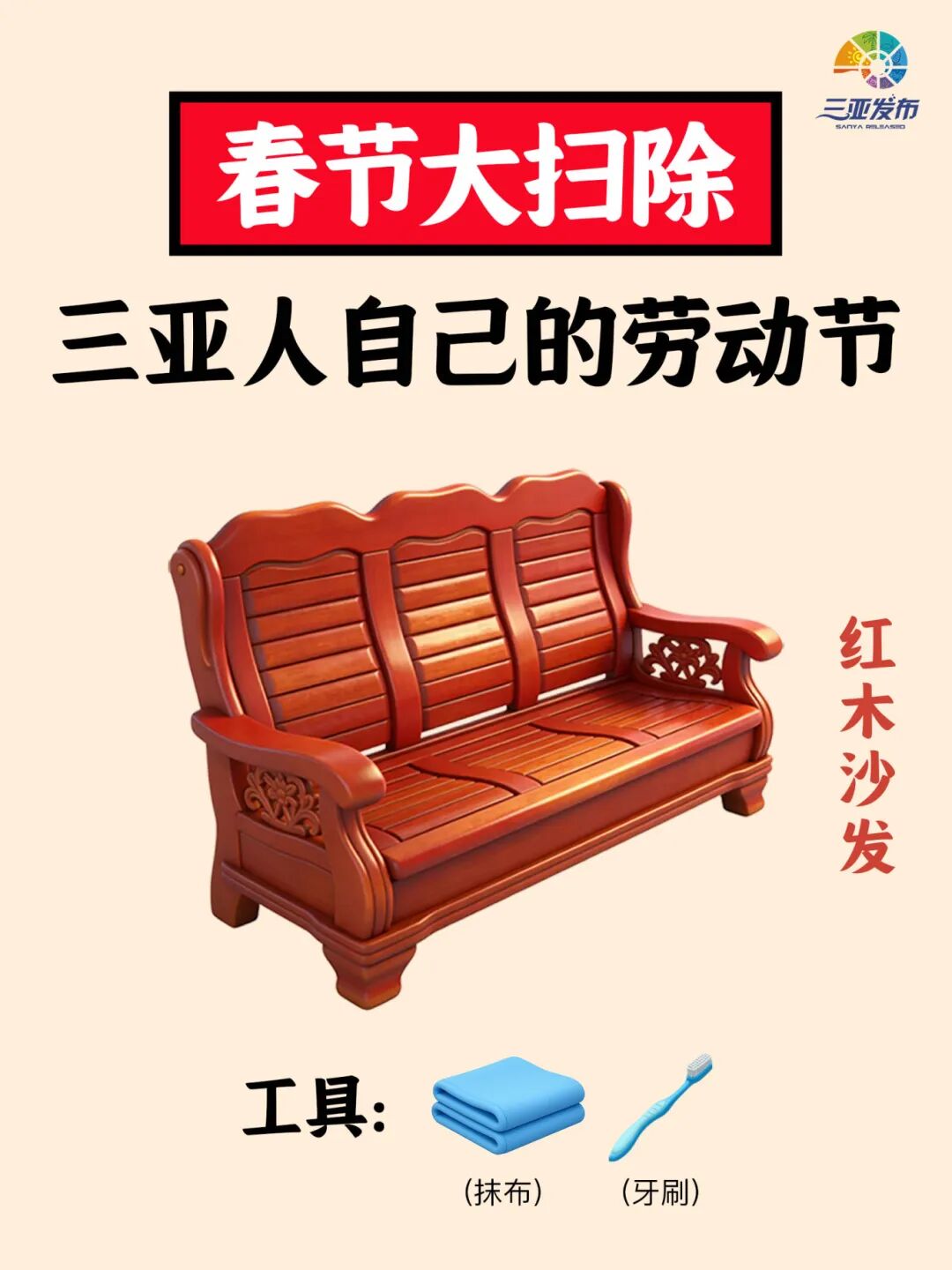
红木沙发

Search documents
不说了,我要干活了!
Xin Lang Cai Jing· 2026-02-08 03:01
Group 1 - The annual cleaning ritual in Sanya is approaching, marking a significant cultural practice as families prepare for the Spring Festival [1] - The cleaning tasks include challenging activities such as washing intricately carved mahogany sofas, which can be time-consuming and labor-intensive [4] - Heavy winter quilts, referred to as "big flower quilts," pose a significant challenge when washing due to their weight when wet, requiring considerable effort from family members [7] Group 2 - Many households in Sanya have unused kitchenware that is typically stainless steel, which must be cleaned annually in preparation for the New Year [10] - Red plastic stools, commonly used for entertaining guests, are easy to store but difficult to clean, often requiring two people to manage the task [13] - The final cleaning tasks include scrubbing stainless steel stair railings and security grilles, which are meticulous and physically demanding, often leading to dissatisfaction with the cleaning results [15]

财经调查丨红木商家偷梁换柱,一套沙发多赚1万元!
Sou Hu Cai Jing· 2025-08-24 12:30
Core Viewpoint - The article highlights the issue of misrepresentation in the redwood market, particularly regarding the sale of lower-quality Thai rosewood being passed off as higher-quality Burmese rosewood, leading to significant price discrepancies and consumer deception [1]. Group 1: Market Overview - The national standard for redwood, GB/T18107-2017, identifies the main production areas for large-leaf rosewood as Thailand, Myanmar, Laos, Cambodia, and Vietnam [1]. - Among these, the highest quality and price are attributed to Burmese rosewood, followed by Laotian rosewood, while Thai rosewood is considered the lowest in quality and price [1]. Group 2: Consumer Deception - Many consumers struggle to distinguish between the subtle differences in quality among the three types of rosewood, resulting in a market where some sellers misrepresent Thai rosewood as Burmese rosewood, potentially reducing the cost of a sofa by 10,000 yuan [1]. - Some merchants admit that mixing Thai rosewood and poor craftsmanship can lead to furniture cracking and deforming, yet they still claim the products are "pure Burmese rosewood" [1]. Group 3: Certification Issues - Certification agencies are reportedly engaging in "wordplay" by only labeling products as "rosewood" without specifying the exact species and origin, which allows them to evade responsibility [1]. - The testing institutions acknowledge that this practice is a means to avoid accountability for the misrepresentation of wood quality [1].
上亿人打卡,广东这个家具城成了「4A级景区」
36氪· 2025-06-26 00:07
Core Viewpoint - The article highlights the transformation of the furniture market in Foshan, Guangdong, into a major tourist attraction, showcasing its industrial strength and extensive product offerings, making it a global hub for furniture manufacturing and export [3][5][19]. Group 1: Overview of Foshan's Furniture Industry - Foshan is recognized as the world's largest furniture production and export base, with over 30,000 furniture enterprises and a total home furnishing industry scale exceeding 1 trillion RMB [5][57]. - The city has a vast furniture market that spans over 3 million square meters, equivalent to approximately 420 standard football fields, making it the largest in the world [12][19]. - The furniture market features 20 themed exhibition halls, showcasing over 2,000 domestic brands and more than 200 European imported brands, providing a comprehensive selection for consumers [15][19]. Group 2: Industrial Capabilities and Innovations - Foshan's furniture industry is characterized by high automation, with factories utilizing robotic arms that can process thousands of different products daily, achieving material utilization rates exceeding 90% [25][29]. - The industry operates on a complete supply chain, with various towns specializing in different aspects of furniture production, from woodworking machinery to manufacturing and trade [29][55]. - The integration of advanced technology and design capabilities allows for immersive customer experiences, where consumers can visualize their furniture choices in real-time [24][66]. Group 3: Historical and Cultural Significance - The region has a rich history in furniture craftsmanship, with traditional styles influenced by Western designs during the Qing Dynasty, making it a significant cultural hub for furniture production [42][44]. - Foshan's geographical advantages, including its location as a transportation hub for timber, have historically supported its furniture manufacturing industry [47][55]. - The legacy of craftsmanship continues to thrive, with many small workshops evolving into standardized factories, contributing to the industry's growth and international reach [63][66]. Group 4: Global Market Presence - Foshan's furniture exports exceed 10 billion RMB annually, with a growing international customer base, particularly among overseas Chinese communities [57][60]. - The city has established strong connections with global markets, leveraging its transportation infrastructure to facilitate efficient shipping of furniture worldwide [55][60]. - The trend of "buying furniture from Foshan" has gained popularity among consumers in Southeast Asia and Europe, who prefer the unique styles and competitive pricing offered by Foshan manufacturers [57][60].