综合数字支付服务

Search documents
一边清仓式分红,一边赴港募资,深陷P2P诉讼的富友支付何时圆梦?
Xin Lang Cai Jing· 2026-02-12 14:07
Core Viewpoint - Fuyou Payment, a digital payment platform, is attempting its fourth IPO application to the Hong Kong Stock Exchange after multiple previous failures, highlighting its urgency to enter the capital market amid increasing competition in the third-party payment industry [3][5]. Group 1: Company Overview - Fuyou Payment, established in July 2011 and headquartered in Shanghai, is a comprehensive digital payment technology platform [3]. - As of the end of 2024, Fuyou Payment ranks eighth among comprehensive digital payment service providers in China, with a market share of 0.8% [4]. Group 2: Financial Performance - For the ten months ending October 2025, Fuyou Payment reported a revenue of 1.307 billion yuan, a year-on-year decline of 2.9%, while its adjusted net profit increased by 52.44% to 125 million yuan [4]. - The gross profit margins from 2022 to 2024 were 28.4%, 25.2%, and 25.9%, indicating a downward trend [4]. - The contribution of cross-border digital payment services to total revenue decreased from 9.2% in 2022 to 5.7% in the first ten months of 2025 [4][22]. Group 3: Corporate Governance and Ownership Structure - Fuyou Payment's ownership structure is complex, with 68 shareholders, where the controlling shareholder, Fuyou Group, holds 61% of the shares [6][7]. - The company lacks a clear actual controller, which has raised questions from regulatory authorities [10][11]. Group 4: Compliance Issues - Fuyou Payment has faced multiple regulatory fines, including a significant penalty of 4.55 million yuan from the People's Bank of China in November 2023 for compliance violations [5][25]. - The company is involved in 47 pending lawsuits related to P2P platforms, indicating ongoing legal challenges [5]. Group 5: Market Position and Strategy - The third-party payment industry in China is highly competitive, dominated by major players like Alipay and WeChat Pay, making it crucial for Fuyou Payment to define its business transformation strategy [12]. - Fuyou Payment has established strategic partnerships with international card organizations like Visa and Mastercard to enhance its cross-border payment services [22].


富友支付第四次IPO:3.65亿清仓分红超净利润,消费者投诉上千条
Sou Hu Cai Jing· 2026-02-06 00:41
Group 1 - The core point of the article is that Fuioupay is making its fourth attempt to list on the Hong Kong Stock Exchange, facing challenges related to compliance issues and significant dividend payouts [2][3][8] - Fuioupay has a history of failed listing attempts, with its first application submitted in April 2024, followed by three subsequent applications that also failed [2][3] - The company has been planning for an IPO for over ten years, having signed various advisory agreements with different securities firms since 2015 [2] Group 2 - Fuioupay is a comprehensive digital payment technology platform established in July 2011, recognized as a pilot provider of multi-channel digital payment and digital business solutions in China [4] - The company has developed a wide range of payment services, including commercial payments, financial payments, and cross-border digital payment services, connecting with major card organizations and banks globally [4] - In 2024, the total payment volume (TPV) of China's digital payment service market was 268.6 trillion yuan, with Fuioupay holding a market share of 0.8% among comprehensive digital payment service providers [5] Group 3 - Fuioupay's financial performance shows revenue growth but fluctuating profits, with revenues of 1.142 billion yuan in 2022, 1.506 billion yuan in 2023, and 1.634 billion yuan in 2024, while net profits were 71.17 million yuan, 92.98 million yuan, and 84.43 million yuan respectively [5] - The company's gross profit margins have declined from 28.4% in 2022 to 25.8% in the first ten months of 2025 [5] - The company has incurred significant costs, with sales and distribution expenses, R&D expenses, and administrative expenses totaling over 1 billion yuan in recent years [6] Group 4 - Fuioupay has distributed a total of 365 million yuan in dividends from 2021 to 2025, which exceeds its net profits during the same period, raising questions about the necessity of its IPO [7][10] - The company has faced multiple compliance issues, including fines totaling 6.66 million yuan for various violations, which may hinder its IPO prospects [12][14] - Consumer complaints against Fuioupay have been significant, with over 1,700 complaints reported, primarily concerning unauthorized charges and refund difficulties [15]

富友支付四战港股IPO:3.65亿巨额分红 曾与P2P、分期商城合作
Xin Lang Cai Jing· 2026-02-02 09:59
Core Viewpoint - Shanghai Fuyou Payment Service Co., Ltd. has submitted its fourth listing application to the Hong Kong Stock Exchange, facing challenges in its long journey to go public, including high reliance on acquiring business, slowing growth, and regulatory pressures [3][27]. Group 1: Business Overview - Fuyou Payment, established in 2011, holds various payment licenses, making it one of the few fully licensed third-party payment institutions in the industry [4][28]. - The company ranks eighth among comprehensive digital payment service providers in China with a market share of 0.8% based on 2024's Total Payment Volume (TPV) [4][28]. - Fuyou Payment's core business includes comprehensive digital payment services and digital business solutions, with merchant acquiring services contributing significantly to its revenue [8][30]. Group 2: Financial Performance - Revenue increased from 1.142 billion yuan in 2022 to 1.634 billion yuan in 2024, but the growth rate has significantly slowed, dropping from 31.87% in 2023 to 8.50% in 2024 [6][30]. - Net profit fluctuated, with a decrease from 93 million yuan in 2023 to 84 million yuan in 2024, despite a significant increase to 109 million yuan in the first ten months of 2025 [8][30]. - The gross profit margin has been declining, attributed to increased commission costs in the domestic payment service sector and reduced service fees in cross-border digital payment services [8][30]. Group 3: Dividend Policy and Financial Health - Fuyou Payment has distributed a total of 365 million yuan in dividends over five years, raising concerns about its financial strategy given its high debt ratio of 86.88% [12][36]. - As of October 2025, the company had cash and cash equivalents of only 317 million yuan against total assets of 5.338 billion yuan and total liabilities of 4.64 billion yuan [14][38]. Group 4: Regulatory and Compliance Issues - The company has faced four administrative penalties totaling approximately 6.9 million yuan since 2021 for non-compliance with regulations [16][40]. - Fuyou Payment has been involved in 47 P2P-related lawsuits, with most resolved favorably for the company, but it still faces ongoing regulatory scrutiny [17][41]. - Customer complaints have surged, with 1,739 complaints reported on a consumer complaint platform, highlighting issues with unauthorized deductions [18][41].

排名前十、全牌照到手,富友支付为何在IPO门外徘徊了11年?
Xin Lang Cai Jing· 2026-01-28 06:40
Core Viewpoint - Shanghai Fuyou Payment Service Co., Ltd. has submitted its fourth listing application to the Hong Kong Stock Exchange, aiming to capitalize on the growing digital payment market in China [1][3]. Company Overview - Fuyou Payment was established in 2011 and obtained a payment business license from the central bank in the same year, holding five types of licenses: prepaid cards, internet payment, bank card acquiring, fund payment, and cross-border payment, making it one of the few fully licensed third-party payment institutions in the industry [1][3]. Market Position - According to Frost & Sullivan, the total TPV (Total Payment Volume) of China's comprehensive digital payment service market is projected to reach RMB 268.6 trillion in 2024, with the top ten comprehensive digital payment institutions collectively holding about 82.0% of the market share [1][3]. - Fuyou Payment ranks eighth among comprehensive digital payment service providers in China with a market share of approximately 0.8%, and fourth among independent comprehensive digital payment service providers with a market share of about 4.5% [1][3]. - In terms of transaction volume, Fuyou Payment ranks first in the aggregation acquiring market with a market share of approximately 15.1% [1][3]. Financial Performance - The company's revenue for the years 2022 to 2024 and the first ten months of 2025 is reported as follows: RMB 1.142 billion, RMB 1.5 billion, RMB 1.634 billion, and RMB 1.307 billion, respectively [2][4]. - Profits for the same periods are reported as RMB 71.17 million, RMB 92.98 million, RMB 84.33 million, and RMB 109 million, respectively [2][4]. - Merchant acquiring business constitutes the majority of Fuyou Payment's revenue, maintaining an income share of over 80% for several years [2][4]. - The gross margins for comprehensive digital payment services during the same periods are 25.6%, 22.1%, 22.2%, and 22.0%, while for digital commercial solutions, the gross margins are 84.4%, 76.5%, 75.2%, and 70.1% [2][4]. Listing Process - The submission of the listing application is only the initial step; Fuyou Payment must pass the Hong Kong Stock Exchange hearing and complete the overseas issuance listing filing with the regulatory authority to successfully list [2][4].
富友支付,再度递表香港联交所,收入依赖单一业务
Zhong Guo Zheng Quan Bao· 2026-01-21 23:24
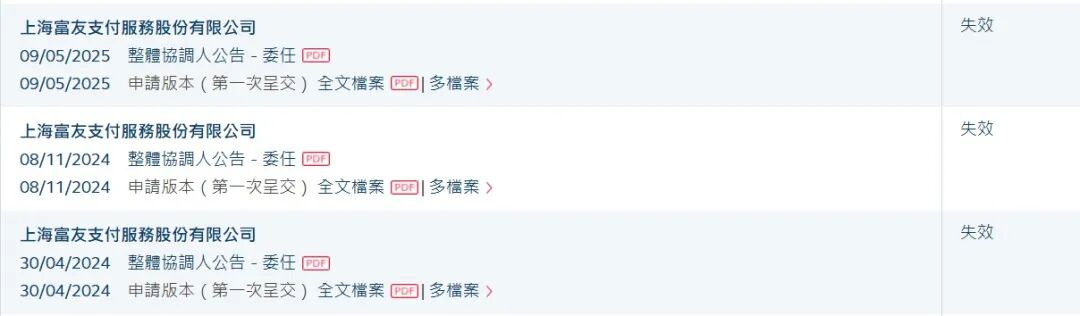
Core Viewpoint - Shanghai Fuyou Payment Service Co., Ltd. has submitted its IPO application to the Hong Kong Stock Exchange, marking its fourth attempt to go public in Hong Kong after previous applications in 2024 and 2025 failed to materialize [1][5]. Company Overview - Fuyou Payment, established in 2011, is a versatile digital payment technology platform in China, providing multi-channel payment services and value-added services across various business scenarios [3][5]. - The company has previously sought to list on the A-share market but faced challenges, including regulatory scrutiny and the termination of advisory agreements with brokers [5]. Financial Performance - The company's revenue for the years 2022, 2023, 2024, and the first ten months of 2025 were RMB 1.142 billion, RMB 1.506 billion, RMB 1.634 billion, and RMB 1.307 billion, respectively [8][9]. - The income from merchant acquiring services consistently accounted for over 80% of total revenue, with specific figures of RMB 931 million, RMB 1.290 billion, RMB 1.342 billion, and RMB 1.096 billion for the same periods [9][10]. Market Position - In 2024, the total payment volume (TPV) of China's digital payment service market was RMB 268.6 trillion, with Fuyou Payment holding an 0.8% market share, ranking eighth among comprehensive digital payment service providers [11]. - As an independent provider, Fuyou Payment ranked fourth in the market with a 4.5% share based on TPV [11]. Competitive Landscape - The payment industry is characterized by high competition and regulatory pressures, with existing and new competitors continuously enhancing their services [12]. - Fuyou Payment operates in a highly regulated environment, holding multiple payment licenses, including those for prepaid cards, internet payments, and cross-border payments [12].
富友支付第四次递表港交所 11年7次冲击IPO
Zhong Guo Jing Ying Bao· 2026-01-20 16:20
Core Viewpoint - Shanghai Fuyou Payment Service Co., Ltd. has submitted its fourth listing application to the Hong Kong Stock Exchange, aiming to capitalize on its position as a licensed third-party payment institution in China's digital payment market [1][2]. Company Overview - Fuyou Payment was established in 2011 and holds five types of licenses, including prepaid cards, internet payment, bank card acquiring, fund payment, and cross-border payment, making it one of the few fully licensed third-party payment institutions in the industry [1]. - The company ranks eighth among comprehensive digital payment service providers in China with a market share of approximately 0.8% and fourth among independent comprehensive digital payment service providers with a market share of about 4.5% [1]. Market Context - According to Frost & Sullivan, the total TPV (Total Payment Volume) of China's comprehensive digital payment service market is projected to reach RMB 268.6 trillion in 2024, with the top ten comprehensive digital payment institutions accounting for around 82.0% of the total market share [1]. - Fuyou Payment holds the first position in the aggregation acquiring market by transaction volume, with a market share of approximately 15.1% [1]. Financial Performance - The revenue figures for Fuyou Payment from 2022 to the first ten months of 2025 are as follows: RMB 1.142 billion, RMB 1.5 billion, RMB 1.634 billion, and RMB 1.307 billion, respectively [2]. - Profit figures for the same periods are RMB 71.17 million, RMB 92.98 million, RMB 84.33 million, and RMB 109 million, respectively [2]. - The merchant acquiring business has consistently been the primary revenue source, contributing over 80% of total revenue for several years [2]. - The gross margins for comprehensive digital payment services during this period were 25.6%, 22.1%, 22.2%, and 22.0%, while digital commercial solutions had gross margins of 84.4%, 76.5%, 75.2%, and 70.1% [2]. Listing Process - The submission of the listing application is just the initial step, with subsequent requirements including passing the Hong Kong Stock Exchange hearing and completing the overseas issuance listing filing with the regulatory authority [2].
2025,金融科技上市「死灰复燃」
3 6 Ke· 2025-10-15 02:03
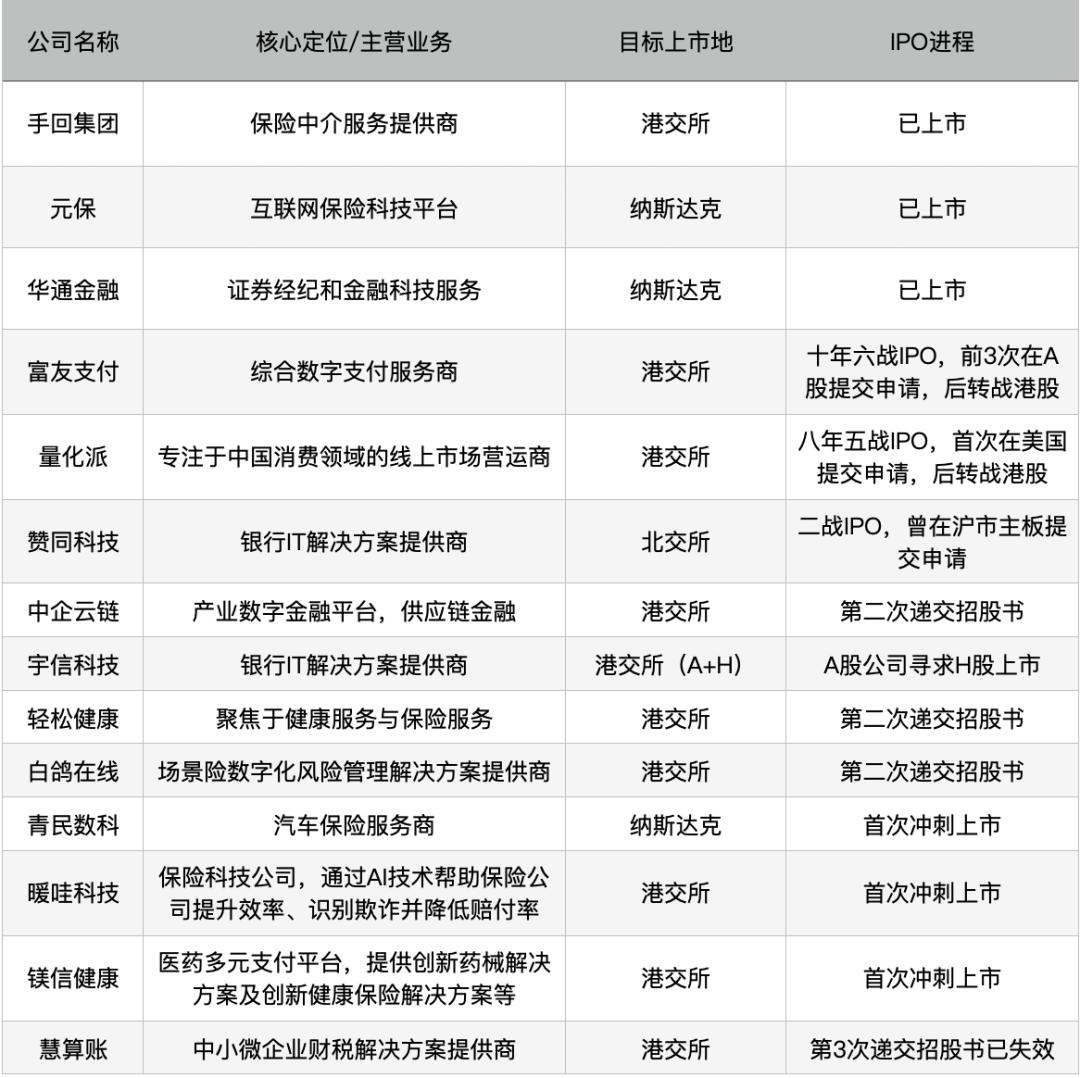
Core Viewpoint - A new wave of IPOs is emerging in China's fintech sector, with several companies successfully listing and many others waiting for approval, indicating a shift in the market dynamics after a prolonged period of stagnation [1][3]. Group 1: IPO Activity in China - Since 2025, companies like Shouhui Group, Yuanbao, and Weiguan have successfully gone public, while over ten others, including Fuyou Payment and Lianghua, have submitted IPO applications [1][2]. - The current IPO candidates represent a diverse range of business areas, including IT solutions, payment services, consumer credit, tax management, supply chain finance, and insurtech, contrasting with the previous focus on lending [3]. - The Hong Kong Stock Exchange has introduced mechanisms to facilitate the listing of tech companies, resulting in a significant increase in IPO activities, with 67 IPOs completed in the first three quarters of 2025, a 50% year-on-year increase [8]. Group 2: IPO Trends in the US - Concurrently, the US fintech market is also experiencing a resurgence in IPOs, with companies like Chime and Klarna successfully listing on major exchanges [4][5]. - In the first half of 2025, over 20 fintech companies globally completed IPOs, reflecting a broader recovery in the capital markets [6][7]. Group 3: Challenges Faced by Companies - Many companies attempting IPOs in China have faced multiple setbacks, with Fuyou Payment and Lianghua being notable examples of firms that have repeatedly tried to go public without success [10][12]. - Companies like Weisuan and Zantong Technology have also struggled, with significant financial losses impacting their ability to attract investors [13][14]. - The pressure to go public often stems from the need for growth and the exit strategies of early investors, leading to a challenging environment for these firms [12][19]. Group 4: Market Sentiment and Valuation - The current market sentiment has shifted towards a more rational approach, with companies like Chime and Klarna seeing their valuations significantly reduced compared to previous funding rounds [24]. - For instance, Chime's valuation dropped from $250 billion to $116 billion at IPO, while Klarna's valuation fell from $460 billion to $173 billion [24]. - Even after successful IPOs, companies face ongoing challenges, as seen with Shouhui Group, whose stock price has declined since its listing [25][26].
富友支付10年6战IPO夹缝求生 净利缩水清仓式分红3.65亿罚单缠身
Chang Jiang Shang Bao· 2025-06-08 23:09
Core Viewpoint - Shanghai Fuyou Payment Service Co., Ltd. (Fuyou Payment) has submitted its IPO application to the Hong Kong Stock Exchange for the third time, reflecting its long-standing ambition to go public despite facing significant challenges and declining financial performance [1][2][6]. Company Overview - Fuyou Payment was established in 2011 and obtained a payment business license in the same year, engaging in various payment services including card acquiring and internet payment [3]. - The company has attempted to go public multiple times, with its first A-share IPO plan initiated in 2015, but it has faced repeated failures, including three terminated advisory agreements with different securities firms [3][4][5][6]. Financial Performance - Fuyou Payment's net profit attributable to shareholders has decreased from 149 million yuan in 2021 to 84 million yuan in 2024, a decline of 43.43% [1][8]. - The company's revenue has shown some growth, with figures of 11.02 billion yuan in 2021, 11.42 billion yuan in 2022, 15.06 billion yuan in 2023, and 16.34 billion yuan in 2024, reflecting a growth rate of 3.63%, 31.87%, and 8.50% respectively [8]. - The company has a high dependency on its digital payment services, which accounted for over 92% of its revenue from 2022 to 2024, with a notable decline in gross margins [9]. Market Position - The third-party payment industry in China is dominated by major players like Alipay, WeChat, and China UnionPay, which collectively hold approximately 75.6% of the market share in the digital payment service sector [10]. - Fuyou Payment's market share is only 0.8%, achieved through aggressive pricing strategies that have impacted its profitability [10]. Dividend Policy - Fuyou Payment has been criticized for its substantial cash dividends, totaling 365 million yuan from 2021 to 2025, which represents about 91% of its net profit during the same period [12][13]. - The company's dividend strategy has raised concerns about its intentions to raise capital through an IPO while simultaneously distributing large amounts of cash to shareholders [11][14]. Regulatory and Compliance Issues - Fuyou Payment has faced multiple regulatory penalties, totaling nearly 7 million yuan from 2021 to 2024, for various compliance violations, including unauthorized foreign exchange operations and failure to meet customer identification requirements [16][17]. - The company has also been involved in legal disputes related to its past partnerships with P2P platforms, indicating potential ongoing risks [17].
富友支付闯上市:增收不增利,股权暗藏家族网,治理乱象频遭敲打
Sou Hu Cai Jing· 2025-05-17 05:37
Core Viewpoint - Shanghai Fuyou Payment Service Co., Ltd. is striving to enter the capital market through an IPO, facing challenges in a competitive digital payment industry while dealing with its complex governance and financial stability issues [1][3][20]. Group 1: Business Structure and Financial Performance - Fuyou Payment has evolved from a regional player to a comprehensive platform, holding five payment business licenses, including internet payment and cross-border payment [4][6]. - The company's revenue grew from 1.142 billion RMB in 2022 to 1.634 billion RMB in 2024, with a compound annual growth rate of 19.6% [6]. - In 2024, Fuyou Payment processed over 54.5 billion payment transactions, ranking eighth among comprehensive digital payment service providers in China with a market share of 0.8% [6]. - The company heavily relies on its core digital payment services, which accounted for 92.5% of total revenue in 2024, indicating vulnerability to market fluctuations [12]. - Despite revenue growth, operating profit showed volatility, with a decline of 7.1% in 2024, and net profit decreased by 9.3% [8][10]. Group 2: Governance and Regulatory Challenges - Fuyou Payment's complex ownership structure, with 68 shareholders and intertwined interests, raises concerns about governance and decision-making independence [13][16]. - The company has faced multiple regulatory penalties, including a fine of 4.55 million RMB in November 2023 for failing to comply with customer identity verification obligations [20]. - The concentration of power among a few executive directors and the presence of related party transactions complicate the governance landscape, potentially impacting the company's compliance and operational integrity [16][17].

拆解IPO|三度叩关港交所,富友支付能否突围而出?
Sou Hu Cai Jing· 2025-05-13 14:27
Core Viewpoint - Company Fuyou Payment has submitted its third IPO application to the Hong Kong Stock Exchange after previous attempts failed, highlighting ongoing challenges in profitability and compliance issues in its pursuit of capital market entry [2][3][6]. Group 1: Company Background - Fuyou Payment, established in 2011 and headquartered in Shanghai, holds various payment licenses in mainland China, Hong Kong, and the United States, focusing on commercial, financial, and cross-border digital payment services [6]. - The company has processed over 545 billion payment transactions, with a total payment volume (TPV) of 15.1 trillion RMB as of the end of 2024 [10]. Group 2: IPO Attempts - Fuyou Payment has previously attempted to list on the A-share market in 2018 and 2021 but was unable to proceed, leading to the termination of related agreements [6]. - After shifting focus to the Hong Kong market, the company submitted its IPO applications on April 30 and November 8, 2024, both of which ultimately expired [6]. Group 3: Financial Performance - The company's revenue for 2022, 2023, and 2024 was approximately 1.142 billion RMB, 1.506 billion RMB, and 1.634 billion RMB, respectively, reflecting a compound annual growth rate of 19.6% [8]. - However, net profits for the same years were 71.17 million RMB, 92.98 million RMB, and 84.43 million RMB, indicating a decline in profit for 2024 compared to the previous year [8]. Group 4: Market Position - In 2024, Fuyou Payment ranked eighth among independent digital payment service providers in China, holding a market share of 0.8%, with no change in market share from 2023 [10]. - The overall digital payment service market in China is projected to reach a TPV of 268.6 trillion RMB in 2024, with the top three non-independent providers holding a combined market share of 75.6% [8][10]. Group 5: Compliance Challenges - Fuyou Payment has faced multiple regulatory penalties since its inception, including significant fines for compliance violations related to payment services and foreign exchange regulations [12]. - The company has been under pressure to enhance compliance and improve service quality to navigate the competitive landscape and regulatory environment [13].