绿色转型债券

Search documents
上海离岸金融应从“跟随者”变为“规则塑造者”——专访中国首席经济学家论坛理事长连平
Guo Ji Jin Rong Bao· 2026-02-24 13:47
Core Viewpoint - The construction of offshore financial (economic) functional zones in Shanghai is a crucial step in enhancing its competitiveness and internationalization as a global financial center, as outlined in the "15th Five-Year Plan" [1][3]. Group 1: Offshore Financial Development - Shanghai's exploration of offshore finance is a significant national strategic practice, evolving from initial trials in the late 1980s to a more structured approach post-2013 with the establishment of the Free Trade Account (FT Account) system [2]. - The turning point for Shanghai's offshore financial strategy occurred in 2021 when the central government emphasized the need for a matching offshore financial system to support Shanghai's international financial center status [2]. - The urgency of this historical mission is particularly pronounced at the beginning of the "15th Five-Year Plan," as Shanghai transitions from "scale expansion" to "functional upgrading" [2]. Group 2: Key Recommendations for Offshore Financial Zones - The construction of offshore financial (economic) functional zones should focus on "system construction" and "function deepening," transitioning from pilot exploration to a comprehensive system [3]. - The institutional framework should evolve from a "sandbox" model to formal regulations, solidifying successful pilot experiences into universally applicable standards [4]. - Market functions should expand from "settlement" to "pricing," with the issuance of offshore RMB bonds serving as a benchmark for asset allocation [4]. - The development model should shift from a purely "foreign" focus to a dual approach that includes both "foreign" and "domestic" elements, establishing a controlled mechanism for interaction with onshore markets [4]. Group 3: Empowering Key Financial Areas - The offshore financial functional zone will play a direct and critical role in supporting five major financial areas, including technology finance, green finance, inclusive finance, pension finance, and digital finance [5][6]. - Specific pathways for empowering these areas include providing comprehensive financial solutions for tech companies, issuing green bonds linked to ESG standards, and creating a robust offshore financial risk prevention system [5][6]. Group 4: FT Account Upgrades - The FT Account, established in 2013, has been pivotal in developing offshore business under controlled conditions, allowing for RMB transactions among non-residents [7][8]. - Key milestones for the FT Account include enabling RMB offshore transactions, facilitating cross-border funding for enterprises, and exploring regulatory practices for limited penetration [8][9]. - Future developments for the FT Account should focus on enhancing its functionality and addressing the fragmentation of existing account systems [9]. Group 5: Global Trends and Opportunities - The global offshore financial market is expected to undergo significant changes, driven by the "weaponization" of financial sanctions, which will increase demand for offshore risk management [11]. - The digitalization of finance, particularly through blockchain technology, is reshaping the global financial landscape, suggesting that a substantial portion of offshore financial activities may occur on-chain [11]. - The need for rule-making authority in offshore finance is becoming increasingly important, as it serves as a platform for establishing international financial transaction and regulatory standards centered around the RMB [11][12]. Group 6: Strategic Recommendations for Shanghai - Shanghai should position itself as a "safe harbor" for RMB, enhancing its independent clearing network and providing a stable platform for RMB-denominated trade and investment [13]. - The city should also focus on the trend of "on-chain" finance, exploring regulatory innovations for offshore RMB digital financial ecosystems [14]. - Establishing offshore RMB bonds as a global asset anchor and yield curve is essential for promoting RMB internationalization [15]. - Collaborative strategies with Hong Kong and other regions should be implemented to leverage complementary strengths and expand RMB usage in international trade [15].
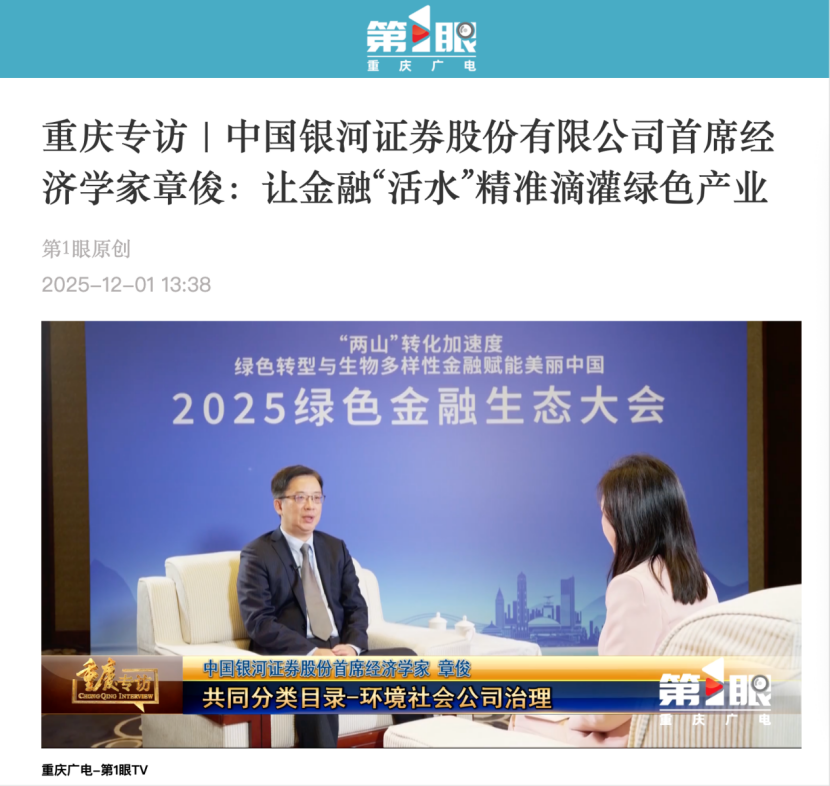
【CGS-NDI之声】重庆广电第1眼TV专访章俊:金融活水浇灌巴渝大地,共绘“两山”转化新画卷
Xin Lang Cai Jing· 2025-12-03 13:21
Core Viewpoint - The 2025 Green Finance Ecological Conference in Chongqing highlighted the city's strategic position as a "best testing ground" for green finance, leveraging its ecological significance and industrial transformation needs to promote ecological protection and industrial transition [3][12]. Group 1: Green Finance Strategies - The strategy of "疏堵结合,精准赋能" (combining restriction and precision empowerment) was proposed to address the high proportion of heavy industry in Chongqing, focusing on limiting investments in high-pollution and high-energy consumption projects while providing comprehensive support for transitioning enterprises [3][14]. - The introduction of products like the CGT-ESG bond portfolio aims to guide funds towards low-carbon and environmentally friendly sectors, facilitating the green transformation of industrial enterprises [3][14]. Group 2: Biodiversity Finance - Biodiversity finance is identified as a frontier area, emphasizing the importance of quantifying ecological value and designing financial products that attract social capital, transforming biodiversity protection from a purely philanthropic effort into a source of stable returns [4][15]. - The goal is to create "green assets" that generate cash flow and returns, thereby encouraging broader market participation in biodiversity protection [4][15]. Group 3: Collaborative Development - China Galaxy Securities plans to focus on three strategic areas to support Chongqing's development model of "capital, ecology, and industry": enhancing full-chain services, leveraging technology for precision service, and promoting regional collaboration for carbon reduction and ecological protection [5][13]. - The integration of industrial transformation and biodiversity protection is seen as a way to achieve synergistic effects, with innovative financial tools like "green transition bonds" and "ecological credit loans" being explored to support this dual empowerment [8][16].