缠绕管式换热器

Search documents
研判2026!中国缠绕管式换热器行业发展历程、产业链、发展现状、企业格局及发展趋势分析:行业应用领域广泛,市场规模达到33.5亿元[图]
Chan Ye Xin Xi Wang· 2026-01-27 01:15
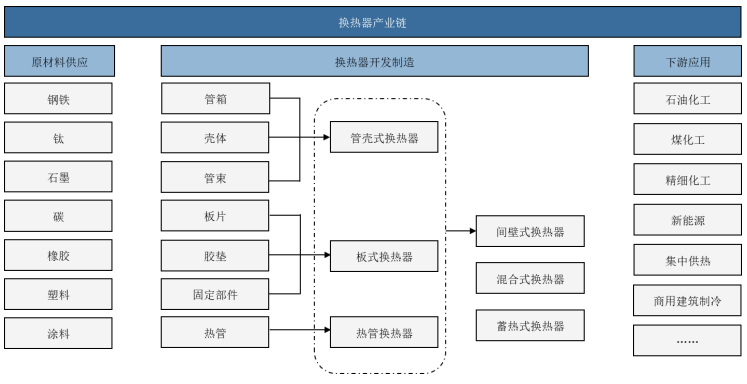
Core Viewpoint - The domestic production level of spiral tube heat exchangers is gradually increasing, supported by national policies, and they are widely used in the petrochemical, coal chemical, and new energy sectors. The market for spiral tube heat exchangers is expected to grow significantly, with a projected compound annual growth rate of 21.9% from 2019 to 2025, reaching approximately 3.35 billion yuan by 2025 [1][7]. Industry Overview - Spiral tube heat exchangers are designed with a unique structure that allows for efficient heat transfer, making them superior to traditional shell-and-tube heat exchangers. They can accommodate various media and are suitable for high-temperature and high-pressure applications [3][4]. Industry Development Stages - The spiral tube heat exchanger industry has evolved through four main stages: technology introduction, domestic breakthroughs, large-scale application expansion, and intelligent green upgrades. The industry has transitioned from relying on imported technology to achieving significant domestic innovations [4][5]. Industry Chain - The industry chain consists of upstream raw materials (steel, rubber, graphite, plastics, coatings), midstream manufacturing of spiral tube heat exchangers, and downstream applications in sectors such as petrochemicals, coal chemicals, fine chemicals, new energy, and centralized heating [5][6]. Market Demand and Growth - The demand for spiral tube heat exchangers is increasing in the petrochemical sector due to the ongoing upgrades of refining projects driven by green and intelligent requirements. In the coal chemical sector, tightening energy-saving and emission reduction policies are creating opportunities for deeper applications of these heat exchangers [1][8]. Competitive Landscape - The market for spiral tube heat exchangers is relatively concentrated due to the high technical requirements for research, design, and manufacturing. Key players include Sichuan Chuanrun Co., Ltd., Zhenhai Petrochemical Construction Engineering Co., Ltd., and others [6][9]. Future Trends - The industry is expected to benefit from increased national policy support for high-end equipment manufacturing, accelerated technological advancements, and a shift towards high-pressure applications. The development of spiral tube heat exchangers is anticipated to continue expanding into new fields and applications [12][13][14].


缠绕管式换热器行业发展概况及发展趋势
Sou Hu Cai Jing· 2025-04-29 03:55
Development History of Heat Exchangers - The global development of heat exchangers can be divided into three periods: exploration in the 19th century, preliminary development in the first half of the 20th century, and rapid development from the second half of the 20th century to the present [1][2] - In China, the heat exchanger industry has gone through four stages: initiation in the 1960s, growth in the 1980s, development in the 21st century, and innovation in recent years, with a focus on high efficiency and energy saving [3] Competitive Landscape of the Heat Exchanger Industry - The heat exchanger industry has formed a competitive landscape driven by technological advancement and market orientation, with leading foreign companies like Alfa Laval and domestic companies like Lansi Heavy Industry [4] - The market concentration for spiral tube heat exchangers is relatively high, with domestic companies holding a market share of 63.4% in 2021 [4] Industry Chain Analysis - The upstream of the heat exchanger industry includes raw material supply such as steel, rubber, and graphite, while the midstream focuses on manufacturing, and the downstream encompasses various application fields including petrochemicals and power generation [5][7][11] Market Size of the Heat Exchanger Industry - The market size of China's heat exchanger industry reached 845.6 billion yuan in 2021, with a projected growth from 868.9 billion yuan in 2022 to 992.1 billion yuan by 2026, reflecting a compound annual growth rate of 3.4% [20] - The spiral tube heat exchanger market in China is expected to grow from 19.3 billion yuan in 2022 to 38.1 billion yuan by 2026, with a compound annual growth rate of 18.5% [22] Development Trends in the Heat Exchanger Industry - The industry is moving towards larger, more efficient, and energy-saving products, with significant advancements in heat transfer efficiency and reduced pressure loss [23] - There is a deepening collaboration across the entire industry chain, with suppliers needing to customize products to meet specific client requirements [24] - The pace of domestic substitution is accelerating, with significant breakthroughs in materials and manufacturing processes for spiral tube heat exchangers, supported by national policies [25][26]