美国西得克萨斯中间基原油(WTI)

Search documents
方正证券:当下原油价格的驱动因素及历史走势复盘
智通财经网· 2026-02-15 01:00
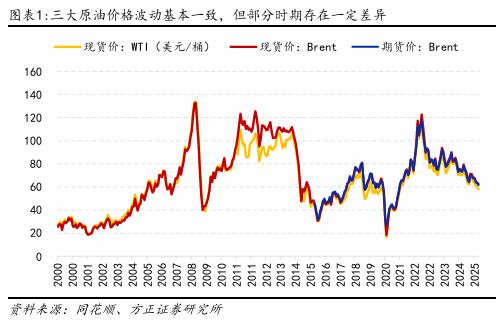
Core Viewpoint - The report from Founder Securities emphasizes that crude oil, as a core commodity in the global energy system, is significantly influenced by supply and demand fundamentals, with the U.S., Russia, and Saudi Arabia forming a tripartite balance in supply. The financial attributes of oil can lead to short-term price deviations, while the political attributes reshape its supply and demand structure [1][31]. Group 1: Crude Oil Price Influencing Factors - Crude oil prices are primarily influenced by three attributes: commodity, financial, and political [2]. - The commodity attribute determines the long-term demand trend, while the financial attribute amplifies price volatility, and the political attribute introduces uncertainty [2][27]. - The global crude oil market features three main pricing systems based on different benchmark oils: WTI, Brent, and Dubai [2]. Group 2: Supply and Demand Dynamics - The demand side of crude oil prices is highly correlated with global economic activity levels, oil inventories, and energy usage [4]. - Crude oil inventories play a crucial role in stabilizing market balance, acting as a buffer against supply disruptions [5]. - The current global crude oil supply structure is characterized by a tripartite balance among the U.S., Russia, and Saudi Arabia, with the U.S. projected to produce nearly 13.2 million barrels per day by 2024 [15]. Group 3: Financial Attributes and Market Dynamics - The dollar's role as the pricing currency for crude oil significantly impacts oil prices, reinforcing the dollar's status as the world's reserve currency [21]. - There exists a dynamic inverse relationship between the dollar index and oil prices, with the dollar's strength typically leading to lower oil prices due to decreased purchasing power in other currencies [22][26]. - The oil market exhibits dual characteristics of commodity and financial attributes, with prices influenced by both supply-demand fundamentals and global financial market conditions [27]. Group 4: Political Attributes and Geopolitical Implications - The "shale revolution" and the establishment of the OPEC+ mechanism have led to a new tripartite oil supply system, increasing interactions and conflicts in energy geopolitics [31]. - The U.S. has shifted its energy strategy from independence to dominance, aiming to lead and influence the international energy market [32]. - The U.S. intervention in Venezuela is seen as a move to re-integrate significant oil reserves into the dollar settlement framework, potentially establishing a new anchor for the petrodollar system [35].