职业本科教育

Search documents
多省公示新大学,越来越多高分考生选择职业本科
Di Yi Cai Jing· 2025-12-11 12:57
Core Viewpoint - The optimization of higher education layout in China is increasingly focusing on vocational undergraduate universities, with several provinces announcing plans to establish or rename institutions in this category [2][4]. Group 1: Recent Developments in Higher Education - Multiple provinces, including Hubei, Hebei, Anhui, and Henan, have recently published public notices regarding the establishment of new higher education institutions [2][3][4]. - Hubei Province plans to apply for the establishment of "Hubei University of Automotive Industry" and "Hubei Health Traditional Chinese Medicine College," both of which are public institutions [2]. - The number of vocational undergraduate institutions has reached a record high of 36 this year, bringing the total to 87 across the country [4]. Group 2: Characteristics and Trends of Vocational Undergraduate Institutions - Vocational undergraduate universities are becoming a key focus in the optimization of higher education layout, with a significant increase in their popularity among parents and students [4]. - Some vocational institutions have established a strong reputation over the years, leading to competitive programs and favorable employment prospects, which in turn raises their admission score lines [5]. - Notable vocational institutions, such as Shenzhen Polytechnic and Beijing University of Science and Technology, have seen their admission scores rise significantly, sometimes matching those of top-tier universities [4].
职业本科招生成绩“亮眼” 考生选择更加理性
Zhong Guo Qing Nian Bao· 2025-08-11 01:48
Core Insights - The surge in enrollment for vocational undergraduate institutions indicates a shift in perception, with high-achieving students increasingly opting for these programs, reflecting a growing recognition of their value in the job market [1][8][11] Enrollment Trends - Vocational undergraduate institutions have seen a significant increase in enrollment, with 33 new institutions admitting students for the first time this year, contributing to a total of 87 vocational undergraduate schools since 2019 [1][2] - High scores in entrance exams have become common among students choosing vocational programs, with examples such as a student scoring 621 points opting for a nursing program at Jinhua Vocational and Technical University, and an average score of nearly 100 points above the undergraduate line for physics students at Guangzhou Vocational University [1][4] Institutional Performance - Beijing University of Science and Technology reported a successful first year of undergraduate admissions, with scores significantly exceeding the control line, indicating strong demand for vocational education [2][9] - In Zhejiang, institutions like Ningbo Vocational Technical University and Jinhua Vocational Technical University achieved high admission scores, with several programs exceeding 570 points, showcasing the competitive nature of vocational education [4][11] Factors Influencing Choices - The preference for vocational education is driven by practical employment considerations, with parents and students prioritizing job prospects and the quality of education [2][8] - Vocational programs are increasingly aligning with regional industry needs, offering practical training and internship opportunities that enhance employability [5][12] Future Implications - The rising popularity of vocational undergraduate programs is expected to reshape the higher education landscape, potentially leading to structural adjustments in the education system to better meet industry demands [11][12] - The increasing number of vocational institutions and their high admission scores may normalize the perception of vocational education, making high scores less of a novelty in the future [11][12]


职业本科,高考新宠|「教」量
2 1 Shi Ji Jing Ji Bao Dao· 2025-06-03 13:33
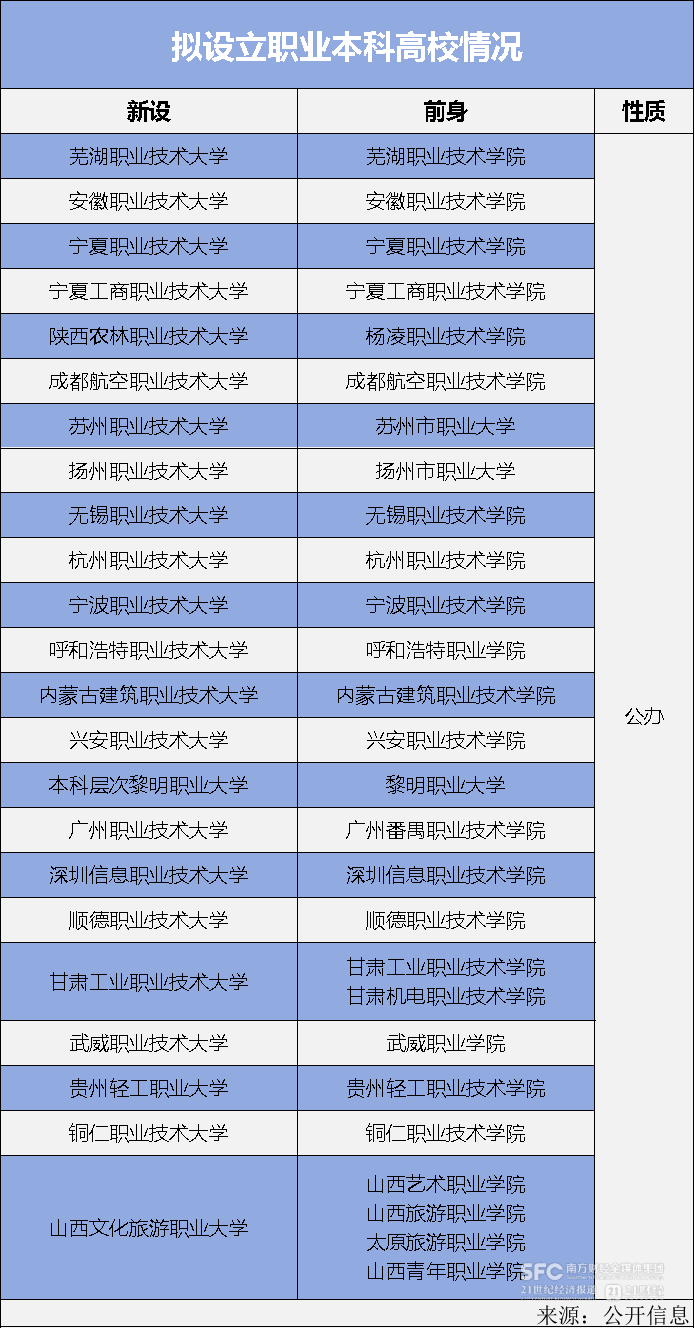
Core Viewpoint - The establishment of 23 new vocational undergraduate institutions in China aims to enhance the scale and quality of vocational education, with a target of enrolling around 500,000 students annually by 2025, compared to nearly 90,000 in 2023 [1][7]. Group 1: New Vocational Undergraduate Institutions - The Ministry of Education has publicly announced the establishment of 23 new vocational undergraduate institutions, including Wuhu Vocational University and others in economically developed regions [1][4]. - A total of 83 vocational undergraduate institutions are currently established or planned in China, with the goal of vocational undergraduate education enrollment reaching at least 10% of higher vocational education enrollment by 2025 [1][7]. - The new institutions are expected to attract a significant number of high school graduates, thereby expanding the vocational undergraduate education scale [1][7]. Group 2: Historical Context and Development Path - Vocational education in China has traditionally been at the secondary and associate degree levels, with undergraduate vocational education being a relatively recent development initiated in 2014 [2][3]. - The first batch of vocational undergraduate pilot institutions was approved in 2019, with a focus on maintaining quality while transitioning from associate to undergraduate levels [2][3]. - The establishment of public vocational undergraduate institutions, such as Shanxi Engineering Technology Vocational University, represents a new path for integrating resources from existing colleges [2][3]. Group 3: Quality and Enrollment Trends - The newly established vocational undergraduate institutions are characterized by strong educational quality, with some having historical significance and high rankings in national assessments [4][7]. - Enrollment rates for these institutions are generally favorable, with some achieving 100% admission rates for top-tier programs [7]. - However, some private vocational undergraduate institutions face challenges in meeting enrollment targets, indicating variability in demand across different regions [7]. Group 4: Industry Demand and Talent Development - The push for vocational undergraduate education is driven by the need for skilled talent in key sectors, with a projected talent gap of nearly 30 million in China's manufacturing industry by 2025 [7][8]. - The government is promoting the training of engineers and skilled workers through various initiatives, including a plan to cultivate 200,000 field engineers by 2025 [8][10]. - The curriculum for vocational undergraduate programs emphasizes practical skills and application, differing from traditional academic programs [9][10]. Group 5: Diverse Pathways for Students - Vocational undergraduate institutions are increasingly offering specialized programs aligned with national and local industry needs, enhancing employability for graduates [11][13]. - The recruitment strategies include not only traditional college entrance examinations but also pathways for students from vocational schools, broadening access to higher education [13][14]. - The establishment of a multi-faceted enrollment system reflects a shift towards more diverse educational pathways, allowing students to choose based on their interests and abilities [14].