膨化硝铵炸药

Search documents
壶化股份: 前次募集资金使用情况鉴证报告
Zheng Quan Zhi Xing· 2025-07-28 16:13
Core Viewpoint - The report confirms that Shanxi Huhua Group Co., Ltd. has accurately reflected the usage of funds raised from its initial public offering as of March 31, 2025, in accordance with the regulations set by the China Securities Regulatory Commission and the Shenzhen Stock Exchange [2][3]. Fundraising Situation - The company raised a total of RMB 368 million from the issuance of 50 million shares, with a net amount of RMB 340.6 million after deducting issuance costs of RMB 70.4 million [3][5]. - The funds were deposited into a special account on September 14, 2020, and the initial balance was RMB 368 million [3]. Actual Usage of Funds - As of March 31, 2025, the total amount of funds used was RMB 22.4 million, with a change in purpose amounting to RMB 22.4 million, representing 65.84% of the total funds raised [5][6]. - The company has terminated several projects, including the Engineering Technology Research Center and the Powdered Emulsified Explosive Production Line, due to changes in market conditions and regulatory requirements [6][7][9]. Project Performance - The company reported that the expanded production line for emulsified explosives has generated a loss of RMB 283.54 million, which is below the expected benefits by over 20% due to increased competition and lower sales prices [12]. - The electronic detonator automation production line project has been delayed, with the first phase completed but not yet operational [11]. Changes in Fund Usage - The company has decided to redirect remaining funds from terminated projects to new initiatives, including the acquisition of a 98.69963% stake in Hebei Tianning Chemical Co., Ltd. [11][12]. - The remaining unused funds as of March 31, 2025, amounted to RMB 19.37 million, representing 5.69% of the total raised funds [11].

【行业深度】一文洞察2025年中国工业炸药行业发展前景及投资趋势研究报告
Sou Hu Cai Jing· 2025-05-29 16:33
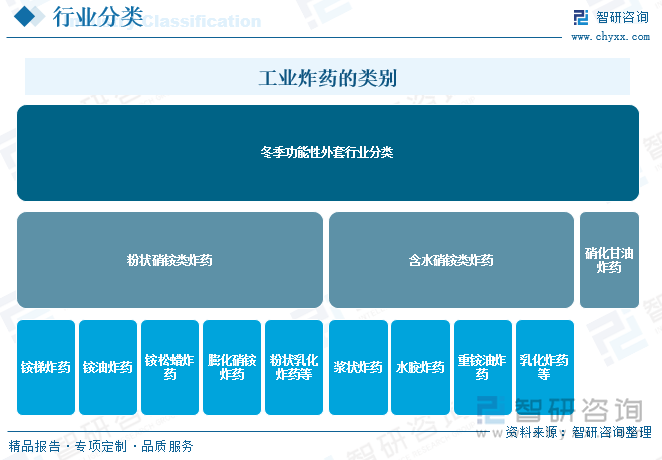
Core Viewpoint - The industrial explosives industry in China is maturing, with significant increases in production capacity and output, driven by growing demand and technological advancements [2][6][10]. Industry Definition and Classification - Industrial explosives, also known as civil explosives, are explosive mixtures primarily composed of oxidizers and fuels, designed based on the principle of oxygen balance [3][4]. - Common types include ammonium nitrate explosives, emulsified explosives, and nitroglycerin explosives, characterized by low cost, simple manufacturing, and reliable application [4]. Current Development Status - The production of industrial explosives in China has increased from 3.54 million tons in 2016 to an expected 4.49 million tons in 2024, with major types including gel emulsified explosives (61.02%), porous ammonium oil explosives (23.15%), and expanded ammonium nitrate explosives (7.17%) [6][8]. - The total sales volume of industrial explosives is projected to reach 4.485 million tons in 2024, with gel emulsified explosives leading at 2.7289 million tons [8]. Industry Trends - The industry is transitioning from extensive growth to a focus on safety, environmental sustainability, and intelligence, with technological innovation and regulatory compliance as key drivers [2][10]. - Future challenges include balancing cost control with technological upgrades and exploring value-added blasting services to address environmental pressures and competition from alternative technologies [2]. Related Companies - Key listed companies in the industrial explosives sector include Yipuli (002096.SZ), Poly United (002037.SZ), Hongda Explosive (002683), and others [3]. - Other relevant companies include Beifang Special Energy, Yunnan Minexplosion, and Longye Chemical [3].







趋势研判!2025年中国工业炸药行业发展现状及全景分析:产量大幅度提升,需求日益增加,行业正向“安全化、绿色化、智能化”转型[图]
Chan Ye Xin Xi Wang· 2025-05-20 01:33
Core Viewpoint - The industrial explosives industry in China is maturing, with significant increases in production capacity and output, driven by expanding applications and demand in various sectors such as mining and infrastructure construction [1][4][19]. Group 1: Industry Definition and Classification - Industrial explosives, also known as civil explosives, are explosive mixtures primarily composed of oxidizers and fuels, designed based on the principle of oxygen balance [2]. - Common types include ammonium nitrate explosives, emulsified explosives, and nitroglycerin explosives, characterized by low cost, simple manufacturing, and reliable application [2]. Group 2: Current Development Status - The production capacity and output of industrial explosives in China have significantly increased, with the domestic output projected to reach 4.4937 million tons in 2024, up from 3.5417 million tons in 2016 [4][6]. - The most widely used types of explosives include gel emulsified explosives, porous ammonium oil explosives, and expanded ammonium nitrate explosives, which together account for 91.35% of total production [4]. Group 3: Industry Chain - The upstream of the industrial explosives industry includes suppliers of raw materials such as ammonium nitrate, TNT, and sodium nitrate, with ammonium nitrate being the primary raw material [8][10]. - The midstream consists of research and production manufacturers, while the downstream customer base includes engineering blasting units involved in mining and construction [8]. Group 4: Competitive Landscape - The industrial explosives market in China is fragmented, with numerous companies including Yipuli, Poly United, Hongda Blasting, and Yahua Group leading the industry [12][14]. - Key players have established competitive advantages through integrated operations, technological capabilities, and extensive distribution networks [14][15][17]. Group 5: Industry Development Trends - The industry is transitioning from extensive growth to a focus on safety, environmental sustainability, and smart technology, driven by innovation and regulatory compliance [19]. - Future growth will be supported by mining demand, infrastructure investment, and emerging application scenarios, while companies must balance cost control with technological upgrades [19].