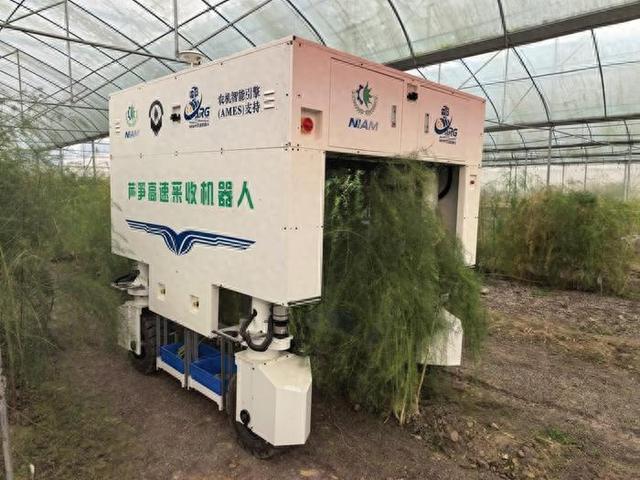
芦笋高速采收机器人

Search documents
采摘侠”升级,直击农业“用工贵、采收难
Xin Hua Ri Bao· 2026-01-13 21:32
Core Insights - The establishment of the "Key Laboratory of Intelligent Harvesting Robots" by the Ministry of Agriculture and Rural Affairs aims to address labor shortages and high labor costs in agriculture [1][5][7] Group 1: Technological Advancements - Intelligent harvesting robots in Jiangsu can perform tasks such as picking asparagus with a precision rate of 95% and can harvest 2,500 asparagus stalks per hour [2] - The robots are equipped with advanced features like 3D depth cameras and AI algorithms, allowing them to operate effectively even in challenging lighting conditions [2][3] - The dual-arm tomato harvesting robot can assess ripeness and predict yield, showcasing the integration of data analytics in agricultural robotics [3] Group 2: Industry Challenges - High costs of harvesting robots, ranging from 150,000 to 800,000 yuan, pose a significant barrier for small to medium-sized farms [5][6] - Maintenance costs for domestic robots are estimated at 10,000 to 20,000 yuan annually, which further discourages adoption among farmers [5] - The lack of industry standards and fragmented systems complicates the integration and usability of different robotic solutions in the market [6] Group 3: Future Directions - The laboratory aims to focus on key technologies such as 3D visual unordered grasping and multi-modal precise perception to overcome existing challenges in agricultural robotics [7] - The goal is to transform agricultural robots from niche technologies into widely adopted tools that can alleviate labor issues and enhance productivity in modern agriculture [7]
机器人收芦笋,能干又可靠
Ren Min Ri Bao Hai Wai Ban· 2026-01-05 08:16
Core Viewpoint - The newly developed asparagus harvesting robot, led by the Agricultural Mechanization Research Institute of the Ministry of Agriculture and Rural Affairs, addresses the high labor costs and inefficiencies in asparagus harvesting, which has historically relied on manual labor [2] Group 1: Industry Context - Asparagus, known as the "king of vegetables," is a high-value crop in China, with a growing industry that has developed from scratch and is now partially leading internationally in technology [2] - Harvesting costs account for over 30% of the total production costs, exacerbated by an aging labor force and expanding planting areas, which hinder the scale of industry development [2] Group 2: Technological Advancements - The agricultural robotics team has achieved breakthroughs in key technologies such as high-precision navigation in complex environments, accurate visual recognition, and efficient multi-arm collaborative control [2] - The robot can identify asparagus with an accuracy rate of ≥95%, has a positioning error of ≤1 millimeter, and can harvest each asparagus stalk in ≤5 seconds, with multi-arm operations capable of harvesting 2,500 fresh asparagus stalks per hour [2] Group 3: Future Directions - The Agricultural Mechanization Research Institute plans to continue focusing on the significant needs of the fruit and vegetable industry, deepening research on key core technologies for agricultural robots [2] - There is an emphasis on accelerating the application of embodied intelligence technology in agricultural production, aiming to inject new momentum into the mechanization and intelligent transformation of traditional agriculture [2]


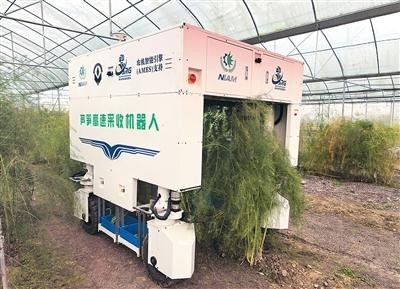
我国首台芦笋高速采收机器人问世,每小时可采2500根
Xin Lang Cai Jing· 2025-12-29 12:01
Core Insights - The asparagus harvesting robot, developed by the Agricultural Mechanization Research Institute of the Ministry of Agriculture and Rural Affairs, was officially unveiled in Sichuan, addressing the high labor costs and inefficiencies in asparagus harvesting [1][3]. Industry Overview - Asparagus is recognized as a high-value crop, often referred to as the "king of vegetables," with significant medicinal and dietary uses. The industry in China has evolved from non-existence to a position where it partially leads in technology on an international scale [3]. - Harvesting costs account for over 30% of the total production costs, and the reliance on manual labor has become a major bottleneck for the industry's scalable development, especially with the aging labor force and expanding planting areas [3]. Technological Advancements - The research team has successfully developed key technologies for high-precision navigation, visual recognition, and multi-arm collaborative control, achieving an asparagus identification accuracy of ≥95%, a positioning error of ≤1 millimeter, and a single-arm harvesting time of ≤5 seconds per stalk [3]. - The robot can harvest up to 2,500 fresh asparagus stalks per hour through multi-arm collaborative operations, adaptable to various planting scenarios, including open fields and facilities [3]. Future Directions - The research team plans to continue focusing on the significant needs of the fruit and vegetable industry, advancing core technologies in agricultural robotics, and accelerating the application of embodied intelligence technology in agricultural production, thereby injecting new momentum into the mechanization and intelligent transformation of traditional agriculture [3].