西部原油管道

Search documents
破纪录的2亿吨背后,西部能源大动脉却暗藏博弈
Sou Hu Cai Jing· 2025-11-26 04:02
Core Insights - The West Oil Pipeline has safely operated for 18 years and has transported over 200 million tons of crude oil, reflecting China's strategic layout in energy security and asset optimization amid dual carbon goals and energy supply constraints [1][5]. Group 1: Strategic Importance of the West Oil Pipeline - The West Oil Pipeline, stretching 1,541 kilometers from Xinjiang to Gansu, is a core support for the "West Oil East Transport" national strategy, forming a significant land-based energy hub [3]. - It connects seamlessly with the China-Kazakhstan oil pipeline and integrates production from major oil fields in Xinjiang, creating a vast energy supply network that enhances energy security without reliance on maritime transport [3]. - The cumulative transport of 200 million tons positions the pipeline as a stabilizing force for the petrochemical industry in Western China, converting resource advantages into economic momentum for the central and eastern markets [3]. Group 2: Technological Advancements and Environmental Considerations - The West Oil Pipeline has seen a doubling of oil transport efficiency since its inception, increasing from 1,000 cubic meters per hour to over 2,000 cubic meters [4]. - It is the first large-diameter pipeline in China to achieve the sequential transport of multiple types of crude oil, showcasing advanced technology that enhances adaptability to different oil markets [4]. - The implementation of energy-saving techniques, such as optimizing the use of elevation differences in storage tanks, has resulted in annual electricity savings of 4 million kilowatt-hours, demonstrating the potential for low-carbon transformation in traditional energy infrastructure [4]. Group 3: Role in Energy Transition - The milestone of 200 million tons transported by the West Oil Pipeline counters the notion that traditional oil and gas infrastructure will soon become obsolete, highlighting the complexity and long-term nature of energy transition [5][6]. - The pipeline supports not only fuel supply but also serves as a foundational resource for high-end manufacturing in Western China, emphasizing the enduring role of oil as a chemical raw material [6]. - The stable operation of the pipeline over 18 years signifies a mature management system and emergency response mechanisms, acting as a stabilizing force during the transition from traditional to new energy systems [6].

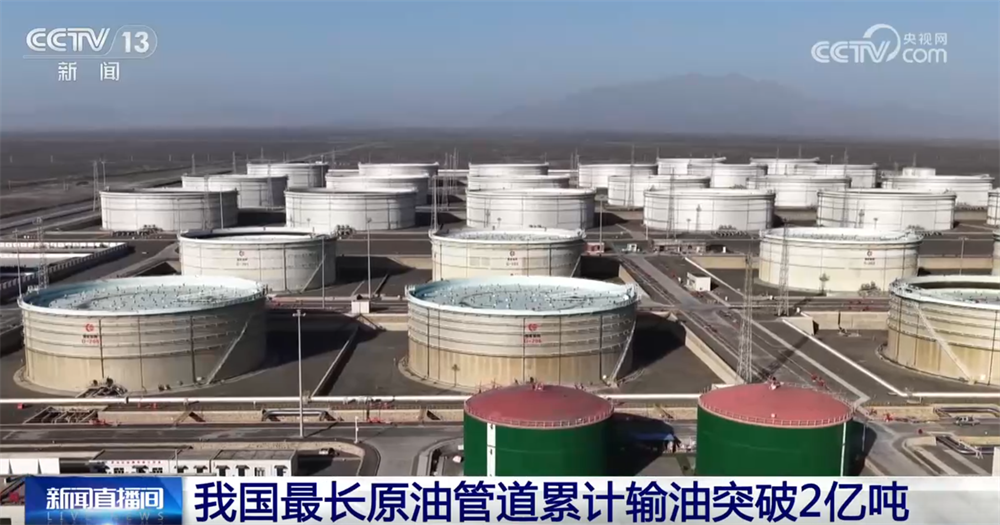
我国最长原油管道累计输油突破2亿吨 织密织牢国家“能源安全网”
Yang Shi Wang· 2025-11-21 09:27
Core Insights - The West Oil Pipeline has surpassed a cumulative oil transportation volume of 200 million tons, reinforcing national energy security [1][5] Group 1: Pipeline Overview - The West Oil Pipeline stretches 1,541 kilometers from Shanshan, Xinjiang, to Lanzhou, Gansu, with a designed annual transportation capacity of 20 million tons [1] - It connects with the China-Kazakhstan oil pipeline and the Northern Xinjiang pipeline network, facilitating the transport of crude oil from the Tuhai, Xinjiang, and Tarim oil fields, as well as resources from Central Asia [1] - The pipeline has transported nearly 13 million tons of crude oil this year alone, with a cumulative transportation volume exceeding 68 million tons during the 14th Five-Year Plan period [1][3] Group 2: Technological Innovations - The National Pipeline Group has intensified technological innovation, enhancing the intelligent operation and maintenance system, and exploring "unmanned" repair operations [3] - The cleaning cycle for storage tanks at the first station of the Shanshan-Lanzhou line has been reduced from 80 days to 45 days, with an average annual fault-free operation time of over 40,000 hours for oil pumps [3] - The pipeline has transitioned from seasonal heating to year-round, closed transportation, becoming the first large-diameter long-distance crude oil pipeline in China to achieve closed sequential transportation of multiple types of crude oil [3] Group 3: Performance Metrics - Over 18 years of operation, the oil transportation volume has increased from an initial rate of 1,000 cubic meters per hour to over 2,000 cubic meters per hour, with annual transportation volume rising from 3.69 million tons to 14.45 million tons, marking a 391% increase [5]