
认种一棵树小程序

Search documents
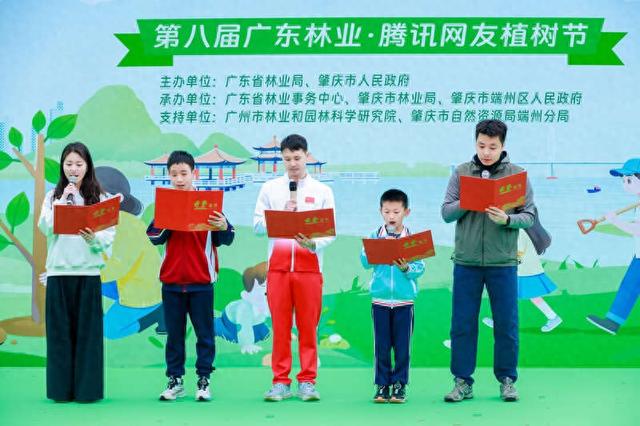
奥运冠军领衔植绿!第八届广东林业·腾讯网友植树节在肇庆开展
Zhong Guo Qing Nian Bao· 2026-02-01 07:51
Group 1 - The event "The 8th Guangdong Forestry · Tencent Netizens Tree Planting Festival" took place in Zhaoqing City, emphasizing the theme "Everyone Plants Trees to Add Green, Building a Beautiful Guangdong Together" [1][3] - Olympic champion Chen Aisen served as the Green Ambassador for the event, encouraging public participation in tree planting and environmental responsibility [3][5] - Over 300 trees, including species like kapok, flame trees, and phoenix trees, were planted by participants, highlighting the community's commitment to environmental stewardship [3][5] Group 2 - Guangdong has expanded avenues for public participation in voluntary tree planting, integrating "Internet + National Voluntary Tree Planting" initiatives, including the launch of the "Recognize a Tree" app and the Green Guangdong public service platform [5] - During the 14th Five-Year Plan period, Guangdong established 179 responsible reception points and conducted over 73,900 activities, engaging more than 5.22 million participants [5]

广东大力传承弘扬“岳山造林”光荣传统:绿美南粤入画来
Ren Min Ri Bao· 2025-11-12 00:43
Core Viewpoint - The "Yueshan Afforestation" tradition in Guangdong has become a significant spiritual asset for ecological civilization construction, emphasizing the importance of tree planting and environmental protection in the region's development [1][2][3]. Group 1: Historical Context and Development - The "Yueshan Afforestation" movement began in the 1970s, where 25,000 people participated in large-scale tree planting, transforming barren mountains into a vast forest area [1][2]. - The movement was a response to severe ecological degradation caused by deforestation in the 1950s and 1960s, which led to soil erosion and impacted local livelihoods [2][3]. - The afforestation efforts spanned 143 days, resulting in the planting of 35,000 acres of trees, significantly improving the ecological conditions of the Yueshan area [3]. Group 2: Current Initiatives and Goals - The Guangdong provincial government has called for the continuation of the "Yueshan Afforestation" tradition, promoting community involvement in tree planting and environmental beautification [2][4]. - The 2022 provincial conference outlined six major actions for ecological construction, including enhancing forest quality and promoting urban-rural greening [4][5]. - The focus is on creating a harmonious relationship between humans and nature, with an emphasis on making ecological benefits a priority in development strategies [5][6]. Group 3: Ecological Restoration and Community Engagement - The "Green Beautiful Guangdong" initiative aims to enhance the ecological environment while also improving the quality of life for residents through community-driven greening projects [5][8]. - Various local projects, such as the "Joyful Forest," have transformed neglected areas into green spaces, fostering community engagement and environmental awareness [8][9]. - The construction of green corridors along transportation routes aims to integrate nature into urban settings, enhancing the aesthetic and ecological value of the region [9][10]. Group 4: Biodiversity and Heritage Conservation - The protection of ancient trees and biodiversity is a key focus, with over 85,000 ancient trees documented and monitored for conservation efforts [12]. - The Guangdong government has implemented measures to restore and protect mangrove ecosystems, which play a crucial role in maintaining ecological balance [12][13]. - The establishment of botanical gardens and conservation areas aims to enhance public access to green spaces and promote environmental education [14][15]. Group 5: Economic and Social Impact - The ecological improvements have led to increased tourism and economic opportunities in regions like the Jiangxia Village, which has transformed into a popular destination [13][14]. - The development of eco-tourism routes, such as the "Most Beautiful Tourist Road," aims to leverage natural resources for sustainable economic growth [14][15]. - The overall goal is to create a model for green development that balances economic growth with environmental sustainability, benefiting both the economy and the community [15][16].