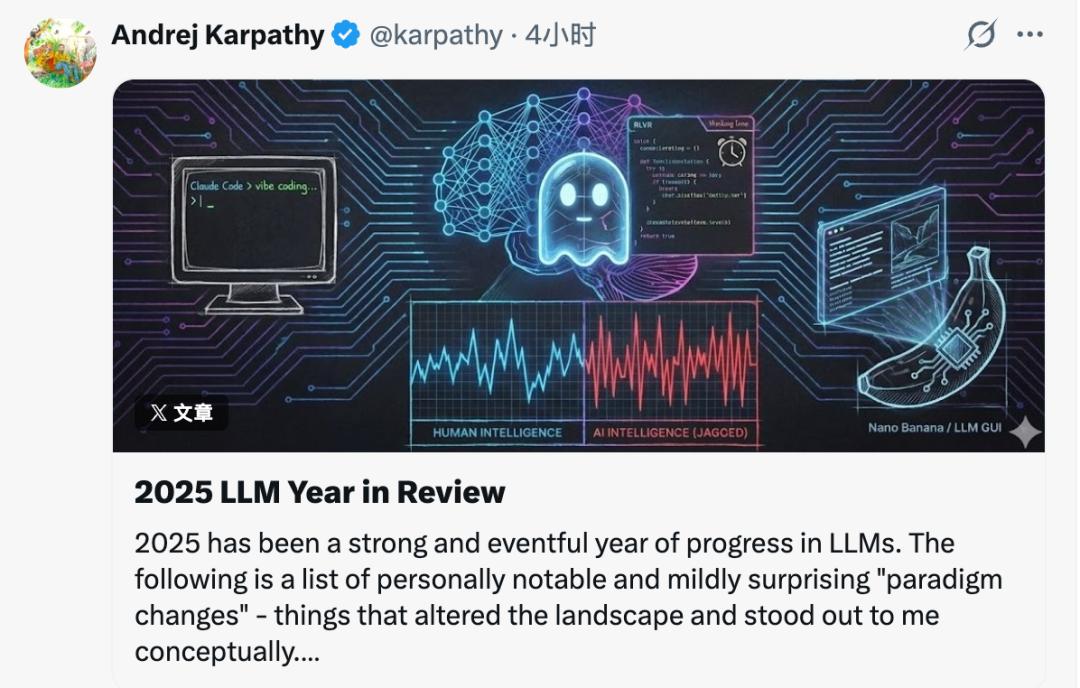
谷歌Gemini Nano Banana

Search documents
大模型的2025:6个关键洞察
3 6 Ke· 2025-12-23 11:39
Core Insights - The report titled "2025 LLM Year in Review" by Andrej Karpathy highlights a significant paradigm shift in the field of large language models (LLMs) from mere "probabilistic imitation" to "logical reasoning" [1][2] - The driving force behind this transition is the maturity of Reinforcement Learning with Verifiable Rewards (RLVR), which encourages models to generate reasoning traces similar to human thought processes [1][2] - Karpathy emphasizes that the potential of this new computational paradigm has yet to be fully explored, with current utilization estimated at less than 10% [2][15] Technological Developments - In 2025, RLVR emerged as the core new phase in the training stack for production-grade LLMs, allowing models to autonomously develop reasoning strategies through training in verifiable environments [4][5] - The year saw a significant extension in the training cycles of models, although the overall parameter scale remained largely unchanged [5] - The introduction of the o1 model at the end of 2024 and the o3 model in early 2025 marked a qualitative leap in LLM capabilities [5] Nature of Intelligence - Karpathy argues that LLMs should be viewed as "summoned ghosts" rather than "evolving animals," indicating a fundamental difference in their intelligence structure compared to biological entities [2][6] - The performance of LLMs exhibits a "zigzag" characteristic, excelling in advanced areas while struggling with basic common knowledge [2][8] New Applications and Trends - The rise of "Vibe Coding" and the practical trend of localized intelligent agents are discussed, indicating a shift towards more user-centric AI applications [2][9] - The emergence of tools like Cursor highlights a new application layer for LLMs, focusing on context engineering and optimizing model interactions for specific verticals [9] User Interaction and Development - The introduction of Claude Code (CC) showcases the capabilities of LLM agents, emphasizing local deployment for enhanced user interaction and access to private data [10][11] - The concept of "atmospheric programming" allows users to create powerful programs using natural language, democratizing programming skills [12][13] Future Outlook - The report suggests that the industry is on the brink of a transition from simulating human intelligence to achieving pure machine intelligence, with future competition focusing on efficient AI reasoning [2][15] - The potential for innovation in the LLM space remains vast, with many ideas yet to be explored [15]

大模型的2025:6个关键洞察
腾讯研究院· 2025-12-23 08:33
Core Insights - The article discusses a significant paradigm shift in the field of large language models (LLMs) in 2025, moving from "probabilistic imitation" to "logical reasoning" driven by the maturity of verifiable reward reinforcement learning (RLVR) [2][3] - The author emphasizes that the potential of LLMs has only been explored to less than 10%, indicating vast future development opportunities [3][25] Group 1: Technological Advancements - In 2025, RLVR emerged as the core new phase in training LLMs, allowing models to autonomously generate reasoning traces by training in environments with verifiable rewards [7][8] - The increase in model capabilities in 2025 was primarily due to the exploration and release of the "stock potential" of RLVR, rather than significant changes in model parameter sizes [8][9] - The introduction of the o1 model at the end of 2024 and the o3 model in early 2025 marked a qualitative leap in LLM capabilities [9] Group 2: Nature of Intelligence - The author argues that LLMs should be viewed as "summoned ghosts" rather than "evolving animals," highlighting a fundamental difference in their intelligence compared to biological entities [10][11] - The performance of LLMs exhibits a "sawtooth" characteristic, excelling in advanced fields while struggling with basic common knowledge [12][13] Group 3: New Applications and Interfaces - The emergence of Cursor represents a new application layer for LLMs, focusing on context engineering and optimizing prompt design for specific verticals [15] - The introduction of Claude Code (CC) demonstrated the core capabilities of LLM agents, operating locally on user devices and accessing private data [17][18] - The concept of "atmospheric programming" allows users to create powerful programs using natural language, democratizing programming skills [20][21] Group 4: Future Directions - The article suggests that the future of LLMs will involve a shift towards visual and interactive interfaces, moving beyond text-based interactions [24] - The potential for innovation in the LLM space remains vast, with many ideas yet to be explored, indicating a continuous evolution in the industry [25]

大模型的2025:6个关键洞察,来自OpenAI创始人、AI大神“AK”
3 6 Ke· 2025-12-22 04:22
Core Insights - The report by Andrej Karpathy highlights a significant paradigm shift in the field of large language models (LLMs) from "probabilistic imitation" to "logical reasoning" in 2025, driven by the maturation of Reinforcement Learning with Verifiable Rewards (RLVR) [1][2] - The industry is at a critical juncture, transitioning from "simulating human intelligence" to "pure machine intelligence," with a focus on how to make AI think efficiently rather than just competing on computational power [2][4] Group 1: Technological Advancements - RLVR has emerged as the core new phase in LLM training, allowing models to autonomously generate reasoning traces by training in environments with verifiable rewards [4][5] - The year 2025 saw a significant extension in the training cycles of LLMs, with the ability to optimize for longer reasoning traces and increased "thinking time," leading to qualitative leaps in model capabilities [5][6] Group 2: Nature of Intelligence - Karpathy argues that LLMs should be viewed as "summoned ghosts" rather than "evolving animals," indicating a fundamental difference in the nature of AI intelligence compared to biological intelligence [6][7] - The performance of LLMs exhibits a "zigzag" characteristic, excelling in specialized areas while struggling with basic common knowledge, reflecting their unique intelligence structure [8] Group 3: New Applications and Interfaces - The emergence of applications like Cursor signifies a new layer in LLM usage, focusing on context engineering and optimizing the orchestration of multiple LLM calls for specific vertical domains [9][10] - The introduction of Claude Code (CC) demonstrates the potential of LLM agents to operate locally on user devices, accessing private data and providing a new paradigm of AI interaction [10][11] Group 4: Programming and Development - The concept of "vibe coding" has gained traction, allowing individuals to create powerful programs using natural language, thus democratizing programming skills beyond trained professionals [11][12] - The shift towards atmosphere programming is expected to transform the software development ecosystem, making coding more accessible and flexible for everyday users [12][13] Group 5: Future Prospects - Despite the rapid advancements, the industry has only tapped into less than 10% of the potential of LLMs, indicating vast opportunities for future exploration and innovation [14][15] - The report emphasizes the need for foundational work to continue alongside the rapid development of LLM technologies, suggesting a sustained period of transformation ahead [14][15]
Karpathy 2025年AI终极觉醒:我们还没发挥出LLM潜力的10%
3 6 Ke· 2025-12-22 00:29
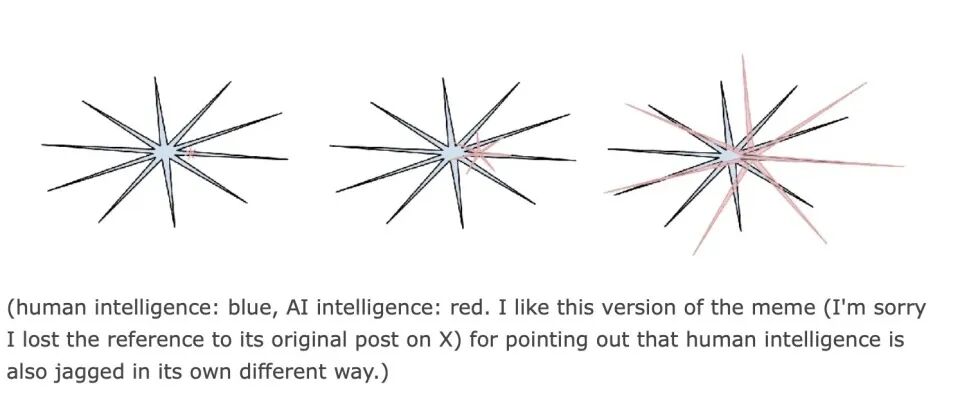
Core Insights - 2025 is anticipated to be a pivotal year in the history of artificial intelligence, marking a transition from "impressive" in 2023 to "confusion" in 2024, and finally to "awakening" in 2025 [1][3] Group 1: RLVR Revolution - The traditional training process for large language models (LLMs) involves three stages: pre-training, supervised fine-tuning, and human feedback reinforcement learning (RLHF) [4][6] - RLHF has been criticized for training models to "appear to reason" rather than genuinely reasoning, leading to issues like "sycophancy" where models produce plausible but incorrect outputs [6][7] - The emergence of RLVR (Reinforcement Learning from Verifiable Rewards) represents a new phase where models are trained based on objective results rather than human feedback, allowing for a more robust learning process [7][12] - RLVR enables models to explore multiple reasoning paths and self-verify their outputs, leading to the development of reasoning capabilities without explicit instruction [18][19] - The shift in focus from training to inference time allows models to enhance their intelligence by spending more time on complex problems, akin to a student taking longer to solve difficult questions [21][23] Group 2: Philosophical Divide - A philosophical debate is presented regarding whether AI is creating new "animals" or "ghosts," with the latter referring to LLMs that lack continuous consciousness and are instead statistical constructs of human language [24][32] - Rich Sutton's "Bitter Lesson" suggests that methods leveraging unlimited computational power will ultimately outperform those relying on human knowledge, emphasizing the supremacy of computational approaches [27][28] - The current AI models are seen as "ghosts" that lack a continuous self and are instead reflections of human language, leading to a "uncanny valley" effect in interactions [33][35] Group 3: Vibe Coding - Vibe Coding represents a shift in programming paradigms where developers focus on intent rather than code details, allowing AI to generate code based on natural language descriptions [40][44] - The emergence of tools like MenuGen demonstrates the potential of Vibe Coding, where even experienced programmers can create applications without writing traditional code [44][45] - The competition between AI programming tools, such as Cursor and ClaudeCode, highlights the evolving landscape of AI-assisted development, with each offering different levels of integration and autonomy [45][46] Group 4: Paradigm Shift - The introduction of Google's Gemini Nano Banana signifies a major paradigm shift in computing, suggesting that LLMs will redefine user interface experiences beyond traditional text-based interactions [47][49] - The preference for visual and spatial information over text indicates a need for LLMs to evolve in how they communicate with users, moving towards more engaging formats [49][50] - The "jagged" intelligence of AI, where it excels in certain areas while failing in others, reflects the uneven distribution of training data and highlights the complexities of AI capabilities [51][52] Group 5: Future Outlook - The year 2025 is positioned as an exciting yet unpredictable time for LLMs, with the potential for significant advancements and untapped capabilities still remaining [53][55] - The belief in rapid development alongside the need for further work suggests a dynamic and evolving landscape in AI research and application [57][58]