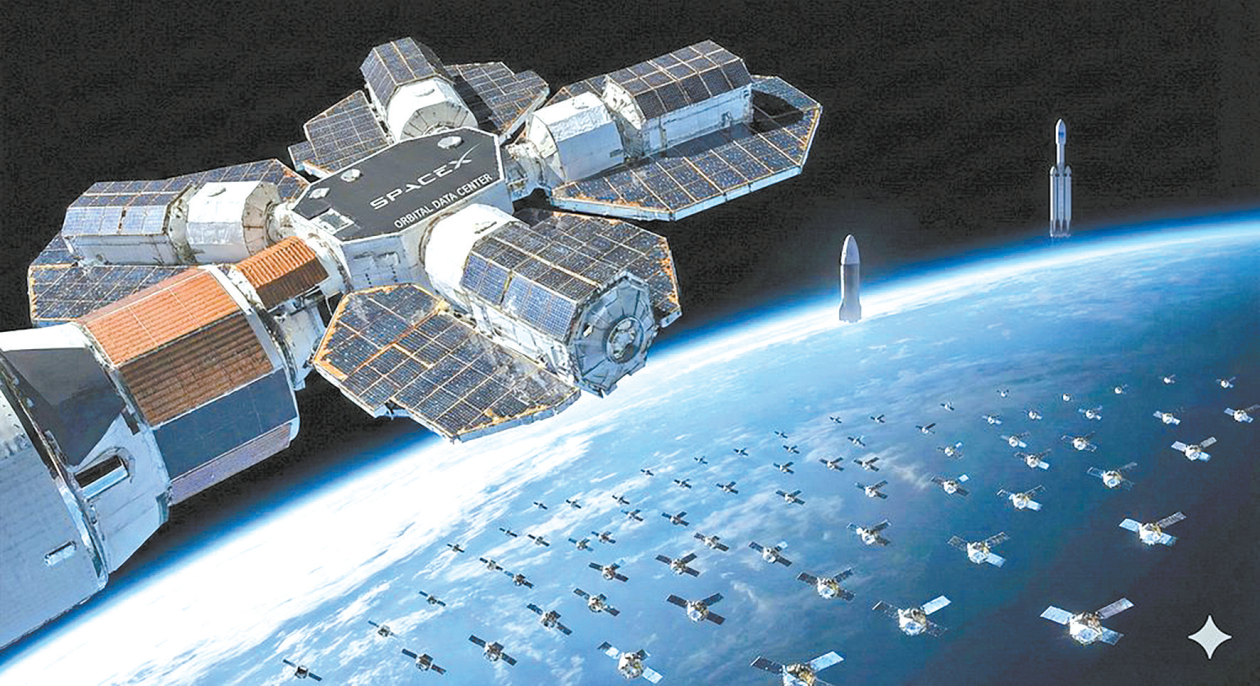
轨道数据中心卫星星座

Search documents
近地轨道拥挤程度将是现在的100倍,SpaceX“百万AI卫星”计划引争议
Huan Qiu Shi Bao· 2026-02-02 23:01
Core Viewpoint - SpaceX plans to launch a constellation of up to 1 million satellites to create an "orbital data center" aimed at addressing the immense energy demands of AI computing, which is seen as a potential solution to the limitations of terrestrial data centers [1][3][4]. Group 1: Project Overview - SpaceX has submitted a proposal to the FCC to deploy up to 1 million satellites in low Earth orbit to support AI applications, claiming this will be the most economical and energy-efficient way to meet the growing demand for AI computing power [3][4]. - The satellites will operate at altitudes between 500 to 2000 kilometers, with a 30-degree orbital inclination, utilizing near-constant solar energy to reduce operational costs and environmental impact [3][4]. - The concept of "orbital data centers" is positioned as a transformative step towards a Type II Kardashev civilization, capable of harnessing the full energy of the sun [3]. Group 2: Technical Aspects - The system will rely on inter-satellite laser links for communication and will use Ka-band frequencies for telemetry, tracking, and control [4]. - SpaceX emphasizes that the orbital data centers will be more environmentally friendly than traditional data centers, which often require significant energy for cooling [8]. - The cooling challenges in a vacuum environment are highlighted, as traditional cooling methods may not be effective in space [8][10]. Group 3: Risks and Concerns - The proposed satellite constellation raises significant concerns regarding collision risks, as the number of satellites in low Earth orbit could increase by 100 times, heightening the likelihood of accidents [5][6]. - Experts warn that uncontrolled satellites could lead to collisions, generating debris that could further complicate space operations and potentially render low Earth orbit unusable [5][6]. - The feasibility of the project is questioned, particularly regarding the effective dissipation of heat in a vacuum and the stability of chips in a high-radiation environment [8][10]. Group 4: Regulatory and Financial Considerations - SpaceX's proposal lacks detailed technical specifications and does not address the deployment timeline or cost estimates for the orbital data center satellites [10]. - The company has applied for exemptions from certain regulatory requirements, raising concerns about its ability to meet deployment deadlines set by the ITU [10]. - The announcement of the orbital data center plan may be strategically timed with SpaceX's potential initial public offering (IPO) [11].