轨道数据中心

Search documents
突发!星链踩刹车
是说芯语· 2026-03-29 06:26
Core Viewpoint - SpaceX's Starlink has significantly reduced its planned satellite deployment from 30,000 to a final target of 15,000-20,000 satellites, indicating a shift in strategy amidst growth concerns despite surpassing 10 million global users [1][3]. Group 1: Market Saturation - Starlink has reached a phase of market saturation in areas with previously unserved regions and weak ground networks, particularly in developed markets like the US and Europe, where competition with terrestrial ISPs is intensifying [3]. - The demand elasticity for Starlink's services has decreased, leading the company to rely on discount promotions to attract new users [3]. Group 2: Technological Evolution - The focus of Starlink is shifting from scale-driven growth to efficiency-driven improvements, with advancements in satellite technology significantly enhancing the capabilities of individual satellites [4]. - The next-generation V3 satellites, with a planned deployment of 20,000 units, are projected to meet the broadband needs of 200 million users, with a tenfold increase in service capacity per satellite compared to the initial generation [4]. Group 3: Structural Optimization and Resource Reallocation - Starlink is transitioning from rapid expansion to a phase of structural optimization, prioritizing service quality improvements and initiatives like gigabit broadband and direct satellite connections for mobile phones [5]. - The decision to cap satellite deployment is not indicative of a retreat from SpaceX's space strategy; rather, it reflects a reallocation of resources towards high-value services such as satellite-to-mobile connections and data centers in orbit [5].


星舰驶向华尔街,史上最大IPO启动
Sou Hu Cai Jing· 2026-02-24 07:17
Core Insights - SpaceX is preparing for an unprecedented IPO in 2026, with a valuation exceeding $1 trillion, marking the largest public offering in history and testing valuation models to their limits [1][3]. Group 1: Valuation and Financial Structure - Following the acquisition of xAI in February 2026, the combined entity's valuation reached $1.25 trillion, with SpaceX's core business valued at approximately $1 trillion and xAI contributing $250 billion [3]. - The IPO aims for a target valuation of $1.5 trillion, which translates to a price-to-sales ratio exceeding 60, significantly higher than competitors like Rocket Lab and Planet Labs [3]. - The $50 billion raised from the IPO will fund three capital-intensive projects: the development of the Starship rocket, the deployment of an "orbital data center," and ongoing support for NASA's lunar system [3]. Group 2: Market Reactions and Investor Sentiment - Since the announcement of the IPO plan in December 2025, SpaceX's private market valuation surged from approximately $80 billion, reflecting investor optimism about the potential $1.5 trillion listing [5]. - The underwriting team, including major banks like JPMorgan, Goldman Sachs, Bank of America, and Morgan Stanley, must substantiate the $1.5 trillion valuation with financial data in the prospectus [5]. - SpaceX plans to allocate a significant portion of shares to retail investors, challenging the traditional allocation favoring institutional buyers, which could increase demand but also pricing uncertainty [5]. Group 3: Strategic Vision and Risks - Elon Musk's strategy involves using solar-powered orbital data centers to overcome terrestrial limitations on AI growth, with plans to launch a system of up to 1 million satellites [8]. - Critics highlight challenges such as high costs of launching payloads, the need for maintenance and cooling of data centers, and the reliance on terrestrial data for AI training [8]. - The integration of rockets, satellites, AI models, and distribution channels presents both synergies and unprecedented concentration risks, as failures in one area could disrupt services across the board [10]. Group 4: Timing and Market Conditions - The IPO is speculated to occur in June 2026, coinciding with Musk's birthday and a significant astrological event, reflecting Musk's personal influence on the timing [10]. - Some bankers and investors express concerns that the June timeline may be too ambitious, given the need for regulatory filings and market conditions, which are increasingly unpredictable [10]. Group 5: Overall Market Implications - The success of SpaceX's IPO hinges on how much the market is willing to pay for exposure to space, AI, and global connectivity narratives [12]. - SpaceX holds a dominant position in the commercial launch market with approximately 90% market share, and its Starlink service has become highly profitable [12]. - The IPO represents a critical test of valuation discipline for Wall Street, requiring a balance between grand narratives and tangible cash flow [12].
建太空数据中心,马斯克被泼冷水
Huan Qiu Shi Bao· 2026-02-23 22:43
Group 1 - OpenAI CEO Sam Altman considers the idea of building data centers in Earth's orbit as "absurd" for the time being, citing high launch and chip maintenance costs as significant barriers [1] - In contrast, SpaceX CEO Elon Musk aims to launch a network of 1 million satellites for orbital data centers, claiming that space will become the cheapest place to deploy artificial intelligence within three years [1] - Other tech companies, including Google and Amazon, are also exploring orbital data centers, with Google announcing the "Sun Catcher Project" to build solar-powered data centers in space [2] Group 2 - The construction cost for a 1 GW orbital data center is estimated at $42.4 billion, nearly three times that of ground-based data centers, indicating significant financial challenges ahead [2] - Amazon AWS CEO Adam Selipsky stated that there are currently not enough rockets to launch 1 million satellites, highlighting the distance from achieving orbital data centers [2] - The development of a robust supply chain for space-grade components and substantial investment in multidisciplinary collaboration are essential for reducing the costs of orbital data center construction [2]
奥特曼批评马斯克太空数据中心愿景:当下不切实际,很荒谬
Sou Hu Cai Jing· 2026-02-23 00:11
Core Viewpoint - OpenAI CEO Sam Altman believes that the concept of orbital data centers is impractical in the current context, citing economic and technical challenges associated with launching data centers into space [2][3]. Group 1: OpenAI's Perspective - Altman stated that the idea of sending data centers into space is absurd given the current circumstances, particularly due to the high launch costs and difficulties in addressing issues related to components like GPUs [3]. - He acknowledged the future potential of orbital data centers but emphasized that the technology is not yet at that stage [3]. Group 2: Elon Musk and SpaceX's Vision - Elon Musk has been advocating for the establishment of data centers in space, claiming that the lowest cost for deploying artificial intelligence will be in space, with a target timeline of two to three years [3]. - Musk's vision includes integrating xAI with SpaceX to accelerate the orbital data center project, which aims to create a network of one million satellites functioning as orbital data centers [3]. Group 3: Google's Initiatives - Google is also exploring the concept of space data centers, with CEO Sundar Pichai describing the initiative as a "moonshot" project aimed at developing a solar-powered system that exceeds Earth's current energy production capabilities [4]. - Pichai mentioned that Google plans to take the first step towards this goal by deploying small equipment racks on satellites by 2027, expressing confidence that this approach will become a conventional method for building data centers in about ten years [4][5]. - The internal project at Google, named "Project Suncatcher," aims to utilize solar energy from space to address the growing energy demands of artificial intelligence while reducing the environmental impact of traditional data centers [5].


商业航天,正在改写太空探索格局
Xin Lang Cai Jing· 2026-02-23 00:08
Core Viewpoint - The commercial space industry is rapidly evolving, with significant advancements from companies like SpaceX and Blue Origin, as well as increasing competition from other nations, particularly China and Europe, aiming to secure a leading position in the space economy [1][3][4]. Group 1: Developments in Commercial Space - SpaceX has submitted an application to the FCC to launch up to 1 million satellites to create an "orbital data center" [1] - Blue Origin successfully recovered its "New Glenn" heavy-lift rocket, becoming the second private company after SpaceX to master vertical recovery technology for orbital rockets [1] - The global commercial space sector is characterized by a competitive landscape where the U.S. maintains a strong lead due to early industry advantages and systematic policy support [3] Group 2: U.S. Leadership in Commercial Space - Since the introduction of the Commercial Space Launch Act in 1984, the U.S. has encouraged private sector participation in space through top-level design and policy guidance [3][9] - SpaceX's Starlink system has launched over 9,000 satellites, providing communication services to more than 5 million users across over 100 countries [3] - The U.S. government has implemented policies to streamline the approval process for commercial space projects, significantly reducing the time required for project approvals [9][12] Group 3: Global Competition and Emerging Players - China's commercial space sector is experiencing a "golden development period," supported by national strategies and achieving significant breakthroughs in rocket and satellite manufacturing [4] - By 2025, China aims to complete 50 launches, accounting for 54% of global space launches, with 25 of those being commercial rocket launches [4] - European companies are collaborating to create a unified aerospace entity to compete with U.S. market dominance, focusing on satellite internet and commercial launch vehicles [6][8] Group 4: Factors Supporting U.S. Commercial Space Growth - The U.S. commercial space industry benefits from a unique public-private partnership model that injects continuous funding into the sector [11][12] - The government supports key technology development through various financial instruments, ensuring funding for long-term, high-risk projects [12] - American companies adopt a rapid iteration and optimization approach in technology development, exemplified by SpaceX's development cycle for the Falcon 9 rocket [13][15]
SPACEX申请至多100万轨位,轨道数据中心时代有望开启
Tebon Securities· 2026-02-12 09:23
Investment Rating - The report maintains an "Outperform" rating for the telecommunications industry [1] Core Insights - The satellite internet sector is transitioning from a communication hub to a computing intermediary, with a significant increase in the number of satellites reported globally by the end of 2025 [3] - SpaceX's application to deploy up to 1 million satellites aims to create a dual barrier of "physical space + spectrum resources," forcing global space powers to reassess the strategic value of orbital assets [3] - The shift to orbital computing could alleviate the energy crisis faced by ground-based AI data centers, utilizing near-infinite solar energy and natural cooling in a vacuum environment [3] - The aggressive satellite deployment plan by SpaceX is expected to catalyze the domestic industry, enhancing China's position in the satellite internet market and accelerating the transition from policy-driven to market-driven growth [3] Summary by Sections Market Performance - The telecommunications sector has shown a performance range from -34% to +103% compared to the CSI 300 index over the specified periods [2] Related Research - The report references several studies that highlight the competitive landscape and technological advancements in the satellite internet and AI sectors, indicating a growing interest and investment potential in these areas [3] Suggested Companies to Watch - The report recommends monitoring several companies, including Xinke Mobile, Aerospace Huanyu, Aerospace Electronics, and others, which are positioned to benefit from the developments in the satellite internet industry [3]
美国FCC接受SpaceX申请,马斯克将以百万颗卫星打造太空数据中心
Sou Hu Cai Jing· 2026-02-05 06:14
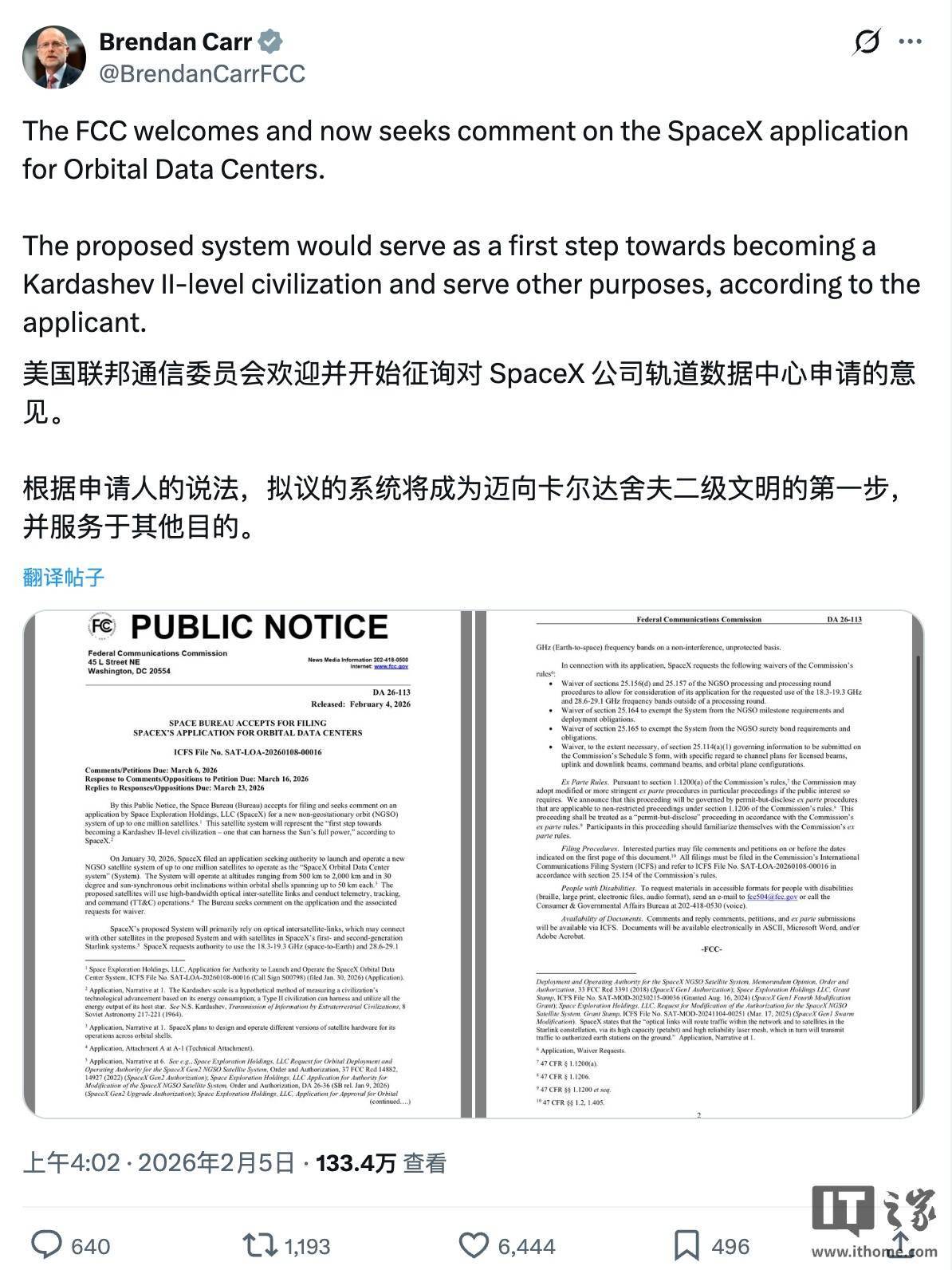
Group 1 - The FCC has accepted SpaceX's application for constructing a non-geostationary satellite system and is seeking public comments on it [1][3] - FCC Chairman Brendan Carr stated that the proposed system is a first step towards becoming a Kardashev II-level civilization and will serve other purposes [1][3] - SpaceX aims to launch up to 1 million satellites to create an "orbital data center" network, providing unprecedented computational power for advanced AI models and related applications [7]
为更有效建造“轨道数据中心”SpaceX收购xAI
Sou Hu Cai Jing· 2026-02-03 23:14
Core Insights - Elon Musk's SpaceX has acquired xAI, an AI startup, to enhance the construction of a solar-powered orbital data center, marking a significant move in Musk's business strategy [1][7] - Both SpaceX and xAI are currently facing urgent cash flow needs, with Musk stating that generating AI computing power in space will be the most cost-effective method in the next 2 to 3 years [1][8] - SpaceX is planning to apply for an IPO in June, aiming to raise up to $50 billion, which could provide a clear path for Musk to secure substantial funding [2][8] Company Acquisition - SpaceX's acquisition of xAI is seen as a strategic move to stabilize xAI's financial situation while leveraging investor interest in AI assets [2][8] - xAI has reportedly burned through approximately $9.5 billion in the first nine months of 2025, indicating significant financial challenges [2][8] Satellite Deployment Application - SpaceX has submitted an application to the FCC to launch up to 1 million satellites to create an orbital data center network, which is described as having unprecedented computational capabilities for advanced AI models [3][10] - The application is part of a strategy to secure frequency resources in the U.S. market, potentially initiating a competitive "land grab" in the aerospace sector [11] Financial Strategy and Market Position - SpaceX is projected to face a cash flow gap of $30 billion to $50 billion in the coming years, prompting preparations for an IPO to boost its valuation to $1.5 trillion, despite current revenues being around $10 billion [4][11] - The ambitious satellite deployment plan is viewed as a means to combine the popular concepts of AI and space to inflate the company's valuation [5][11] International Implications - If SpaceX's application is approved, it will need to seek international authorization from the ITU, which could complicate global frequency and orbital resource allocation [12][13] - The increasing number of satellite applications from various countries could strain the ITU's coordination mechanisms, potentially leading to a chaotic resource allocation environment [13] Competitive Landscape - The approval of SpaceX's application could pressure competitors in the U.S. market, although it is noted that this development may not directly impact China's aerospace sector [14]
100万颗卫星+AI,马斯克要在太空做什么
Sou Hu Cai Jing· 2026-02-03 17:18
Core Viewpoint - SpaceX, led by Elon Musk, has submitted an application to the Federal Communications Commission to deploy a system of up to 1 million satellites in low Earth orbit to create an orbital data center network to support high-performance computing needs such as artificial intelligence (AI) [1][3] Group 1: Satellite Deployment and Technology - The proposed satellites will operate at altitudes between 500 to 2000 kilometers, powered by solar energy, and will communicate with each other via lasers and connect to SpaceX's Starlink satellite internet for high-speed data transmission [1][3] - The feasibility of deploying 1 million satellites is questioned, as currently, there are about 15,000 satellites in orbit globally, making such a large-scale deployment seem unlikely [4] - The success of this satellite deployment largely depends on the new generation of reusable heavy-lift rocket, Starship, which is currently under development [6] Group 2: Challenges and Concerns - Experts highlight multiple challenges related to satellite operation and maintenance, orbital congestion, space debris risks, and regulatory scrutiny that could hinder the deployment of such a large number of satellites [6] - Significant issues remain unresolved, including the need for large solar panels for energy supply, heat dissipation for massive chip production, and the impact of cosmic radiation on chips and computing [6] Group 3: Strategic Moves and Financial Aspects - SpaceX has acquired xAI, an AI startup also owned by Musk, to integrate innovative resources across AI, rockets, and space internet sectors, which is aimed at building the orbital data center more effectively [8] - SpaceX's main business includes the manufacturing and launching of rockets and satellites, while xAI operates the chatbot Grok and is expected to complete its integration with the social platform X by 2025 [8] - Musk plans to push for SpaceX's initial public offering in mid-June, with an expected fundraising of $50 billion, which could provide a significant funding pathway for the company's ambitious projects [8]
100万颗卫星+AI 马斯克要在太空做什么
Yang Shi Xin Wen· 2026-02-03 16:38
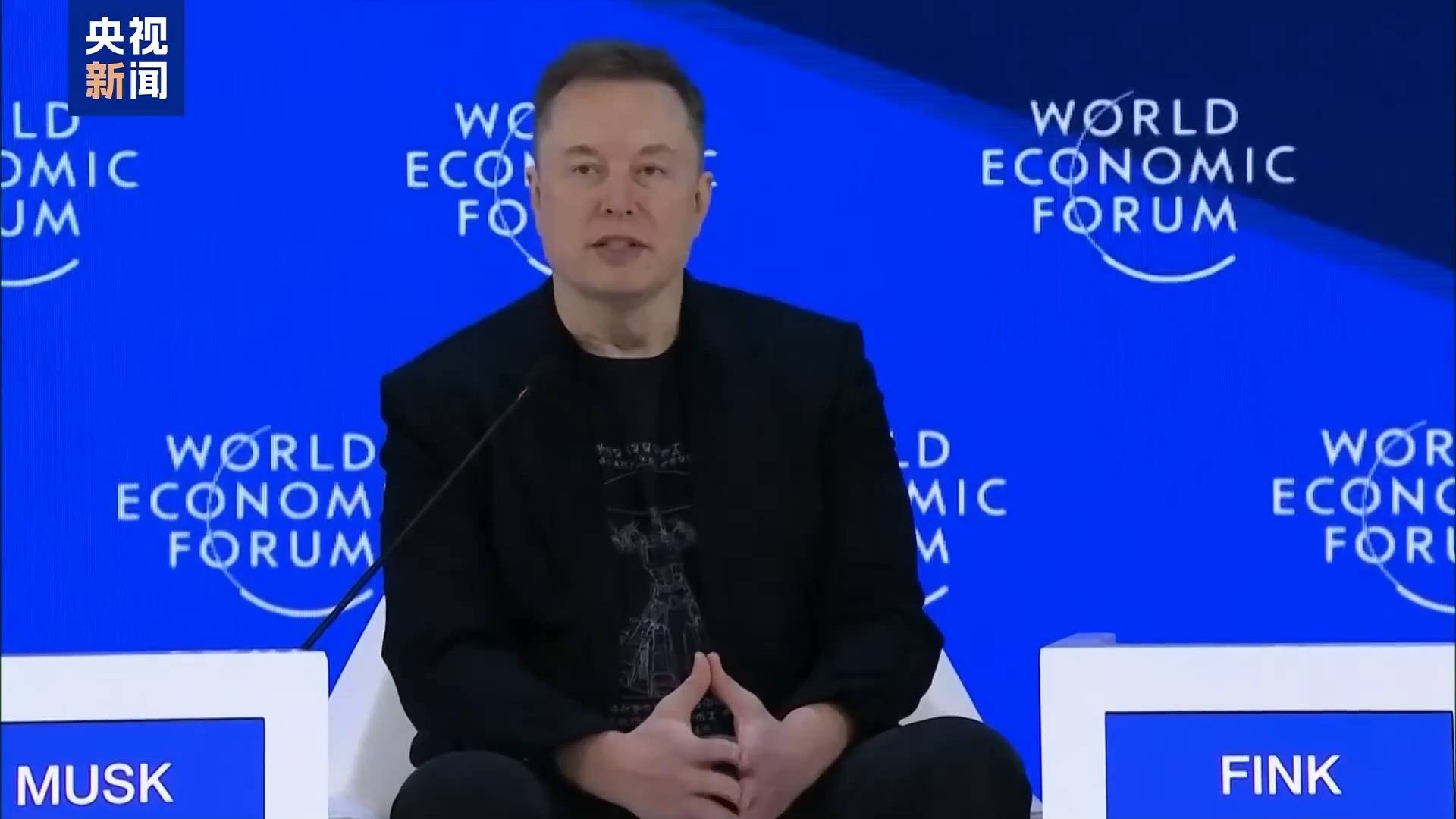
Core Viewpoint - SpaceX, led by Elon Musk, has submitted an application to the FCC to deploy a system of up to 1 million satellites in low Earth orbit to create an orbital data center network to support high-performance computing needs such as artificial intelligence [1][3] Group 1: Satellite Deployment and Technology - The proposed satellites will operate at altitudes between 500 to 2000 kilometers, powered by solar energy, and will communicate with each other via lasers and connect to SpaceX's Starlink satellite internet for high-speed data transmission [1][3] - The feasibility of deploying 1 million satellites is questioned, as there are currently about 15,000 satellites in orbit globally, making such a large-scale deployment seem unlikely [4] - The success of this satellite deployment largely depends on SpaceX's development of the next-generation reusable heavy-lift rocket, Starship, which aims to begin operational use this year [6] Group 2: Challenges and Concerns - Experts highlight multiple challenges related to satellite operation and maintenance, orbital congestion, space debris risks, and regulatory scrutiny that could hinder the deployment of such a large number of satellites [6] - Significant issues remain unresolved, including the need for large solar panels for energy supply, heat dissipation for massive chip production, and the impact of cosmic radiation on chips and computing [6] Group 3: Strategic Moves and Financial Aspects - SpaceX has acquired xAI, an AI startup also owned by Musk, to integrate innovative resources across AI, rockets, and space internet, with the aim of building the orbital data center more effectively [9] - SpaceX plans to launch its initial public offering (IPO) in mid-June, with expected fundraising of up to $50 billion, which could provide a substantial financial pathway for Musk [9]