
载人航天器

Search documents
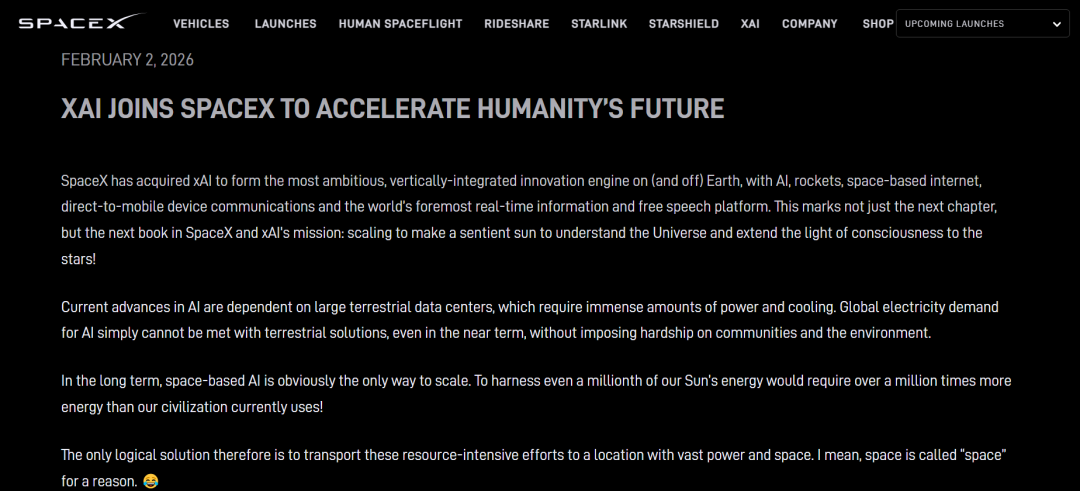
SpaceX收购xAI 马斯克整合商业帝国
Guo Ji Jin Rong Bao· 2026-02-03 08:24
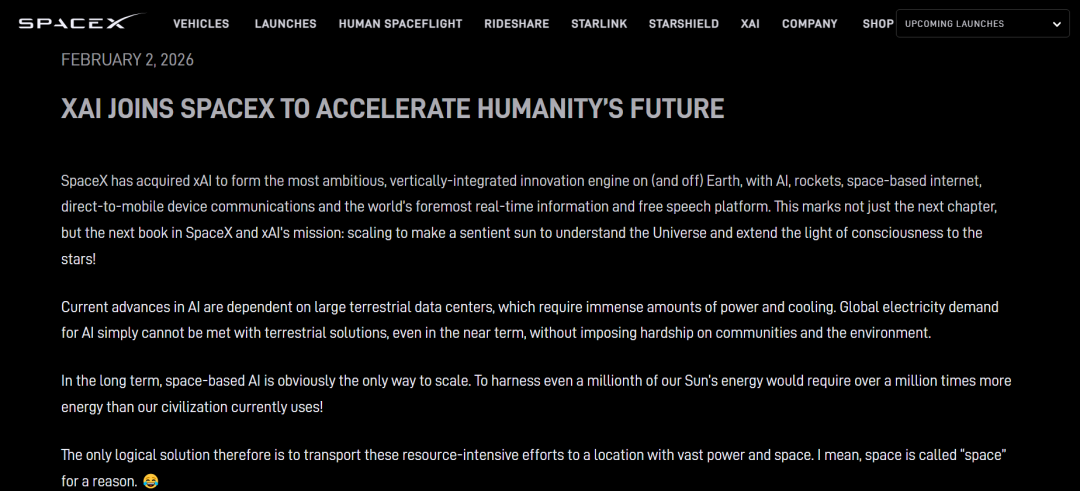
Core Viewpoint - Elon Musk announced the acquisition of AI startup xAI by SpaceX, marking a significant step in the vertical integration strategy within the "space + AI" sector [1][2]. Group 1: Acquisition Details - SpaceX confirmed the acquisition of xAI, aiming to create an ambitious innovation engine for both Earth and space [1][2]. - The overall valuation of the combined entity is approximately $1.25 trillion, with xAI valued at around $250 billion [2]. - The merger may be completed through a stock exchange, converting xAI shares into SpaceX stock at a ratio of 0.1433 shares [2]. Group 2: Company Background - SpaceX operates a fleet of reusable rockets and has developed a crewed spacecraft capable of sending astronauts into orbit, alongside the Starlink project providing broadband internet [2]. - xAI focuses on training large language models and has launched the chatbot Grok, integrated into the social media platform X (formerly Twitter) [2]. Group 3: Strategic Vision - Musk envisions integrating rockets, satellites, and AI into a single company, describing it as a long-term goal to create a "perceptive sun" to understand the universe [2]. - The demand for AI computing power is rapidly increasing, and Musk suggests deploying some computing resources in space to mitigate environmental impacts [2]. - The concept of "space data centers" has garnered interest from other tech leaders, although it remains in the conceptual phase and faces significant technical and cost challenges [2].

SpaceX收购xAI,马斯克整合商业帝国
Guo Ji Jin Rong Bao· 2026-02-03 08:19
Core Viewpoint - Elon Musk announced the acquisition of AI startup xAI by SpaceX, marking a significant step in the vertical integration strategy within the "space + AI" sector [1] Group 1: Acquisition Details - SpaceX confirmed the acquisition and stated the aim is to create the most ambitious innovation engine on Earth and beyond [1] - The overall valuation of the merged companies is approximately $1.25 trillion, with xAI valued at around $250 billion [3] - The merger may be completed through a stock exchange, converting xAI shares into SpaceX stock at a ratio of 0.1433 shares [3] Group 2: Company Background - SpaceX operates a reusable rocket fleet and has developed crewed spacecraft, alongside the Starlink project providing broadband internet services globally [2] - xAI focuses on training large language models and has launched the chatbot Grok, integrated into the social media platform X (formerly Twitter) [2] - SpaceX became one of the first customers of xAI in 2024, utilizing its technology for customer support in Starlink services [2] Group 3: Financial Insights - Musk controls approximately 42% of SpaceX shares and holds about 80% of the voting rights [4] - As of February 2, SpaceX's stock was valued at nearly $527 per share, up from approximately $421 per share in a secondary offering last December [4] - xAI recently completed a $20 billion funding round and is seeking to raise additional funds with a target valuation of around $230 billion [4] Group 4: Strategic Vision - Musk's vision includes integrating rockets, satellites, and AI into a single company, aiming to create a "perceptive sun" to understand the universe [5] - He emphasizes the increasing power demand for AI and suggests deploying some computing resources in space to mitigate environmental impacts [5] - The concept of "space data centers" has garnered interest from other tech leaders, although it remains in the conceptual phase and faces significant technical and cost challenges [5] Group 5: Future Plans - Prior to the acquisition announcement, SpaceX filed plans to deploy an orbital AI data center network consisting of up to 1 million satellites, pending regulatory approval [6]
我国载人航天领域首个国际标准正式注册立项
Yang Shi Wang· 2025-10-14 01:24
Core Points - The international standard project ISO/NP14620-5 for manned spacecraft safety requirements has been officially registered by the International Organization for Standardization (ISO), marking China's first successful establishment of an international standard in the manned spaceflight sector [1] - This standard aims to enhance China's international influence and voice in manned spaceflight safety, providing a "Chinese solution" for promoting safety in manned space missions [1] - The standard is based on over 30 years of safety work experience in China's manned space program and incorporates advanced safety technologies and methods from foreign aerospace sectors [1] Summary by Sections - **Standard Content**: The standard includes safety management requirements, technical requirements, design and verification requirements, and safety requirements for in-orbit flight missions, ensuring safety across all stages of manned space missions, including development, launch, operation, and landing [2] - **Applicability**: It is applicable to manned spacecraft, cargo spacecraft, space stations, and related payload products, and also provides guidance for safety design in lunar exploration projects [2] - **Future Plans**: The project team will proceed with the planned stages of standard preparation to ensure its successful release and implementation [2]