边缘交互式AI芯片UniOne系列

Search documents
多家AI企业“赶考”港股盈利难题仍待解决
Shang Hai Zheng Quan Bao· 2025-06-27 19:50
Core Insights - The demand for computing infrastructure has seen exponential growth globally due to rapid iterations of AI large models and widespread application innovations, prompting many AI companies to seek listings in Hong Kong [1][2]. Group 1: AI Companies Seeking IPO - As of June 30, 2023, Yunzhi Voice is set to debut on the Hong Kong stock market, marking a significant move for AI companies focused on intelligent voice technology [2]. - Over 20 AI-related companies are currently in the IPO pipeline at the Hong Kong Stock Exchange, including notable firms like Teslian, Woan Robotics, and Qunhe Technology, indicating a significant increase compared to previous years [1][2]. - These emerging AI companies typically take 10 to 15 years from establishment to IPO, with Qunhe Technology being founded in 2011 and developing its first AIGC product in 2023 [2]. Group 2: Industry Development and Challenges - The period from 2012 to 2018 was characterized as a technological accumulation phase for the AI industry, with advancements in cloud computing and computer vision laying the groundwork for AI commercialization [3]. - Since 2019, AI technology has matured and penetrated various sectors, including finance, security, healthcare, and manufacturing, creating opportunities for companies to go public [3]. Group 3: Profitability Issues - Many AI companies pursuing IPOs are currently unprofitable, with Yunzhi Voice reporting net losses of 375 million yuan, 376 million yuan, and 454 million yuan from 2022 to 2024, totaling over 1.2 billion yuan in losses [4]. - The high R&D costs and long profitability cycles present significant challenges for AI firms, necessitating a balance between technological development and commercial viability [4]. - Investors are increasingly focused on the ability of AI companies to convert technological advantages into commercial value, highlighting the need for clear profitability pathways [4]. Group 4: Future Market Outlook - The Chinese AI market is projected to grow significantly, with an expected market size of 747 billion yuan in 2024, representing a 41% year-on-year increase, and reaching 1,045.7 billion yuan by 2025 [5]. - Global spending on AI solutions is anticipated to reach $586 billion by 2025, with financial services, healthcare, and retail e-commerce accounting for over 60% of this expenditure [6]. - The strong performance of AI stocks, with the Hang Seng AI Index up 26.7% this year, is creating a favorable environment for financing and IPOs, while also indicating potential market consolidation as the industry matures [6].
云知声IPO:12亿亏损背后的业务困局与项目制生死考
3 6 Ke· 2025-06-19 23:15
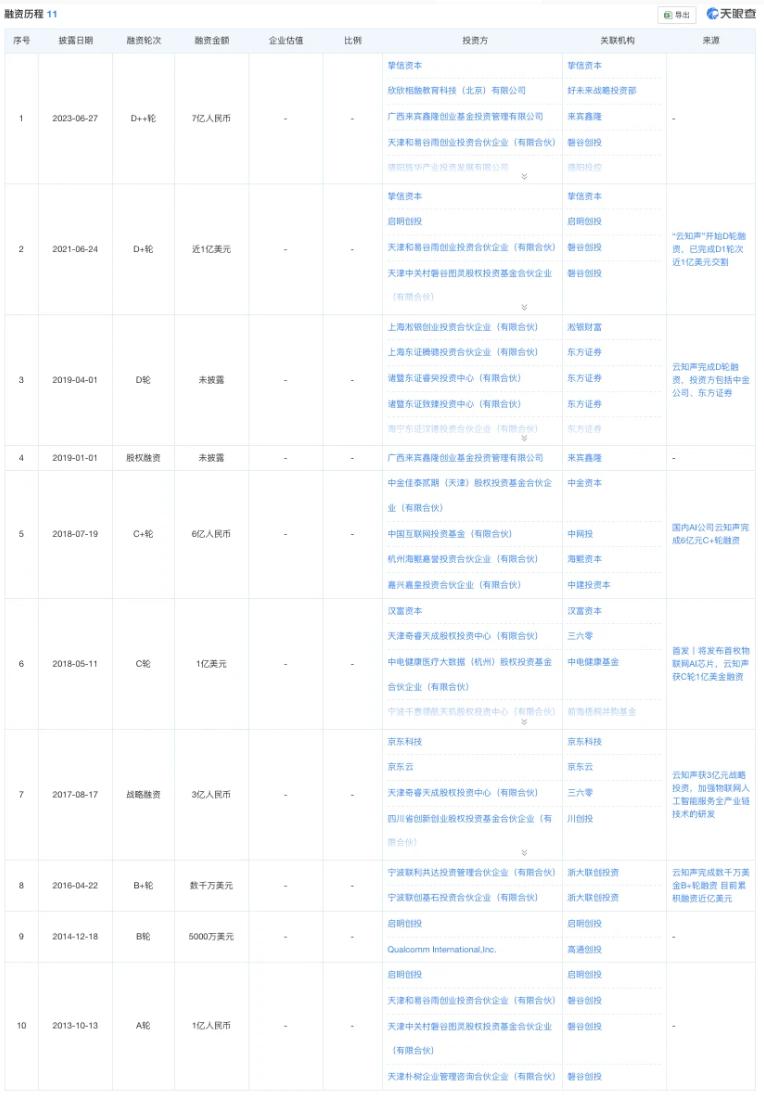
Core Viewpoint - Yunzhisheng, an early player in AI, is preparing for its IPO after multiple attempts, facing challenges in customer growth and financial stability despite revenue increases [1][2][4]. Financial Performance - In 2024, Yunzhisheng reported total revenue of 939 million RMB, a year-on-year increase of 29.16%, with daily life business contributing 740 million RMB, accounting for 78.5% of total revenue [4][12]. - The company incurred a loss of 454 million RMB in 2024, marking a 21.39% increase in losses, with cumulative losses exceeding 1.2 billion RMB [4][5]. Customer Dynamics - Customer growth has stagnated, with the number of major clients in daily life decreasing from 78 to 71 in 2024, and customer retention rates dropping from 70.4% in 2022 to 53.3% in 2024 [12][13][14]. - The revenue per major customer increased, with daily life clients contributing 1.8 million RMB each in 2024, up 20.99% year-on-year [15]. Funding and Investment - Yunzhisheng has completed 11 rounds of financing since its establishment, raising over 340 million USD, with the latest D++ round raising 700 million RMB [2][3]. - The upcoming IPO aims to raise funds primarily for investment in AI infrastructure and talent development [11]. Business Model and Strategy - The company relies heavily on a project-based model, which has led to high costs and low margins, posing long-term sustainability risks [16][17]. - There is a need for a strategic shift towards verticalization and product standardization to enhance competitiveness against larger players in the AI sector [16][17]. Technological Development - Yunzhisheng has transitioned from voice recognition to large models, launching the Shanhai model with 60 billion parameters, but still lags behind leading competitors in terms of scale and application [9][10]. - The reliance on third-party outsourcing for R&D has raised concerns about the company's core technological capabilities [9].