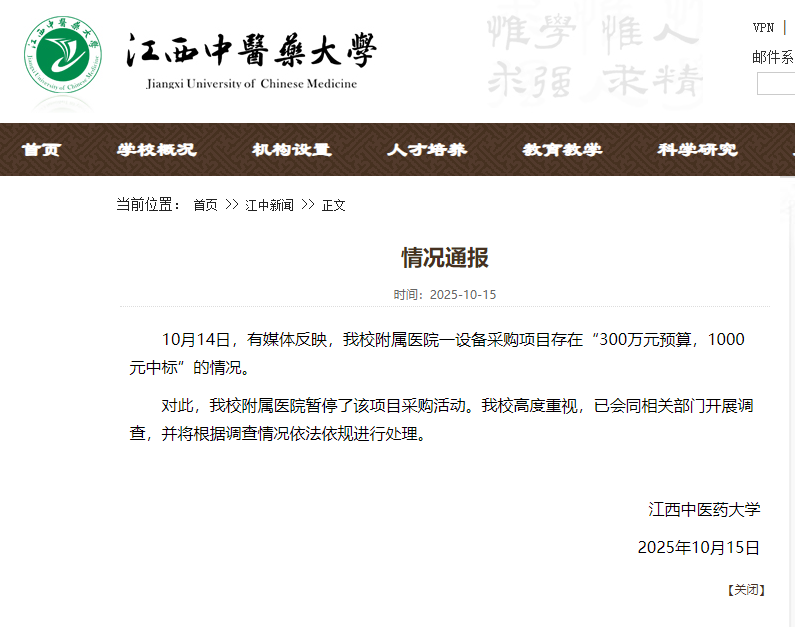
迈瑞MT8000

Search documents
“300万预算,1000元中标”:医院超低价采购被叫停
Hu Xiu· 2025-10-17 00:17
Core Viewpoint - The incident involving Jiangxi University of Traditional Chinese Medicine's procurement of a biochemical immunoassay analysis line at an unusually low price of 1,000 yuan against a budget of 3 million yuan highlights systemic issues in the medical equipment procurement process, particularly concerning "abnormally low bids" and the implications of government policies aimed at curbing such practices [1][2][3]. Group 1: Incident Overview - Jiangxi University of Traditional Chinese Medicine has suspended the procurement project and initiated an investigation following media reports of the low bid [1]. - The procurement project was publicly announced on September 4, with a budget of 3 million yuan and a maximum price of 1.6 million yuan, yet the winning bid was only 1,000 yuan [3][4]. - The incident has drawn attention from government bodies, the university, and the public, indicating a broader concern regarding procurement practices in the medical sector [2]. Group 2: Industry Context - The low bid is part of a troubling trend in the medical equipment industry, where suppliers often submit abnormally low bids to secure contracts, anticipating profits from subsequent sales of consumables [7][11]. - Similar incidents have been reported in other regions, with instances of extremely low bids for the same type of equipment, suggesting a widespread issue rather than isolated cases [6][4]. - The IVD (in vitro diagnostics) industry is experiencing significant pressure due to government policies aimed at reducing costs, leading to a competitive environment where companies resort to low pricing strategies to maintain market share [11][12]. Group 3: Government Response - The Chinese government has recognized the issue of "involutionary competition" in procurement practices and is taking steps to regulate and standardize bidding processes [12][13]. - Recent government reports have highlighted the need for audits and corrective actions regarding low-price bids, indicating a shift towards stricter oversight in procurement practices [13]. - The central government has set goals for 2025 to address these competitive practices, signaling a commitment to improving the market environment for medical procurement [12].

迈瑞医疗“300万元预算1000元中标”采购项目被叫停曾因1元“地板价”废标
Xin Lang Cai Jing· 2025-10-15 21:14
Core Viewpoint - The procurement project at Jiangxi University of Traditional Chinese Medicine Affiliated Hospital has drawn attention due to a low bid of 1,000 yuan against a budget of 3 million yuan, raising concerns about potential bundled sales of medical equipment and consumables [1][2][3]. Group 1: Procurement Details - The project was initially budgeted at 3 million yuan, with a maximum price limit of 1.6 million yuan, but the winning bid was only 1,000 yuan [1][2]. - Other hospitals have reported procurement prices for similar equipment ranging from 336,000 yuan to 2.06 million yuan [2]. - The hospital has suspended the procurement activity pending investigation [2]. Group 2: Industry Practices - The phenomenon of low-price bidding in the medical device industry is not uncommon, with instances of bids as low as 1 yuan being reported [3][4]. - Industry insiders indicate that bundled sales are a common practice, where companies sell devices at low prices but require ongoing purchases of consumables, which are more profitable [4][5]. - A significant portion of medical devices in hospitals is supplied by dominant companies, leading to concerns about market fairness and competition [4][5]. Group 3: Company Insights - Mindray Medical, the company involved, has seen its MT8000 product gain significant market share, capturing 58% of top-tier clients [2]. - The MT8000 product line has received numerous orders, with 185 new orders and nearly 100 installations reported in the first half of 2023 [2].
“300万元预算,1000元中标”,通报发布:已暂停该项目采购,开展调查
Sou Hu Cai Jing· 2025-10-15 06:42
Core Points - The procurement project for an automatic biochemical immunoassay analysis line at Jiangxi University of Traditional Chinese Medicine's affiliated hospital has raised concerns due to a significant discrepancy between the budget of 3 million yuan and the winning bid of only 1,000 yuan [1][3][4] - The university has suspended the procurement activity and initiated an investigation in collaboration with relevant departments to address the situation [1][4] Summary by Sections Procurement Details - The project had a budget of 3 million yuan, with a maximum price limit set at 1.6 million yuan [4] - The winning bid was awarded to a pharmaceutical trading company for the purchase of a device from the brand Mindray, specifically the MT8000 model, with a quantity of one unit [4][6] Investigation and Response - Following media inquiries, the Jiangxi Provincial Finance Department indicated that they would investigate the matter further [3][6] - The hospital's staff stated that the procurement process followed standard procedures and that there was no deviation in the budget [6]

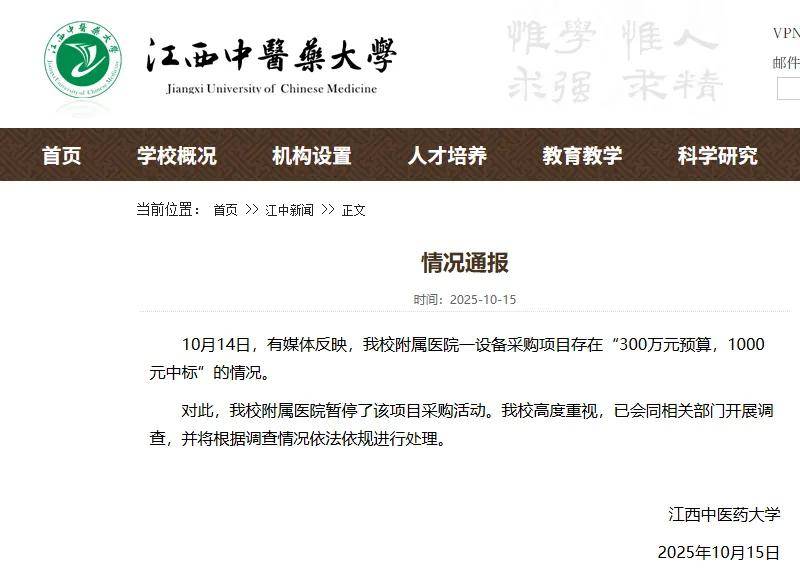
医院设备采购项目“300万元预算,1000元中标”,江西中医药大学通报:暂停采购,开展调查
Mei Ri Jing Ji Xin Wen· 2025-10-15 03:05
Core Viewpoint - The procurement project for an automatic biochemical immunoassay analysis line at Jiangxi University of Traditional Chinese Medicine has raised concerns due to a significant discrepancy between the budget of 3 million yuan and the winning bid of only 1,000 yuan, prompting an investigation by the university and relevant authorities [1][4][5]. Group 1: Project Details - The budget for the procurement project was set at 3 million yuan, while the winning bid was only 1,000 yuan, highlighting a substantial gap in pricing [4][5]. - The winning bid was awarded to a pharmaceutical trading company for the purchase of a Mindray MT8000 device [5]. - The project was publicly announced on September 4, 2025, with a maximum price limit of 1.6 million yuan [5]. Group 2: Institutional Response - Jiangxi University of Traditional Chinese Medicine has suspended the procurement activity and is conducting an investigation into the matter [1][4]. - The university emphasized that the procurement process followed standard procedures and that there was no deviation in the budget [7].