
进口再生纸浆

Search documents
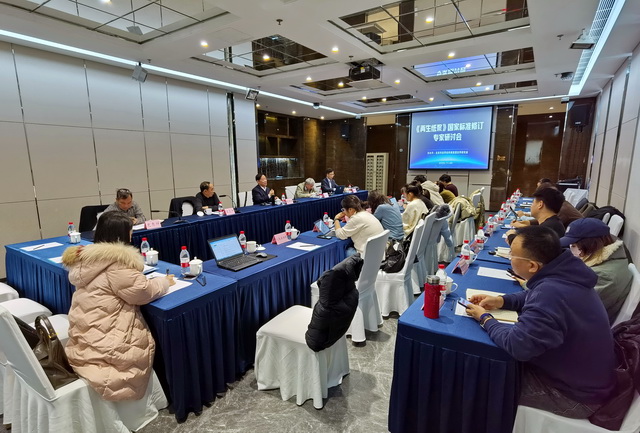
进口再生纸浆监管引关注,业界专家提出《北京共识》
Di Yi Cai Jing· 2025-11-29 08:46
Core Viewpoint - The paper industry is urged to integrate into the national "dual carbon" strategy and accelerate green technology innovation and application, while addressing issues related to the import of recycled paper pulp, including incomplete national standards and environmental risks [1][5]. Regulatory Developments - Recent discussions have focused on enhancing the supervision and standardization of imported recycled paper pulp, with multiple government departments collaborating to issue new regulations and standards [2][3]. - The announcement from the General Administration of Customs on October 9 and subsequent joint announcements from six departments aim to regulate the import of recycled paper pulp more effectively [2]. Environmental Concerns - There have been instances of domestic paper companies misusing the label of recycled paper pulp to import solid waste, raising significant environmental concerns [3]. - Experts have highlighted the inadequacies of the dry processing method for recycled paper pulp, which fails to adequately remove contaminants and poses safety risks [4]. Standardization Issues - The current national standard for recycled paper pulp (GB/T43393-2023) is criticized for lacking mandatory constraints and not adequately addressing biosecurity and bacterial content for imported products [4][5]. - The absence of microbial testing indicators in the existing standards allows low-quality materials to enter the market, complicating customs regulation [4]. Recommendations from Experts - The "Beijing Consensus" calls for strict enforcement of hard standards for imported recycled paper pulp, including limits on contamination and the prohibition of hazardous materials [5][7]. - Experts advocate for the paper industry to adopt green technologies and enhance responsibility towards environmental protection, aligning with national interests [5]. Future Outlook - According to customs statistics, the total import of recycled paper pulp in 2024 is projected to be approximately 4.14 million tons, with a significant portion produced using the dry method [7]. - The industry anticipates a shift towards increased domestic production capacity, potentially reducing reliance on imports by 2026-2027 [7].

规范进口再生纸浆监督监管,海关总署三解读
Di Yi Cai Jing· 2025-10-22 13:54
Core Viewpoint - The announcement by the General Administration of Customs aims to regulate the supervision of imported recycled paper pulp, ensuring that only properly classified and processed materials are allowed, thereby promoting the recycling of resources and maintaining ecological safety [1][2]. Group 1: Regulatory Framework - The announcement was jointly issued by six government departments, including the General Administration of Customs and the National Development and Reform Commission, and will take effect on October 18, 2025 [1]. - Imported recycled paper pulp must originate from classified recycled paper, cardboard, and paper products, and must meet the GB/T 43393 national standard [1][4]. - Enterprises involved in the production and operation of recycled paper pulp are required to implement strict quality control and adhere to legal and ethical business practices [1][4]. Group 2: Quality Control and Inspection - Customs will conduct sensory inspections of imported recycled paper pulp and may delegate attribute identification to professional institutions if the pulp is suspected to be solid waste [2]. - If identified as solid waste, the pulp will be returned or destroyed, and legal responsibilities will be pursued for violations of relevant laws and regulations [2][4]. - Specific contamination limits are set, such as a maximum of 0.50% for metals, plastics, and glass; exceeding this limit may result in return or destruction of the pulp [4]. Group 3: Import Declaration Requirements - The customs commodity code for imported recycled paper pulp is 4706200000, and importers must specify the production method (dry or wet) in the declaration [5]. - It is emphasized that different production methods should not be mixed during the import process to facilitate customs checks [5].
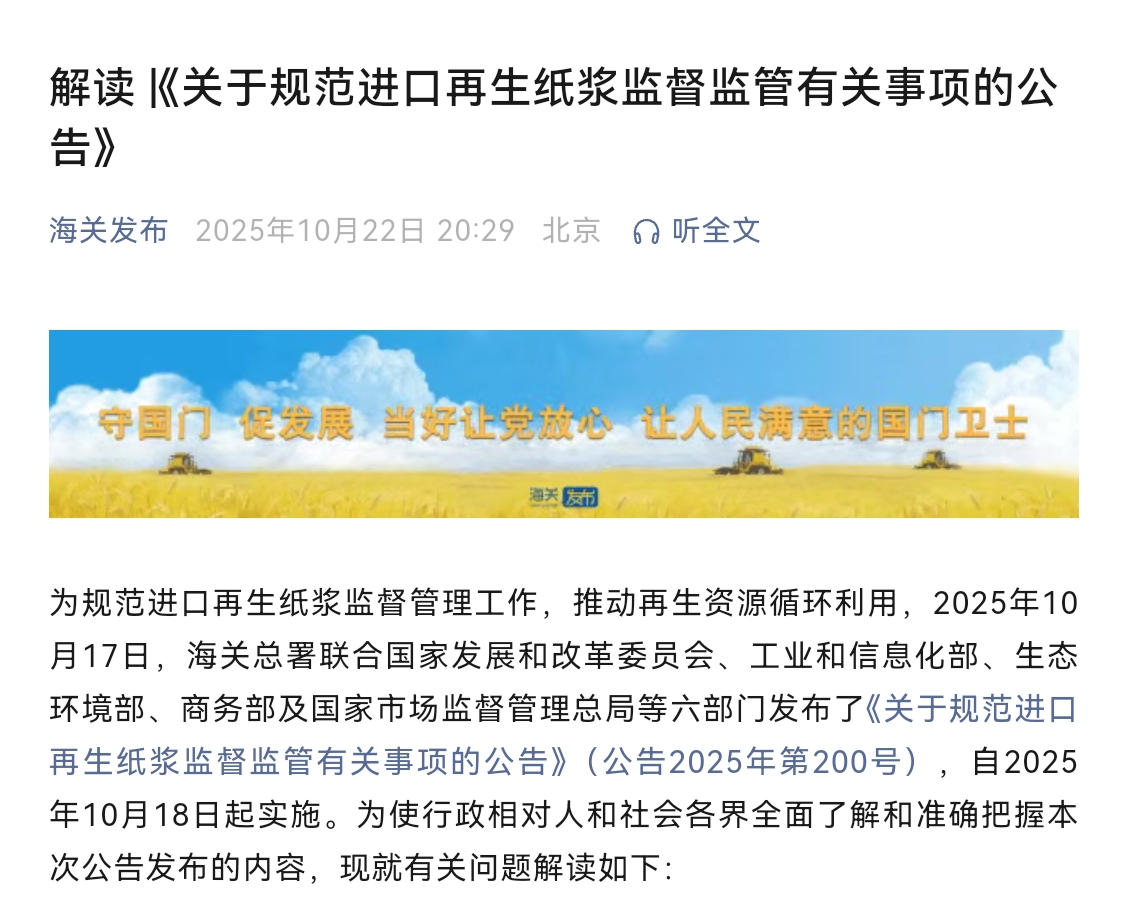
海关总署等六部门发布公告,规范进口再生纸浆监督监管
第一财经· 2025-10-18 04:09
Core Viewpoint - The announcement by multiple government departments aims to regulate the import of recycled paper pulp, enhancing quality and safety standards to promote a green and healthy development of China's paper industry [3][4]. Regulatory Framework - The announcement specifies that imported recycled paper pulp must be made from classified recycled paper, cardboard, and paper products, adhering to the GB/T 43393 national standard [3][4]. - The customs code for imported recycled paper pulp is 4706200000, which is for customs declaration reference only [4]. Quality Control Measures - Customs will conduct sensory inspections and test key indicators as per technical specifications. If imported recycled paper pulp is suspected to be solid waste, it will be identified by a professional agency, and if confirmed, it will be returned [4]. - The announcement emphasizes the need for strict management across the entire supply chain, including raw materials, production, processing, storage, and transportation, to ensure ecological and biological safety [3][4]. Industry Standards - The "Key Indicator Requirements for Recycled Paper Pulp" outlines that recycled paper pulp should not contain rotten pulp or unpleasant odors, and must have consistent shape, color, and material [4]. - Specific limits are set for contaminants, including a maximum of 0.50% for foreign materials, and prohibitions against radioactive substances and hazardous waste [4][5]. Heavy Metal Regulations - The announcement includes regulations on heavy metal content, specifying limits for lead (Pb), chromium (Cr), mercury (Hg), and cadmium (Cd) [5].

海关总署等六部门发布公告 规范进口再生纸浆监督监管
Di Yi Cai Jing· 2025-10-18 02:26
Core Points - The announcement aims to regulate the supervision of imported recycled paper pulp to enhance quality and safety standards, promoting the green and healthy development of China's paper industry [1][2] - The new regulations will take effect from October 18, 2023, and require that the raw materials for imported recycled paper pulp must be classified recycled paper, cardboard, and paper products [1] - Importers must comply with the national standard GB/T 43393, ensuring strict quality control throughout the entire production and supply chain [1][2] Regulatory Requirements - Imported recycled paper pulp must not contain rotten pulp or unpleasant odors, and should have consistent shape, color, and material [3] - The allowable contamination level of foreign materials is set at ≤0.50%, and the pulp must not contain radioactive substances or hazardous waste [3] - Key indicators for recycled paper pulp include limits on heavy metal content and the strength of hand-made sheets [3][4] Customs and Compliance - Customs will conduct sensory inspections and assess key indicators as per technical specifications [1][2] - If imported recycled paper pulp is suspected to be solid waste, customs can delegate to professional institutions for identification, and if confirmed as solid waste, it will be returned [2] - Government departments are tasked with strengthening oversight and enhancing communication and collaboration to ensure effective regulation [2]
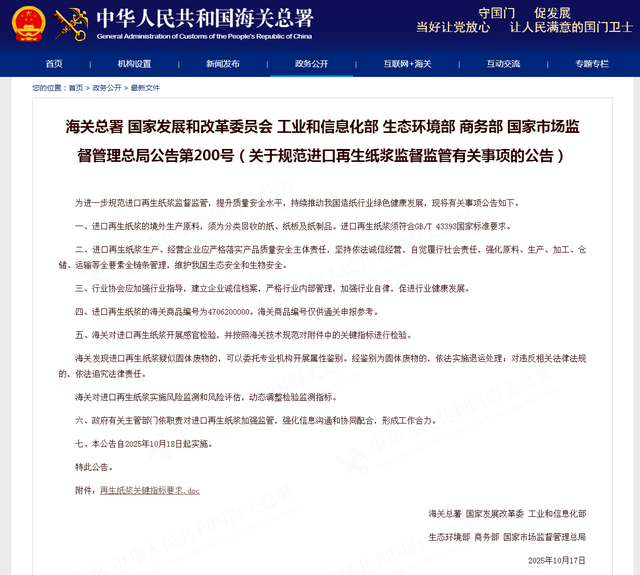
海关总署等六部门发布公告,规范进口再生纸浆监督监管
Di Yi Cai Jing· 2025-10-18 02:22
Core Viewpoint - The announcement by multiple government departments aims to regulate the import of recycled paper pulp, enhance quality and safety standards, and promote the green and healthy development of China's paper industry [1][2][3] Group 1: Regulatory Framework - The announcement specifies that imported recycled paper pulp must be made from classified recycled paper, cardboard, and paper products, adhering to the GB/T 43393 national standard [1] - The customs code for imported recycled paper pulp is 4706200000, which is for customs declaration reference only [1] - Customs will conduct sensory inspections and evaluate key indicators as per technical specifications [1][2] Group 2: Quality Control Measures - If customs suspects that imported recycled paper pulp is solid waste, it can commission professional agencies for attribute identification, and if confirmed as solid waste, it will be returned [2] - The announcement emphasizes the responsibility of production and business enterprises to ensure product quality and safety, and to manage the entire supply chain from raw materials to transportation [1][3] Group 3: Key Indicators for Recycled Paper Pulp - The key indicators for recycled paper pulp include no rotten pulp or unpleasant odors, consistency in shape, color, and material, and a contamination level of less than 0.50% [3] - The recycled paper pulp must not contain radioactive materials or hazardous waste, and there are specific regulations regarding heavy metal content and mechanical strength of hand-made sheets [3]