
再生资源循环利用

Search documents
每年产生工业固废超40亿吨,25部门明确2030年治理目标
Di Yi Cai Jing· 2026-01-13 06:24
Core Viewpoint - The comprehensive utilization of industrial solid waste and renewable resources is crucial for transforming waste into valuable resources, addressing the global challenge of solid waste management and pollution control [1][3]. Group 1: Action Plan and Goals - The National Development and Reform Commission, in collaboration with 25 departments, has drafted the "Solid Waste Comprehensive Management Action Plan," which outlines systematic and integrated policy measures [1]. - By 2030, the plan aims for significant improvements in solid waste management, including controlling historical stockpiles, curbing illegal dumping, achieving an annual comprehensive utilization of 4.5 billion tons of major solid waste, and recycling 510 million tons of primary renewable resources [1][3]. Group 2: Current Situation and Challenges - China generates over 4 billion tons of industrial solid waste annually, with increasing environmental pollution risks [3]. - The mining, smelting, and power generation industries produce substantial amounts of solid waste, such as coal gangue and fly ash, with historical stockpiles posing significant challenges [3][4]. - The reduction of traditional utilization channels has made it more difficult to manage new stockpiles of industrial solid waste, necessitating efforts to address both historical and new waste accumulation [3]. Group 3: Strategies for Waste Management - The Ministry of Ecology and Environment is focusing on both controlling new waste generation and managing existing stockpiles, exploring new channels for large-scale utilization of industrial solid waste [3][4]. - The ministry has revised pollution control standards for general industrial solid waste storage and landfill, allowing certain waste types to be used in backfilling activities [3][4]. Group 4: Utilization and Technological Development - The comprehensive utilization of industrial solid waste is a key component of solid waste management, with the Ministry of Industry and Information Technology promoting the development of advanced utilization technologies and improving policy standards [4][5]. - The comprehensive utilization rate of major industrial solid waste in China has reached 57%, with ongoing efforts to enhance collaboration across the industry chain [4]. - Focus areas include the recycling of complex waste types such as red mud and phosphogypsum, as well as the promotion of remanufactured products [5].

现实端需求转弱 沪铝盘面价格后续可能会有反复
Jin Tou Wang· 2026-01-08 06:02
Group 1 - Canyon Resources has completed key preparatory work for its flagship Minim Martap bauxite project in Cameroon, with mining operations scheduled to commence in February 2026 and the first shipment expected in June 2026 [1] - As of January 4, the inventory of electrolytic aluminum ingots reached 684,000 tons, an increase of 24,000 tons month-on-month, while the inventory of aluminum rods in major domestic consumption areas was 153,500 tons, up by 14,500 tons month-on-month [1] - The Shandong Provincial Department of Industry and Information Technology has issued a work plan to stabilize growth in the non-ferrous metals industry, which includes policies for the recycling of waste aluminum and the regulation of the recycling processes for copper and aluminum [1] Group 2 - The current aluminum market is experiencing weak demand, with high aluminum prices suppressing downstream purchasing sentiment and leading to a continuous increase in aluminum ingot inventory [3] - The rise in aluminum prices is primarily driven by speculative expectations rather than substantial supply-demand fundamentals, raising concerns about potential market corrections as demand weakens and inventory depletion struggles [4] - In the broader market context, gold and silver show bearish signals, while copper has reached significant resistance levels, suggesting a strategy of buying put options for risk management and potential returns [4]
山东:落实废铝回收利用增值税30%即征即退政策
Ge Long Hui· 2026-01-07 11:00
Core Viewpoint - The Shandong Provincial Department of Industry and Information Technology, along with multiple departments, has issued a work plan aimed at stabilizing growth in the non-ferrous metal industry, focusing on the development of recycling and resource utilization [1] Group 1: Industry Development Initiatives - The plan emphasizes the establishment of a copper industry cluster in Linyi, integrating "recycled copper smelting + urban mining" [1] - A recycling base for recycled aluminum is to be developed in Binzhou and Linyi, enhancing the circular economy [1] - The initiative supports the construction of an "Internet + recycling" platform to improve the efficiency and coverage of recycled resource collection [1] Group 2: Policy and Regulatory Framework - The implementation of a 30% immediate tax refund policy on value-added tax for recycled aluminum collection is highlighted [1] - The plan aims to standardize the dismantling and sorting processes for recycled copper and aluminum [1] - There is a focus on promoting the resource utilization of emerging solid waste, such as used power batteries and photovoltaic components, to create a comprehensive recycling industry chain [1] Group 3: International Expansion - The plan encourages recycling companies to expand internationally, enhancing their capabilities in acquiring overseas scrap copper and aluminum [1]
大利好!国务院重磅发布!
天天基金网· 2026-01-05 01:05
Core Viewpoint - The State Council of China has issued the "Solid Waste Comprehensive Management Action Plan," aiming to enhance solid waste management and promote green transformation by 2030, marking a significant step in systematic governance of solid waste [2][3]. Group 1: Goals and Objectives - By 2030, significant improvements are expected in solid waste management, including effective control of historical waste stockpiles and a reduction in illegal dumping, with annual comprehensive utilization of major solid waste reaching 4.5 billion tons and recycling of major renewable resources reaching 510 million tons [3]. Group 2: Source Control and Reduction - The plan emphasizes source reduction of industrial solid waste through strict enforcement of policies, elimination of outdated production capacity, and promotion of green design and production processes to lower waste generation [4]. - It also addresses urban solid waste management by promoting construction waste classification, green construction practices, and integrating waste reduction costs into project budgets [4]. Group 3: Collection, Transfer, and Storage - The action plan aims to standardize urban solid waste collection and transfer systems, enhance waste classification and recycling, and improve information management for construction sites and temporary storage areas [5]. Group 4: Resource Utilization - The plan focuses on improving the comprehensive utilization of major solid waste, including smelting slag and construction waste, and encourages the recycling of agricultural waste and the development of remanufacturing industries [6]. - It also promotes the application of recycled materials and the establishment of standards for these materials, aiming to increase their usage in production [6]. Group 5: Special Rectification in Key Areas - The plan outlines initiatives for the remediation of historical solid waste storage sites, with a target of addressing over 60% of these sites by 2030, and emphasizes the management of phosphogypsum storage and utilization [7]. - It calls for technological innovation to support solid waste recycling and pollution control, including the development of key technologies and the revision of relevant guidelines [7].

到2030年大宗固废年利用量达45亿吨
Xin Lang Cai Jing· 2026-01-04 20:03
Core Viewpoint - The State Council has issued the "Solid Waste Comprehensive Management Action Plan," aiming to achieve a significant increase in solid waste utilization by 2030, targeting an annual utilization of 4.5 billion tons of major solid waste and 510 million tons of major recyclable resources [1][2]. Group 1 - The Action Plan is guided by Xi Jinping's thoughts and aims to implement the new development philosophy, focusing on reduction, resource utilization, and harmlessness [1]. - By 2030, the plan aims for noticeable improvements in solid waste management, effective control of historical waste stockpiles, and a halt to illegal dumping practices [1]. - The comprehensive management system will include source reduction, process control, end-use, and a full-chain harmless management approach [1]. Group 2 - The Action Plan targets major waste-producing sectors such as industry, urban areas, and agriculture, emphasizing a full-chain governance approach [2]. - It outlines specific tasks for each stage of waste management, including source control, collection, transportation, storage, and resource utilization [2]. - Local governments are required to take responsibility for implementation, ensuring that pollution sources are held accountable for waste management [2].
国务院重磅发布《固体废物综合治理行动计划》,利好塑料循环
DT新材料· 2026-01-04 16:04
Core Viewpoint - The article discusses the "Comprehensive Solid Waste Management Action Plan" issued by the State Council, which aims to significantly improve solid waste management by 2030, including achieving a comprehensive utilization of 4.5 billion tons of major solid waste and 510 million tons of major recycled resources annually [1][3]. Group 1: Overall Requirements - The plan emphasizes a systematic approach to solid waste management, focusing on reduction, resource utilization, and harmless disposal, with a goal to effectively control historical waste storage and curb illegal dumping [3]. Group 2: Source Control and Reduction - Industrial solid waste source reduction will be strengthened through strict enforcement of policies and support for green design and production processes [4]. - Urban solid waste management will include promoting construction waste classification and green construction practices, with costs for waste management integrated into project budgets [5]. - Agricultural solid waste reduction will focus on the scientific use of agricultural films and promoting circular agricultural practices [5]. Group 3: Collection, Transfer, and Storage Standards - Industrial solid waste management will be standardized with improved tracking and classification systems to prevent contamination [6]. - Urban waste recycling and transfer systems will be enhanced, integrating waste collection points with recycling networks [6]. - Agricultural waste collection capabilities will be improved through the establishment of specialized service providers and recycling systems [7]. Group 4: Resource Utilization Enhancement - Comprehensive utilization of major solid waste will be promoted, including the effective extraction of valuable components from industrial by-products [8]. - The recycling industry will be regulated, with initiatives to encourage producer responsibility and the development of remanufacturing industries [8]. - The application of recycled materials will be promoted through the establishment of standards and certification systems [8]. Group 5: Harmless Treatment Capacity Increase - The plan aims to enhance the harmless treatment of industrial solid waste, reducing landfill volumes and environmental risks [9]. - Exploration of large-scale disposal methods for industrial solid waste will be conducted, ensuring compliance with environmental standards [9]. Group 6: Special Rectification in Key Areas - A crackdown on illegal dumping of solid waste will be implemented, with a focus on identifying and rectifying issues in key regions [10]. - Environmental pollution risks at landfill sites will be systematically assessed and addressed [11]. - Special measures will be taken to manage construction waste and historical solid waste storage sites [12][13]. Group 7: Regulatory and Technical Framework Improvement - The legal framework for solid waste management will be strengthened, including revisions to existing laws and the establishment of new regulations [16]. - Standards for solid waste pollution control will be updated to enhance resource utilization and product quality [16]. - Technological innovation in solid waste recycling and pollution control will be prioritized [16].
废旧家电家具回收体系日益完善
Xin Hua She· 2025-12-22 02:49
Core Viewpoint - The recycling and disposal system for old household appliances and furniture is becoming increasingly efficient, driven by the ongoing "old-for-new" consumption policy, which is positively impacting the potential for consumer spending in this sector [1] Group 1: Recycling Network Expansion - The number of recycling points is increasing, with over 120 collection points for old furniture in Guangzhou, allowing residents to either drop off items or schedule pickups [2] - In Guangxi, cities like Wuzhou and Liuzhou have over 700 recycling points each, while Wuhan has established 2,320 standardized community recycling points by the end of 2024 [2] - Hangzhou has set a target of one recycling point for every 1,000 urban households and one for every 2,000 rural households, with 48 sorting centers and 2,676 recycling points established by the end of 2024 [2] Group 2: Diverse Recycling Models - The "Internet+" recycling model is integrating into daily life, with platforms like "Sui Recycling" in Guangzhou offering cash for appliances and charging fees for furniture due to lower reuse value [3] - Zhejiang's Tiger Brother Waste Management Company has implemented an online order and pickup service, covering 379,000 households in Hangzhou's Yuhang District by September 2025 [3] - Companies like Haier are building national recycling networks and establishing recycling factories, while IKEA is using a buyback strategy to encourage second-hand furniture sales [3] Group 3: Standardized Disposal Practices - Companies like Shunde Xinhai Resource Utilization Co. in Guangdong are implementing traceable processing for old appliances, handling up to 2.6 million units annually [4] - The number of standardized dismantled appliances in China is expected to grow by 20% year-on-year in 2024, with Midea Group collaborating with certified dismantling companies to recover 4.6 million appliances [4] - Supportive policies for legitimate companies are promoting standardized recycling practices, with subsidies in Hangzhou reducing operational costs for recycling firms [4]
东江环保:公司以构建再生资源循环利用产业链为重点战略转型方向
Zheng Quan Ri Bao Zhi Sheng· 2025-11-18 13:09
Core Viewpoint - Dongjiang Environmental is focusing on the strategic transformation towards building a recycling resource circular economy, with battery recycling as a key segment of this industry chain [1] Group 1: Business Strategy - The company is committed to developing its battery recycling business, which is an important part of its recycling resource circular economy strategy [1] - Dongjiang Environmental has established a joint venture to enter the automotive parts remanufacturing sector, which is currently in its initial stages [1] - The company plans to intensify efforts to promote the development of its recycling resource circular economy layout [1] Group 2: Research and Development - Dongjiang Environmental possesses a certain level of research and development foundation and technical reserves in the field of battery recycling [1] - The company is continuously monitoring developments in the battery recycling sector to enhance its capabilities [1]

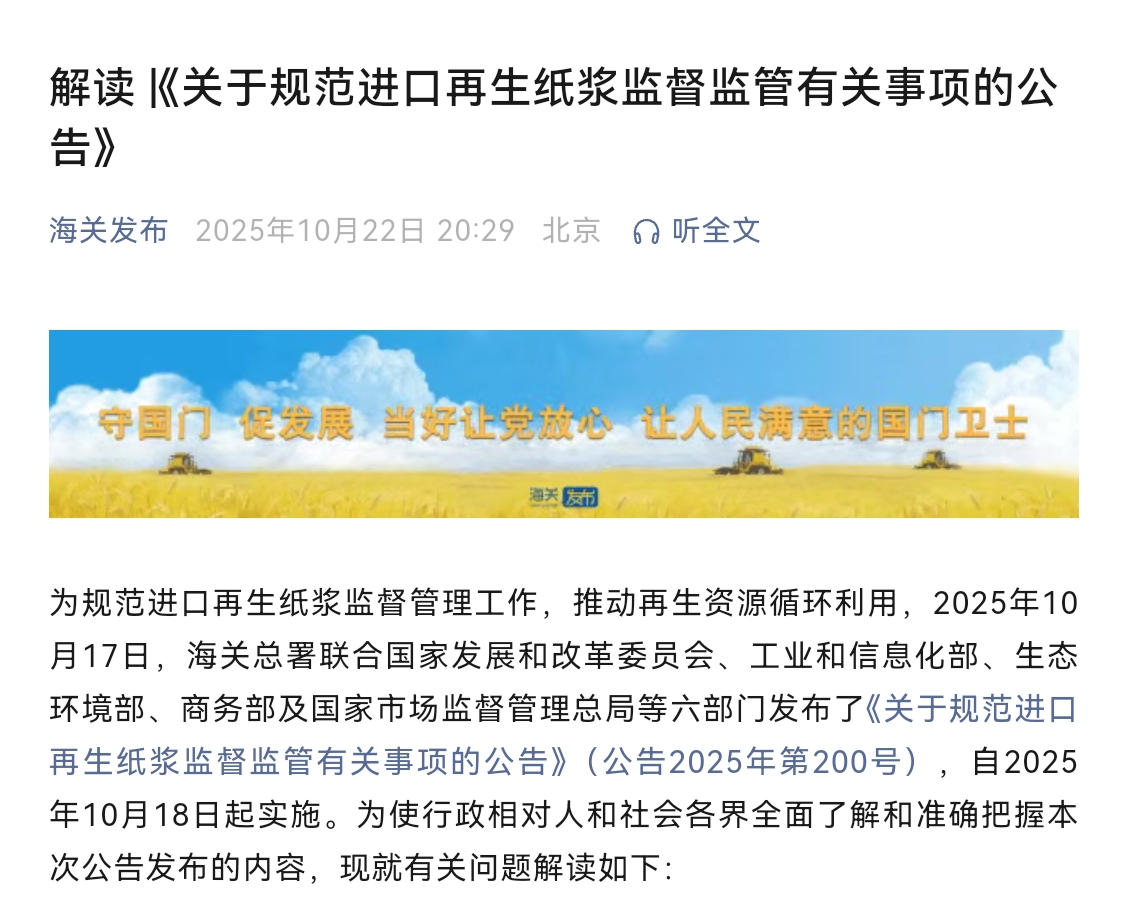
规范进口再生纸浆监督监管,海关总署三解读
Di Yi Cai Jing· 2025-10-22 13:54
Core Viewpoint - The announcement by the General Administration of Customs aims to regulate the supervision of imported recycled paper pulp, ensuring that only properly classified and processed materials are allowed, thereby promoting the recycling of resources and maintaining ecological safety [1][2]. Group 1: Regulatory Framework - The announcement was jointly issued by six government departments, including the General Administration of Customs and the National Development and Reform Commission, and will take effect on October 18, 2025 [1]. - Imported recycled paper pulp must originate from classified recycled paper, cardboard, and paper products, and must meet the GB/T 43393 national standard [1][4]. - Enterprises involved in the production and operation of recycled paper pulp are required to implement strict quality control and adhere to legal and ethical business practices [1][4]. Group 2: Quality Control and Inspection - Customs will conduct sensory inspections of imported recycled paper pulp and may delegate attribute identification to professional institutions if the pulp is suspected to be solid waste [2]. - If identified as solid waste, the pulp will be returned or destroyed, and legal responsibilities will be pursued for violations of relevant laws and regulations [2][4]. - Specific contamination limits are set, such as a maximum of 0.50% for metals, plastics, and glass; exceeding this limit may result in return or destruction of the pulp [4]. Group 3: Import Declaration Requirements - The customs commodity code for imported recycled paper pulp is 4706200000, and importers must specify the production method (dry or wet) in the declaration [5]. - It is emphasized that different production methods should not be mixed during the import process to facilitate customs checks [5].
我国首批进口锂离子电池用再生黑粉原料顺利通关
Zhong Guo Jing Ji Wang· 2025-08-15 05:08
Core Insights - The first batch of imported recycled black powder for lithium-ion batteries has successfully passed customs inspection in Ningbo, marking a significant step in promoting the recycling of resources in China [1][2] Group 1: Import Regulations and Procedures - The import of recycled black powder is part of the implementation of the announcement issued by six Chinese government departments, which clarifies that compliant recycled black powder does not fall under solid waste and can be imported freely [1] - The announcement took effect on August 1, following its release on June 9, indicating a streamlined process for importing recycled materials [1] Group 2: Industry Context and Benefits - Recycled black powder is derived from waste lithium-ion batteries through processes such as discharging, dismantling, pyrolysis, crushing, and sorting, containing valuable metals like lithium, nickel, and cobalt [2] - The richness of these metals in recycled black powder is significantly higher than that of raw ores, which helps to expand supply channels and reduce reliance on raw mineral extraction, contributing to carbon reduction and ecological protection [2] Group 3: Company Initiatives - The company has established a comprehensive and efficient resource recovery and recycling system by connecting domestic and international upstream and downstream enterprises, logistics, and customs [1] - The company has conducted pre-inspections on key indicators of the recycled black powder, such as nickel, cobalt, lithium, phosphorus, and water-soluble fluorine, to ensure compliance with safety and environmental standards [2]