
遛娃舱

Search documents
春运第一天,返乡路上暖意浓
Xin Lang Cai Jing· 2026-02-03 00:12
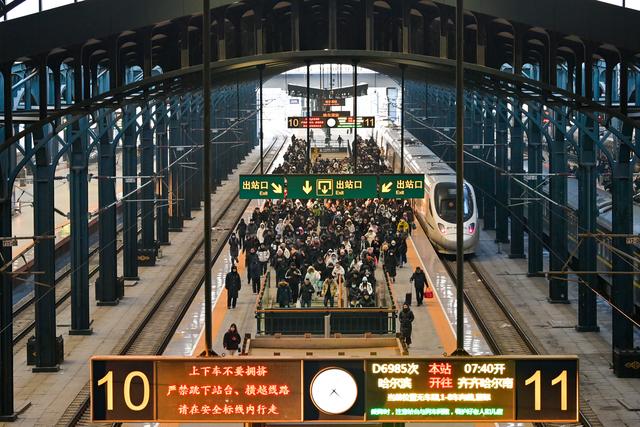
Core Viewpoint - The 2026 Spring Festival travel rush (Chunyun) has officially started, with an expected total of 9.5 billion trips across the country, highlighting the focus on enhancing transportation capacity, optimizing services, and leveraging technology to ensure safe and smooth travel for passengers and goods [2][3]. Group 1: Transportation Capacity and Services - The Wuhan Railway Bureau plans to operate 522.5 pairs of trains before the festival and 523.5 pairs after, representing a 9.7% and 9.3% increase in capacity compared to the 2025 Spring Festival [4][5]. - Wuhan Railway Station anticipates sending 2.622 million passengers during the Spring Festival, with a festive atmosphere enhanced by cultural activities and improved facilities [3][4]. - The Fuzhou Railway Station expects to send 4.1 million passengers, a 7.23% increase from 2025, and has implemented various measures to enhance passenger experience and safety [10]. Group 2: Technological Innovations - Fuzhou Railway Station has introduced smart service robots to assist passengers with inquiries, showcasing the integration of technology in enhancing travel experiences [11]. - The railway sector is exploring a "dual transport" model, combining passenger and freight services to optimize logistics and meet rising demand [12]. Group 3: Collaborative Efforts and Community Engagement - Various railway stations, including Lanzhou West Station, are conducting cultural activities to create a festive environment and enhance passenger engagement during the travel rush [6][7]. - The collaboration between railway and aviation sectors at Lanzhou Airport aims to streamline passenger transfers, improving overall efficiency [7][8].

2月起拓展静音车厢服务范围 乘坐时需注意什么?
Ren Min Ri Bao· 2026-01-28 00:40
Core Viewpoint - The introduction of quiet carriages on trains aims to enhance passenger experience by providing a quieter travel environment through various measures, including reduced audio levels and promoting quiet behavior among passengers [1][2][4]. Group 1: Quiet Carriage Implementation - Starting February 1, over 8,000 high-speed trains will offer quiet carriage services, covering major routes across the national high-speed rail network [2]. - G-series trains are nearly fully covered with quiet carriages, while D-series trains have about 80% coverage, excluding sleeper and certain types of trains [2]. - Quiet carriages are typically located at the front or rear of the train and are designated as second-class seating [2][3]. Group 2: Passenger Guidelines - Passengers wishing to use quiet carriages can select trains marked with a "quiet" label and opt for priority seating in these carriages during ticket purchase [3]. - The quiet carriage rules include maintaining silence, keeping electronic devices on silent or vibrate, and moving to other areas for phone calls [5][6]. Group 3: Enforcement and Compliance - Train staff will actively remind passengers to adhere to quiet rules, using visual aids and gentle reminders to maintain a quiet atmosphere [4][6]. - In cases of non-compliance, staff may assist passengers in relocating to non-quiet carriages if necessary [6]. Group 4: General Conduct in All Carriages - The railway department encourages all passengers, regardless of carriage type, to maintain a civilized and quiet environment [7]. - Other carriages will also have measures in place to promote quietness, such as announcements and staff monitoring [7]. Group 5: Additional Services - The railway is exploring additional services, such as "play areas" for children, to cater to diverse passenger needs and enhance overall travel experience [8].
乘坐静音车厢,有啥注意事项?
Xin Lang Cai Jing· 2026-01-28 00:15
Core Viewpoint - The introduction of "quiet carriages" on trains aims to enhance passenger experience by providing a quieter travel environment through specific measures and guidelines [1][2][3]. Group 1: Quiet Carriage Implementation - Starting from February 1, over 8,000 high-speed trains will offer quiet carriage services, covering major routes and passenger corridors across the national high-speed rail network [2]. - G-series trains are nearly fully covered by quiet carriages, while D-series trains have about 80% coverage, excluding sleeper and certain types of trains [2]. - Quiet carriages are typically located at the front or rear of the train and are designated as second-class seating [2][3]. Group 2: Passenger Guidelines and Enforcement - Passengers wishing to use quiet carriages can select trains marked with a "quiet" label and opt for a seat in the quiet carriage during ticket purchase [3]. - To maintain a quiet environment, measures include lowering audio volume, closing entertainment systems, and providing reading materials [4][5]. - Passengers are expected to adhere to quiet agreements, which include keeping noise to a minimum, using headphones, and supervising children to prevent disturbances [5]. Group 3: General Conduct in Other Carriages - All passengers are encouraged to maintain a civilized and quiet atmosphere in all carriages, not just the quiet ones [6]. - The railway department promotes awareness through announcements and staff monitoring to minimize noise in non-quiet carriages [6]. - Additional services, such as "play areas" for children, are being developed to cater to diverse passenger needs while maintaining a comfortable environment [6][7].
2月1日起,提供服务的动车组将超8000列 乘坐静音车厢,有啥注意事项?(深阅读)
Ren Min Ri Bao· 2026-01-27 22:25
Core Viewpoint - The introduction of "quiet carriages" on trains aims to enhance passenger experience by providing a quieter travel environment, addressing the diverse needs of travelers [1][2]. Group 1: Quiet Carriage Implementation - The quiet carriage service will be available on over 8,000 high-speed trains starting February 1, covering major routes and passenger corridors across the country [2]. - G-series trains are nearly fully covered by the quiet carriage service, while D-series trains have about 80% coverage, excluding sleeper and concentrated power trains [2]. - Quiet carriages are typically located at the front or rear of the train and are designated as second-class carriages [2][3]. Group 2: Passenger Guidelines and Enforcement - Passengers wishing to use the quiet carriage must select the "quiet" option when purchasing tickets, and no standing tickets will be sold for these carriages [3]. - To maintain a quiet environment, the train staff will implement various measures, including lowering audio volume and providing visual reminders [4]. - Passengers are expected to adhere to specific quiet agreements, such as keeping noise to a minimum and using headphones for electronic devices [5]. Group 3: General Conduct in Other Carriages - All passengers are encouraged to maintain a civilized and quiet environment in all carriages, not just the quiet ones [6]. - The railway department will continue to promote quiet behavior through announcements and staff monitoring in non-quiet carriages [6]. - Additional services, such as "play areas" for children, are being introduced to cater to specific passenger needs while maintaining overall comfort [6][7]. Group 4: Future Developments - The railway department will monitor the effectiveness and social response to the quiet carriage service and make adjustments as necessary to improve passenger experience [7].