
量子科学计算平台UnitaryLab

Search documents
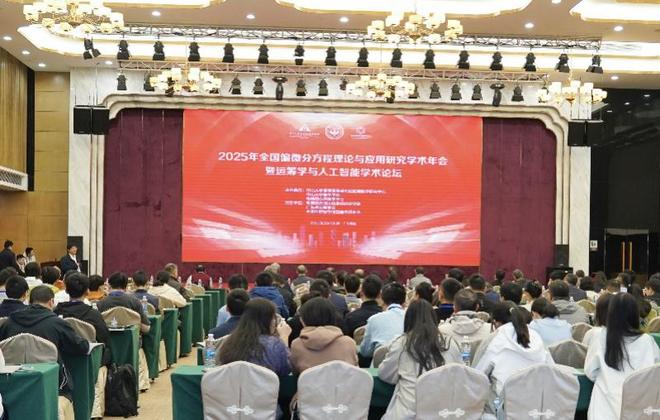
偏微分方程驱动AI创新!多个高校与科研院所专家共话新成果
Nan Fang Du Shi Bao· 2025-12-06 09:04
Core Insights - The conference aims to enhance academic exchange and collaboration in the field of partial differential equations (PDEs) and related areas, highlighting the importance of PDEs in the context of artificial intelligence [1][4][21] Group 1: Conference Overview - The "2025 National Academic Annual Conference on the Theory and Application of Partial Differential Equations and the Operations Research and Artificial Intelligence Academic Forum" was held in Qingyuan, Guangdong, from December 6 to 7 [1] - The event was organized by several institutions, including the Center for Applied Mathematics at Sun Yat-sen University and the Guangdong-Hong Kong-Macao Greater Bay Area Interdisciplinary Science Society [1][4] Group 2: Keynote Addresses - Professor Yao Zheng'an emphasized that PDEs are entering a new era of opportunities, particularly in validating AI solutions through rigorous theoretical frameworks [4] - Professor Xin Zhouping highlighted the dual nature of good mathematics, which should be profound and easily communicable, and noted the bridging role of PDEs between various fields [6] - Professor Zhu Xiping supported the idea of PDEs as a bridge to both pure and applied mathematics, stressing their significance in practical applications [8] Group 3: Research Presentations - Various scholars presented their latest research findings, including: - Professor Wang Weike from Shanghai Jiao Tong University discussed the existence of solutions for the Keller-Segel equation with Couette flow [13] - Professor Yin Jingxue from South China Normal University reported on recent advancements in semi-linear parabolic equations with nonlinear source terms [15] - Professor Chen Hua from Wuhan University presented on fine embeddings and geometric inequalities related to generalized Sobolev spaces defined by Hermite vector fields [17] - Professor Jin Shi from Shanghai Jiao Tong University introduced the quantum computing platform "UnitaryLab" aimed at solving ordinary and partial differential equations using quantum algorithms [19] Group 4: Institutional Background - The Center for Applied Mathematics at Sun Yat-sen University in Hong Kong aims to gather top global talents and promote deep integration between mathematical theory innovation and engineering technology applications [21] - The center has established close collaborations with several prestigious universities and research institutions in Hong Kong, focusing on key areas such as new information technology, intelligent manufacturing, and healthcare [21]

科学计算软件的“量子跃迁” 上海交大全球首发“量子科学计算平台UnitaryLab”
Zhong Guo Xin Wen Wang· 2025-11-23 01:44
Core Insights - Shanghai Jiao Tong University has officially launched the world's first quantum scientific computing platform, UnitaryLab, which aims to overcome the computational power limitations of classical computing by developing quantum algorithms for various fields such as differential equations, numerical linear algebra, optimization, machine learning, and statistical computing [1][2] Group 1: Platform Features - UnitaryLab1.0 focuses on solving ordinary and partial differential equations, achieving quantum algorithm construction, solution, and quantum circuit design, thus breaking through traditional computational efficiency bottlenecks [1] - The platform is built on the "Schrödingerization" series of quantum algorithms proposed by the research teams, which innovatively transform partial differential equations into a form that can be directly processed by quantum systems [2] - The platform supports dual scenarios of "research + industry," allowing for a single platform to meet multiple needs, thereby enriching quantum teaching tools in universities and connecting talent cultivation, research innovation, and industrial application [3] Group 2: Industry Impact - UnitaryLab1.0 significantly lowers the barriers to using quantum computing, enabling engineers, researchers, and students from non-quantum fields to quickly engage in quantum scientific computing and engineering simulations, thus accelerating the problem-solving efficiency [2] - The platform has already attracted positive testing from domestic and international research teams and has established collaborations with leading domestic quantum hardware companies for real machine verification [3] - Future plans include further innovation in quantum algorithms, development of specialized hardware for algorithm adaptation, and the establishment of a standardized system for quantum solutions to partial differential equations, promoting the transition from fragmented exploration to standardized implementation [3]