金融Agent

Search documents
恒生电子首席科学家白硕:Agent之难,无关算力、模型与平台
雷峰网· 2025-12-22 05:52
Core Insights - The article discusses the challenges and opportunities in the implementation of AI Agents in the financial sector, emphasizing the importance of business logic and interface depth over mere technological capabilities [4][5][10]. Group 1: Key Challenges in AI Agent Implementation - The main barrier to integrating AI Agents into core business scenarios is not just computational costs or model capabilities, but rather the lack of sufficiently "thick" business interfaces that can understand complex business intents expressed in natural language [4][8]. - Current AI Agent platforms are seen as lacking value if they do not have deep vertical domain knowledge, making them mere "empty shells" without substantial service capabilities [4][14]. - The understanding of business intent is crucial, and the depth of interface openness determines how well technology can meet business needs [10][12]. Group 2: Evolution of Financial AI Agents - Financial AI Agents have progressed from hard-coded solutions to semi-automated systems, and now to natural language-driven interactions, but there is still room for advancement [5][19]. - The future architecture of financial AI Agents is expected to involve a clear division between dynamic and stable business processes, with Agents handling the former and backend systems managing the latter [5][33]. - The development of AI Agents is seen as a gradual process, with institutions needing to adapt their existing resources and interfaces to better support AI capabilities [22][24]. Group 3: Importance of Service Capabilities - The value of an AI Agent is determined by the variety of services it can provide, akin to how a rice cooker is valued for the number of recipes it can prepare rather than the quality of its heating element [12][18]. - Companies should focus on building and enriching atomic service capabilities to ensure that Agents can meet diverse business needs effectively [15][18]. - The competitive edge lies in the ability to offer a wide range of well-packaged services that can be easily accessed and utilized through natural language [12][18]. Group 4: Future Directions and Market Perception - There is a misconception that generic AI Agent platforms will have significant market demand; true demand will only emerge once the interface systems are sufficiently rich and deep [34][35]. - The article suggests that the future of financial AI Agents will involve a more integrated approach, where shared resources across different business units can lead to innovation and efficiency [22][23]. - The financial sector is expected to see a shift towards platformization, allowing for better resource sharing and cross-system data integration [22][23].



金融Agent落地,谁能“敲开”银行的大门?
3 6 Ke· 2025-07-31 09:13
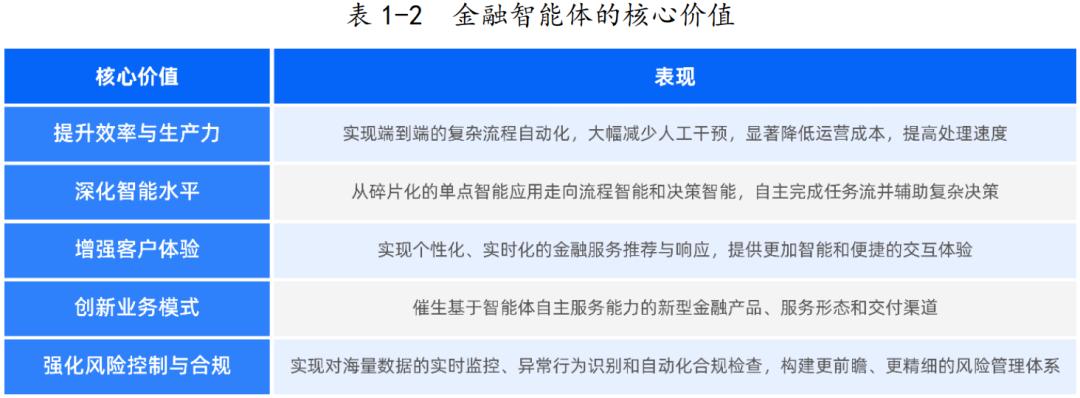
Core Insights - The Chinese banking industry is at a turning point with the emergence of AI technology, particularly AI Agents, which are set to revolutionize core banking functions such as credit and risk management by significantly enhancing productivity and efficiency [1][3][21] - AI Agents, built on large AI models, can autonomously perform tasks, assist in decision-making, and provide personalized financial services, thereby reducing manual intervention and operational costs [1][3][4] Group 1: AI Agent Implementation and Value - AI Agents are becoming a core focus for banks, with significant investments being made to develop and implement these technologies [4][6] - The core values of AI Agents include improving efficiency through end-to-end automation, enhancing decision-making capabilities, and providing personalized customer experiences [3][21] - Major banks like ICBC and Agricultural Bank of China are leading in financial technology investments, with ICBC planning to spend approximately 28.518 billion yuan in 2024 [6][8] Group 2: Bank-Specific Developments - Agricultural Bank of China has introduced the "Mosu Loan Scoring Card" AI Agent, which can generate credit reports in 30 seconds, significantly speeding up the due diligence process [8] - Postal Savings Bank is rapidly advancing its AI capabilities, achieving over 87.5% automation in alarm troubleshooting through its AI Agents [9] - Other banks, including China Merchants Bank and Ping An Bank, are also developing their own AI Agents to enhance data analysis and customer service [11][12] Group 3: Technology Partnerships - Banks are increasingly collaborating with technology companies to bridge the technological gap and enhance their AI capabilities [13][20] - Major tech players like Baidu, Alibaba, and Tencent are providing comprehensive AI solutions and infrastructure, which are crucial for the successful implementation of AI Agents in banking [14][15] - The partnership between banks and tech companies is essential for unlocking the potential of AI in the financial sector, especially for smaller banks [13][20] Group 4: Challenges and Future Outlook - Despite the rapid development of AI Agents, many banks are still focused on non-core applications, indicating a gap between potential and actual implementation [21][22] - The banking sector requires high accuracy and reliability from AI systems, which currently face challenges such as a 95% accuracy rate in leading financial models [23][24] - The transition to AI-driven banking is a long-term process that necessitates a solid AI strategy and collaboration between banks and technology providers to achieve significant ROI [30][31]