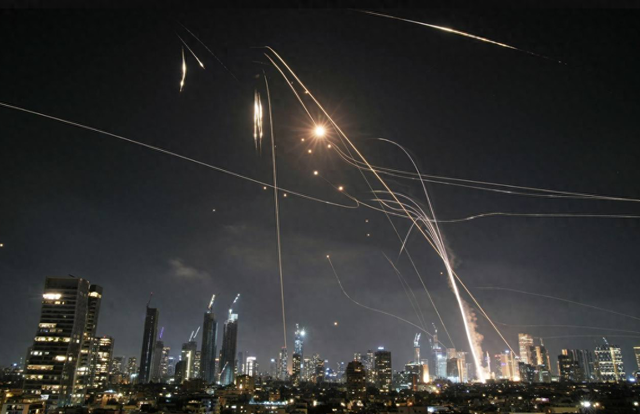
铁穹防空系统

Search documents
莫迪力挺以色列引巨大争议
Xin Lang Cai Jing· 2026-02-28 03:42
Core Viewpoint - Indian Prime Minister Modi's recent visit to Israel has elevated bilateral relations to a "special strategic partnership," amidst ongoing tensions in the Middle East, which has sparked significant domestic and international controversy [2][3][4]. Group 1: Bilateral Relations - Modi and Israeli Prime Minister Netanyahu announced the elevation of their countries' relationship to a "special strategic partnership" focused on peace, innovation, and prosperity [2]. - During the visit, 16 agreements and memorandums of understanding were signed, with a commitment to finalize a free trade agreement soon [2]. - A roadmap for enhanced defense cooperation was also established between the two nations [2]. Group 2: Domestic and International Reactions - Modi's strong support for Israel has led to fierce criticism from opposition parties in India, who accuse him of moral cowardice and neglecting the plight of Palestinians [5]. - The Indian National Congress party condemned Modi's actions as damaging to India's longstanding position on peace and justice in international issues [5]. - Iranian officials expressed regret over India's strengthening ties with Israel, labeling it unfortunate given the ongoing humanitarian crisis in Gaza [7]. Group 3: Defense and Military Cooperation - From 2020 to 2024, India has purchased $20.5 billion worth of arms from Israel, accounting for about one-third of Israel's arms exports [6]. - A potential $10 billion defense cooperation agreement is anticipated, which would include the provision of the Iron Dome defense system and laser defense technologies to India [6]. - If finalized, this agreement would elevate the trust level of India-Israel relations to that of the United States [6].

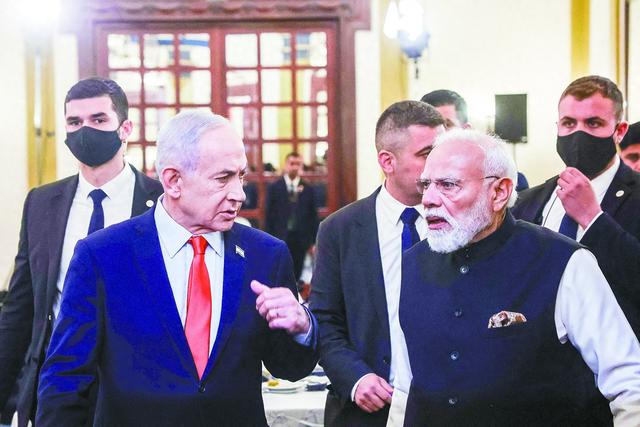
莫迪力挺以色列引巨大争议,印度反对党抨击其损害“和平与正义立场”
Huan Qiu Shi Bao· 2026-02-27 22:38
Core Viewpoint - Indian Prime Minister Modi's recent visit to Israel has elevated bilateral relations to a "special strategic partnership," amidst ongoing tensions in the Middle East, which has sparked significant domestic and international controversy [1][3][4]. Bilateral Relations - Modi and Israeli Prime Minister Netanyahu announced the enhancement of their countries' relationship to focus on peace, innovation, and prosperity, signing 16 agreements and memorandums of understanding, and committing to finalize a free trade agreement [3][5]. - The visit was marked by high diplomatic honors, including Modi receiving the "Parliament Medal," the highest honor from the Israeli parliament [3]. Domestic Reactions - Modi's support for Israel has faced fierce criticism from opposition parties in India, who argue that it undermines India's long-standing position on Palestinian support and non-alignment [1][6]. - The Indian National Congress party accused Modi of moral cowardice for ignoring the humanitarian crisis in Gaza while aligning with Netanyahu's government [6]. International Reactions - Iran expressed regret over India's strengthened ties with Israel, labeling it as unfortunate and criticizing Modi for engaging with a regime accused of genocide [8]. - Pakistan's Transport Minister condemned Modi's stance as a shocking display of double standards, urging Middle Eastern countries to reassess their relationships with India based on its current foreign policy [9]. Defense Cooperation - From 2020 to 2024, India has purchased $20.5 billion worth of arms from Israel, accounting for about one-third of Israel's arms exports [7]. - A potential $10 billion defense cooperation agreement is anticipated, which would include advanced defense technologies such as the Iron Dome system [7].
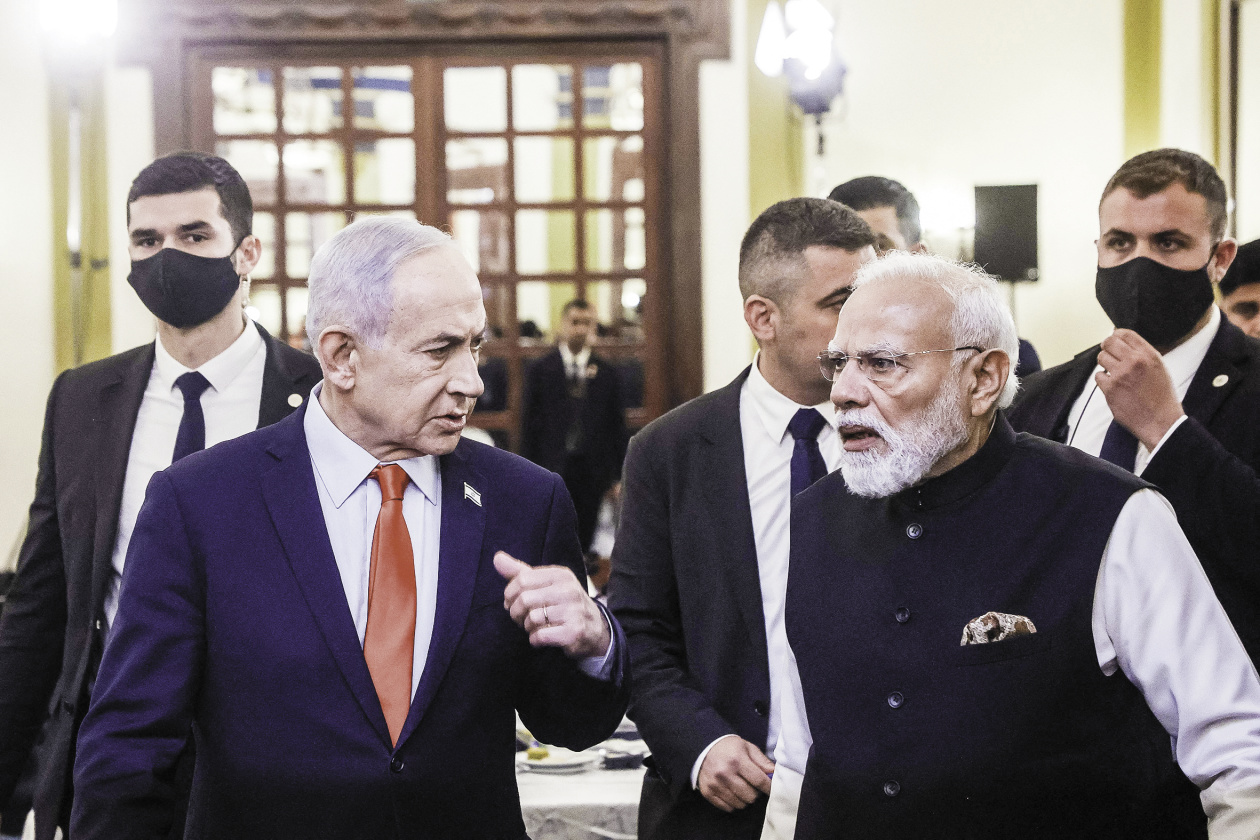
拉拢印度,以色列被曝或将分享“铁穹”等军事技术
Xin Lang Cai Jing· 2026-02-26 15:35
Core Viewpoint - India and Israel are expected to sign a $10 billion defense cooperation agreement, which includes the provision of Israel's "Iron Dome" and "Iron Beam" air defense systems to India [1][4]. Group 1: Defense Cooperation Agreement - The agreement will involve the transfer of advanced military technologies, including offensive weapons such as the SPICE-1000 precision-guided bomb and various missile systems [1]. - The focus of the defense collaboration will be on air defense systems, particularly the "Arrow" missile defense system, "David's Sling," "Iron Dome," and "Iron Beam" [1][2]. - India aims to produce these systems under the "Make in India" initiative and integrate them into a multi-layered defense network by 2035 [1]. Group 2: Strategic Partnership - The strengthening of India-Israel relations is being referred to as a "special strategic partnership," a term previously reserved for the U.S.-Germany relationship [4]. - Analysts suggest that Israel is looking to bind India into its security architecture through the transfer of sensitive military technology, which would create long-term institutional ties [5]. - The collaboration is seen as a move to counter regional threats, particularly from Turkey and other hostile forces in the Middle East [5]. Group 3: Political Context - The meeting between Indian Prime Minister Modi and Israeli Prime Minister Netanyahu emphasized the importance of defense and security in their partnership [5]. - The partnership is also viewed as a response to India's vulnerabilities in drone, missile, and cyber capabilities, especially following the India-Pakistan conflict [5].
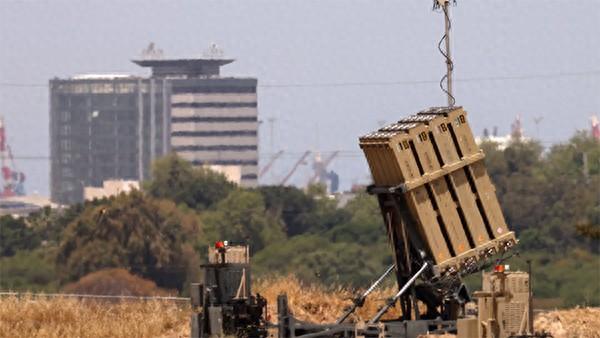
再过10-12天,以军将耗尽反导系统
Guan Cha Zhe Wang· 2025-06-18 09:30
Core Insights - The ongoing conflict between Iran and Israel has led to significant depletion of Israel's missile defense systems, with estimates suggesting they could be exhausted in 10 to 12 days if Iran maintains its current attack intensity [1][5] - Iran's missile stockpile is also under pressure, with approximately 2,000 missiles initially available, of which around 400 have been launched, resulting in a loss of one-third of their arsenal [3][4] Group 1: Israel's Defense Situation - Israel's missile defense system is reportedly overwhelmed, leading to a "missile rationing" strategy where they must selectively intercept incoming threats [1][5] - The cost of Israel's missile defense operations is substantial, with nightly expenses reaching 1 billion shekels (approximately 285 million USD) [4] - The reliance on expensive missile systems, such as the Arrow system costing 3 million USD per missile, poses sustainability challenges for Israel's defense strategy [6] Group 2: Iran's Offensive Strategy - Iran appears to be employing a strategy of small-scale, continuous attacks to deplete Israel's defense capabilities, potentially using older and less advanced missiles [4] - The intensity of Iran's missile launches has decreased significantly, with a drop from over 150 missiles in one night to just 10 in a subsequent attack [3] - Analysts suggest that Iran's remaining missile capabilities are still significant, with more than half of their arsenal reportedly intact and possibly hidden in underground facilities [3]