
长江班列

Search documents
四川多趟货运班列春节不打烊
Xin Lang Cai Jing· 2026-02-24 15:14
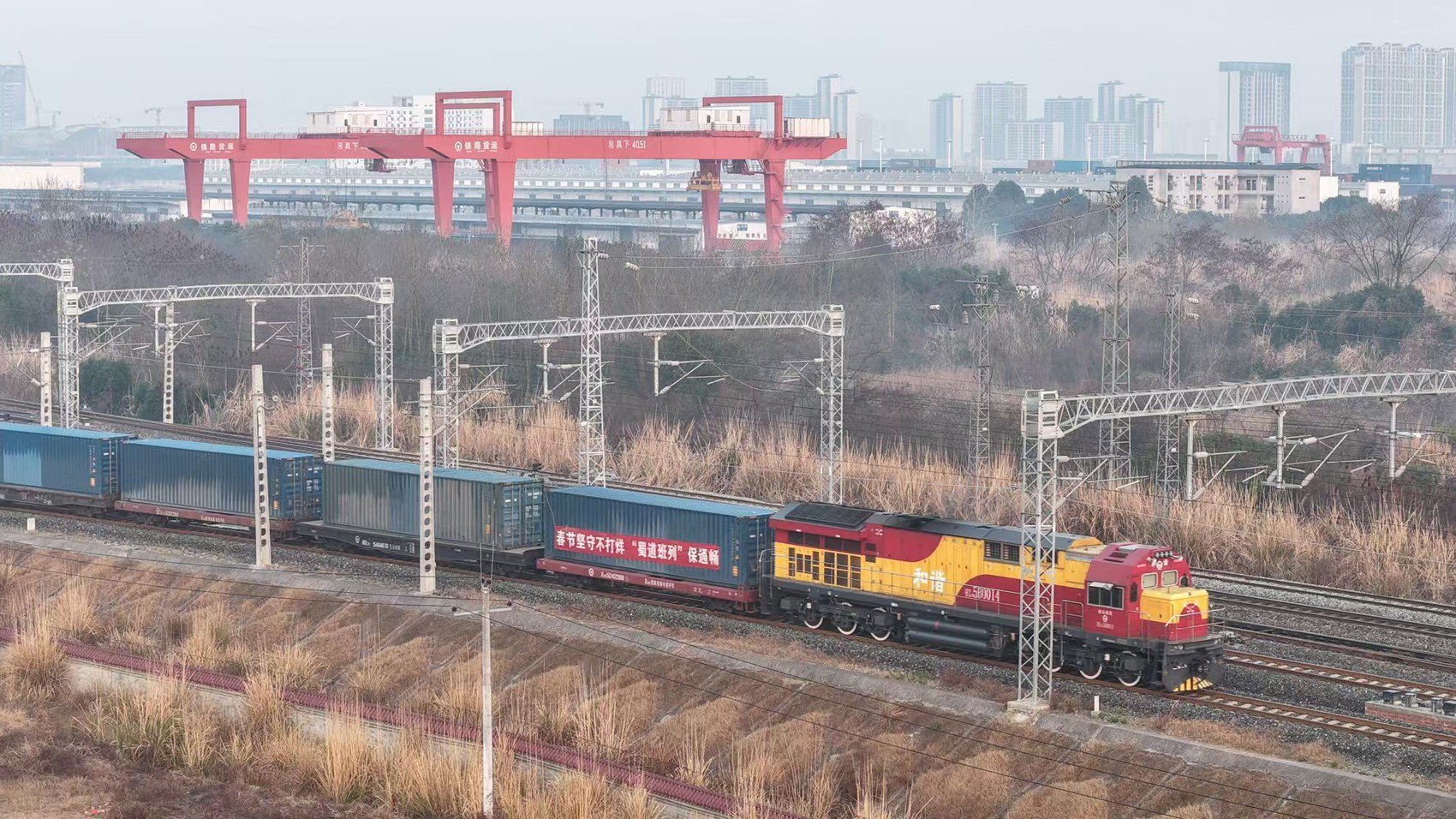
Core Insights - The article highlights the continuous operation of freight trains during the Spring Festival, specifically the "Yangtze River Express," "Northbound Express," and "Greater Bay Area Express," which collectively operated 39 trains and transported approximately 54,395 tons of goods, ensuring uninterrupted supply during the holiday season [1][2]. Group 1: Freight Train Operations - The "Yangtze River Express" was established to enhance the transportation capacity of the Yangtze River Golden Waterway, utilizing a rail-water intermodal system that significantly reduces transportation time by half compared to traditional water transport [1][2]. - During the Spring Festival, a train loaded with 1,100 tons of coke traveled from Dazhou to Wuhan, demonstrating the efficiency of the "Yangtze River Express" in transporting raw materials for steel production [3]. - The "Northbound Express" transported 20 standard containers of flour from Meishan to Yinan, Shandong, showcasing its role in regional supply chains [3]. Group 2: Regional Supply Chain Impact - The "Greater Bay Area Express" facilitated the rapid delivery of Sichuan specialties such as hot pot base and doubanjiang to the Guangdong-Hong Kong-Macau Greater Bay Area within 36 hours, enhancing the festive market offerings [2][3]. - The return trips of the "Greater Bay Area Express" included transporting fashion items, beverages, and home appliances from the Greater Bay Area to Sichuan, further enriching the local holiday market [3].

“长江班列”九江首发 实现长江中游三省全覆盖
Si Chuan Ri Bao· 2025-10-27 00:48
Core Viewpoint - The launch of the "Yangtze River Express" from Jiujiang marks a significant expansion of the rail-water intermodal transport system, enhancing the logistics capabilities for bulk commodity transportation in the central Yangtze River region [1] Group 1: Transportation Development - The "Yangtze River Express" is designed to improve the transportation capacity of the Yangtze River Golden Waterway, successfully extending its service to Jiangxi province after covering Sichuan, Hubei, and Hunan [1] - The intermodal transport system combines rail and water transport, significantly reducing transportation time for goods, such as corn, from 25 days to 10-12 days [1] Group 2: Operational Efficiency - The new transport model shifts from traditional bulk transport to a standardized containerized approach, utilizing 50 standard containers for the shipment of corn [1] - This transition to a "bulk to container" transport model enhances efficiency by reducing loading and unloading times and minimizing loss rates during transportation [1]
成都青白江区再启新班列 联通中国“四大增长极”
Mei Ri Jing Ji Xin Wen· 2025-07-23 14:11
Core Insights - The launch of the "Northbound Train" and "Bay Area Premium Train" from Chengdu marks a new chapter in cross-regional logistics, creating a closed-loop connection among China's four major economic growth poles: Beijing-Tianjin-Hebei, Yangtze River Delta, Guangdong-Hong Kong-Macao Greater Bay Area, and Chengdu-Chongqing Economic Circle [1][2] Group 1 - The "Northbound Train" and "Bay Area Premium Train" signify a key upgrade for the provincial operator, Shudao Group, transitioning from a single eastward operation to a "three-axis collaborative" network that enhances logistics efficiency between strategic national regions [2] - The "Yangtze River Train," set to launch on December 10, 2023, will significantly reduce transportation time by up to two-thirds compared to traditional water transport and lower costs by approximately one-third compared to full rail transport, establishing a cost-effective and timely logistics channel [1] - The regular operation of multi-directional trains will lead to a substantial decrease in energy consumption per ton of goods transported and significantly lower carbon emissions per unit of turnover, promoting a shift from road to rail transport for bulk goods [2] Group 2 - This green logistics model aligns with the national "dual carbon" strategy and aims to guide the logistics industry towards low-carbon development, fostering a comprehensive green transformation in production, transportation, and storage sectors [2]