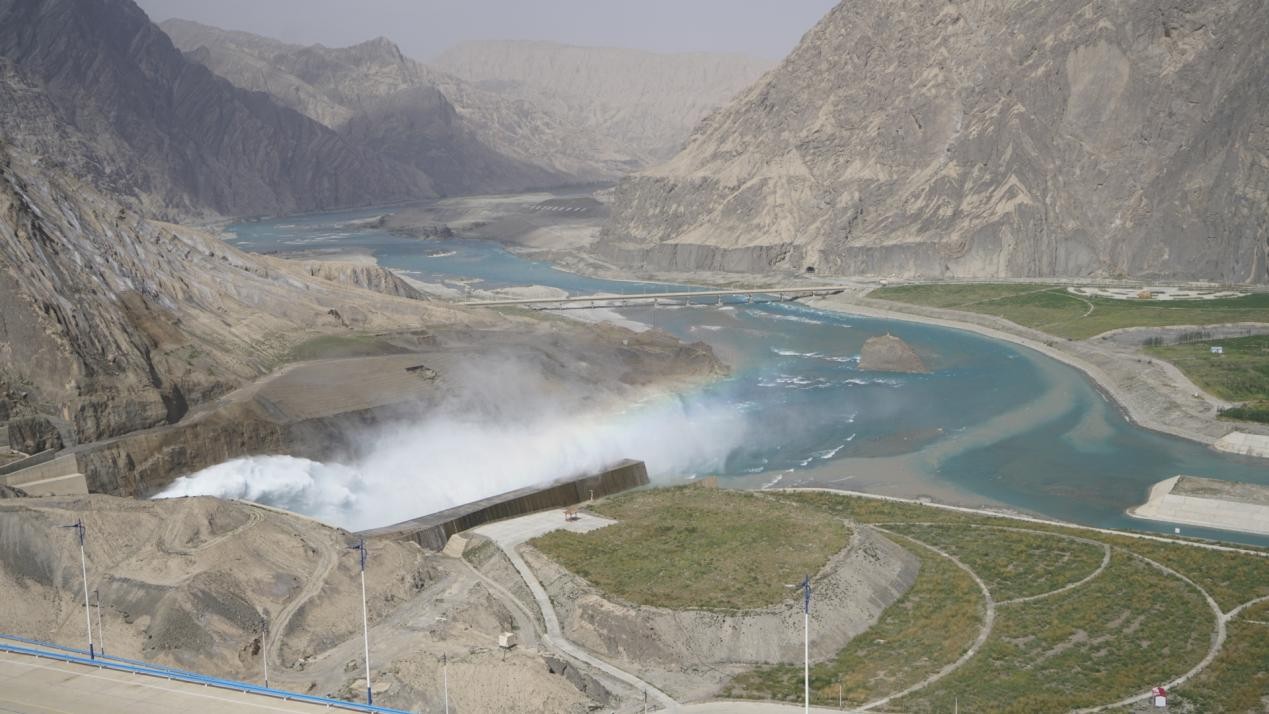
阿尔塔什水利枢纽

Search documents
绘就人水和谐新画卷(砥砺奋进七十载 天山南北谱华章)
Ren Min Ri Bao· 2025-09-18 03:35
Core Viewpoint - The water conservancy projects in Xinjiang have significantly improved agricultural irrigation, flood control, and ecological sustainability, contributing to the region's high-quality economic and social development over the past 70 years [1]. Group 1: Water Conservancy Projects - The construction of the Altash Water Conservancy Hub began in 2011, addressing challenges such as high seismic intensity and deep riverbed coverage, and has since improved flood control standards and expanded irrigated areas from 6.51 million acres to over 10 million acres [2]. - The Dashi Gorge Water Conservancy Hub, part of a national initiative, is expected to provide ecological water for over 8 million acres of farmland upon completion in 2026, with a total reservoir capacity of 1.17 billion cubic meters [3]. Group 2: Economic and Social Impact - The Altash project has created approximately 12,000 job opportunities during its construction, with over 3,000 technical workers trained, leading to an expected per capita annual income of 24,000 yuan in the village by 2024 [2]. - The Uruvat Water Conservancy Hub has supplied 23.9 billion cubic meters of water, increasing irrigated areas to 6.0379 million acres and improving irrigation water utilization efficiency to 0.575 [4]. Group 3: Technological Integration - The introduction of digital technologies in irrigation has reduced water usage from 90 cubic meters per acre to 35 cubic meters per acre, saving significant costs and improving crop yields by 20 kilograms per acre [7]. - The digital agricultural training base has trained over 20,000 individuals, enhancing fertilizer utilization rates by 20% and reducing labor costs by over 70% [7]. Group 4: Infrastructure Development - Xinjiang has constructed 671 reservoirs, 125,400 kilometers of irrigation channels, and over 8,000 kilometers of protective embankments, achieving an irrigation area of 99.17 million acres and a rural tap water coverage rate of 99% [8].
新疆水利事业实现从“人逐水走”到“水为人用”的跨越 绘就人水和谐新画卷(砥砺奋进七十载 天山南北谱华章)
Ren Min Ri Bao· 2025-09-17 21:53
Core Viewpoint - The water management and irrigation projects in Xinjiang have significantly improved agricultural productivity and ecological sustainability, marking a transition from traditional water usage to modern, efficient systems [1][2][3]. Group 1: Water Management Projects - The Altarash Water Conservancy Project, initiated in 2011, has transformed flood management and irrigation in the Yarkand River basin, increasing irrigated land from 6.51 million acres to over 10 million acres [2]. - The Dashi Gorge Water Conservancy Project, part of a national initiative, is expected to provide ecological water for over 8 million acres of farmland upon completion in 2026, with a total reservoir capacity of 1.17 billion cubic meters [3]. - The Uruvat Water Conservancy Project has supplied 23.9 billion cubic meters of water, increasing irrigated area to 6.0379 million acres and improving irrigation efficiency [4]. Group 2: Technological Integration - The integration of digital technologies in irrigation, such as the "Hui Feng Shou" app, has allowed farmers to manage water usage more efficiently, reducing costs and increasing crop yields [7]. - The use of satellite remote sensing and smart electric valves has decreased water usage per acre from 90 cubic meters to 35 cubic meters, saving significant water resources [7]. - The agricultural irrigation water utilization efficiency in the region has reached 0.7, with fertilizer utilization rates improving by 20% and labor costs decreasing by over 70% [7]. Group 3: Economic and Social Impact - The construction of water projects has created job opportunities, employing 12,000 local workers and training over 3,000 skilled laborers [2]. - The average annual income in Altarash village is projected to reach 24,000 yuan by 2024, reflecting the economic benefits of improved water management [2]. - The overall irrigation area in Xinjiang has reached 99.17 million acres, with a rural tap water coverage rate of 99%, showcasing the extensive impact of water management initiatives [8].
阿尔塔什枢纽赋能 水困村变致富乡
Ren Min Wang· 2025-08-16 07:23
Core Viewpoint - The Altash Water Conservancy Project has significantly improved the livelihoods of local villagers by providing employment opportunities and enhancing infrastructure, ultimately contributing to the socio-economic development of the region [1][5][8]. Group 1: Project Overview - The Altash Water Conservancy Project is the largest water conservancy project in Xinjiang, located at the border of Shache County and Akto County [1][5]. - As part of the national "13th Five-Year Plan," the project was completed in 2021 and has resolved issues related to water scarcity and flooding in the Yarkand River basin [5]. - The project features a dam height of 164.8 meters, making it the tallest dam built on soft foundations at the time of its completion [5]. Group 2: Economic and Social Impact - The project has provided employment for 80% of the labor force in the village, leading to increased income and skill development among villagers [1][5]. - Infrastructure improvements in transportation and communication have been stimulated by the project, creating additional job opportunities [8]. - The project has ensured stable water and electricity supply, significantly improving the quality of life for local residents and enabling them to invest in their futures [8]. Group 3: Technical Achievements - The construction of the dam involved overcoming several world-class technical challenges, including high seismic intensity and stability of high slopes [5]. - Advanced technologies such as high slope stability techniques and concrete construction methods in cold regions were applied, establishing the project as a benchmark in the water conservancy field [5]. Group 4: Broader Implications - The Altash Water Conservancy Project serves multiple functions, including power generation, flood prevention, irrigation, and ecological protection, contributing to social stability and national security in the region [5][8]. - The project exemplifies the "water management for prosperity" initiative in southern Xinjiang, promoting ethnic unity and socio-economic development [8].