阿里通义千问(Qwen)

Search documents
性能比肩Gemini 3 Pro!昨晚,阿里千问最强模型来了
机器之心· 2026-01-27 04:59
Core Viewpoint - The launch of Alibaba's Qwen3-Max-Thinking model marks a significant advancement in AI capabilities, positioning it among the top domestic models comparable to international leaders like GPT-5.2 and Gemini 3 Pro [1][5]. Performance Evaluation - Qwen3-Max-Thinking has achieved impressive scores across various benchmarks, including: - MMLU-Pro: 85.7 - MMLU-Redux: 92.8 - C-Eval: 93.7 - GPQA: 87.4 - LiveCodeBench v6: 85.9 - IMOAnswerBench: 83.9 - Overall, it has surpassed previous records in 19 mainstream evaluation benchmarks [4][5]. Model Specifications - The model boasts over 1 trillion parameters and has been trained on 36 trillion tokens, making it Alibaba's largest and most powerful reasoning model to date [4][5]. Innovative Features - Qwen3-Max-Thinking introduces a Heavy Mode for reasoning, allowing for iterative self-reflection and experience accumulation, which enhances problem-solving efficiency without significantly increasing token costs [13]. - The model integrates tool usage into the reasoning process, enabling it to perform complex tasks in a more strategic manner, thus reducing errors and improving real-world applicability [14]. Market Impact - As of January 2026, the Qwen series has achieved over 1 billion downloads on Hugging Face, establishing itself as one of the most popular open-source AI model series [15]. - The introduction of Qwen3-Max-Thinking signifies a shift in the AI market focus from merely intelligent chatbots to powerful intelligent agents capable of executing complex tasks [15].


智谱API订阅制取得显著商业化进展 目前年度经常性收入已过亿
Zheng Quan Shi Bao Wang· 2025-12-02 14:18
Core Insights - The CEO of Zhiyu, Zhang Peng, announced that the company's software tools and model business (GLM coding plan) has achieved an annual recurring revenue (ARR) of over 100 million RMB (approximately 14 million USD) [1] - Despite being average compared to American competitors, this figure indicates significant progress in convincing Chinese developers to pay for AI services [1] - Zhiyu expects to see over 100% revenue growth by 2025 [1] Revenue Diversification - Zhiyu is diversifying its revenue structure by shifting focus from government and enterprise clients to embrace developers in China and other regions [1] - The company aims to prioritize model applications and API services, with a goal of increasing the revenue share from API business to 50% [1] - Currently, Zhiyu's API platform serves over 2.7 million paying customers, including some of China's largest tech companies [1] Subscription Model - The API subscription model allows developers to subscribe to services on a monthly or annual basis [1] - In September, Zhiyu launched an AI-driven coding tool subscription plan priced as low as 20 RMB per month, which is about one-seventh of the price of Anthropic's Claude [1] - The coding tool plan has reportedly attracted over 150,000 users [1] Competitive Positioning - Zhang Peng stated that Zhiyu's models are among the best in the world, emphasizing significant advantages in pricing and costs [2] - The company aims to become the first publicly listed AI large model vendor in China [2] - There is a strong demand for high-quality AI services in the Chinese market, which currently exceeds supply [2] Model Performance - Zhiyu was founded in 2019 by researchers from Tsinghua University and has received support from Alibaba, Tencent, and various local government funds [2] - The GLM-4.6 model from Zhiyu ranks just below top models from Silicon Valley on the benchmark site LMArena, alongside models from DeepSeek and Alibaba's Qwen [2] - The recent releases of GLM-4.5 and GLM-4.6 have garnered global attention for their performance, particularly in enhancing programming and intelligent agent capabilities [2]
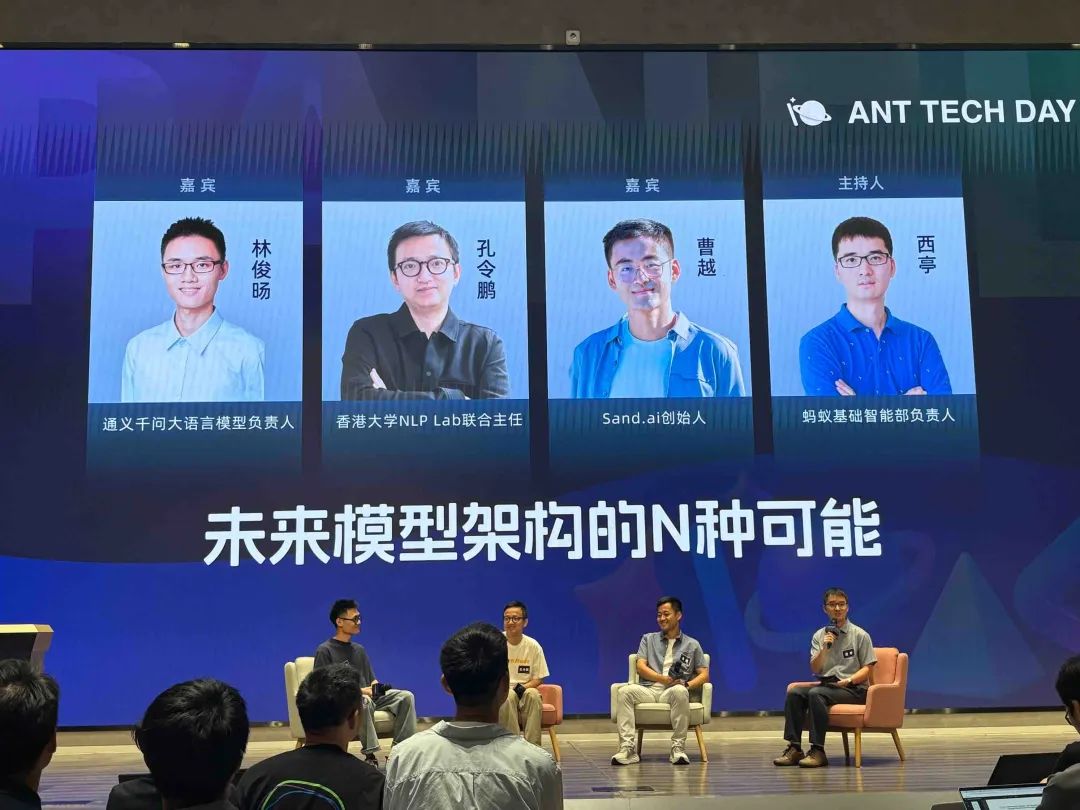
三位顶流AI技术人罕见同台,谈了谈AI行业最大的「罗生门」
3 6 Ke· 2025-05-28 11:59
Core Insights - The AI industry is currently experiencing a significant debate over the effectiveness of pre-training models versus first principles, with notable figures like Ilya from OpenAI suggesting that pre-training has reached its limits [1][2] - The shift from a consensus-driven approach to exploring non-consensus methods is evident, as companies and researchers seek innovative solutions in AI [6][7] Group 1: Industry Trends - The AI landscape is witnessing a transition from a focus on pre-training to exploring alternative methodologies, with companies like Sand.AI and NLP LAB leading the charge in applying multi-modal architectures to language and video models [3][4] - The emergence of new models, such as Dream 7B, demonstrates the potential of applying diffusion models to language tasks, outperforming larger models like DeepSeek V3 [3][4] - The consensus around pre-training is being challenged, with some experts arguing that it is not yet over, as there remains untapped data that could enhance model performance [38][39] Group 2: Company Perspectives - Ant Group's Qwen team, led by Lin Junyang, has faced criticism for being conservative, yet they emphasize that their extensive experimentation has led to valuable insights, ultimately reaffirming the effectiveness of the Transformer architecture [5][15] - The exploration of Mixture of Experts (MoE) models is ongoing, with the team recognizing the potential for scalability while also addressing the challenges of training stability [16][20] - The industry is increasingly focused on optimizing model efficiency and effectiveness, with a particular interest in achieving a balance between model size and performance [19][22] Group 3: Technical Innovations - The integration of different model architectures, such as using diffusion models for language generation, reflects a broader trend of innovation in AI [3][4] - The challenges of training models with long sequences and the need for effective optimization strategies are critical areas of focus for researchers [21][22] - The potential for future breakthroughs lies in leveraging increased computational power to revisit previously unviable techniques, suggesting a cycle of innovation driven by advancements in hardware [40][41]