
雅加达综合指数

Search documents
印尼股市创30年来最大两日跌幅
Di Yi Cai Jing· 2026-01-29 07:37
Core Viewpoint - The Indonesian stock market is experiencing its worst two-day performance in 30 years, driven by concerns raised by MSCI regarding the market's investability and transparency [1][3][4]. Market Performance - On January 29, the Jakarta Composite Index fell by as much as 10%, triggering a 30-minute trading halt, following a drop of over 8% the previous day [3]. - The market is at risk of entering a technical bear market if the downward trend continues [3]. - The Indonesian rupiah also saw its largest decline against the US dollar since October of the previous year, dropping by 0.5% [5]. MSCI Concerns - MSCI has raised alarms about the low free float of stocks in the Indonesian market, with over 200 components having a free float ratio below 15% [4]. - MSCI has suspended certain index adjustments and frozen the addition of new constituents until issues related to concentrated ownership are addressed by Indonesian regulators [4]. - If improvements in transparency are not made by May, MSCI may reassess Indonesia's market access, potentially leading to a downgrade in its weight in the MSCI Emerging Markets Index [4]. Investor Sentiment - Goldman Sachs and UBS have downgraded their ratings on the Jakarta Composite Index, with Goldman Sachs warning of a potential outflow of over $13 billion from the Indonesian stock market under extreme conditions [5]. - There has been a notable shift in investor sentiment, with foreign investors net selling $192 million worth of Indonesian stocks as of January 23, marking the first outflow in 16 weeks [5]. Regulatory Response - The Indonesia Stock Exchange has acknowledged MSCI's feedback and is committed to enhancing market data transparency and reliability [6]. - The exchange plans to publicly disclose free float data starting January 2, 2026, and will consult market participants on ideal free float ratios [6]. - Regulatory bodies are considering increasing the minimum free float requirement from the current 7.5% to between 10% and 15%, with a long-term goal of 25% [6][7].

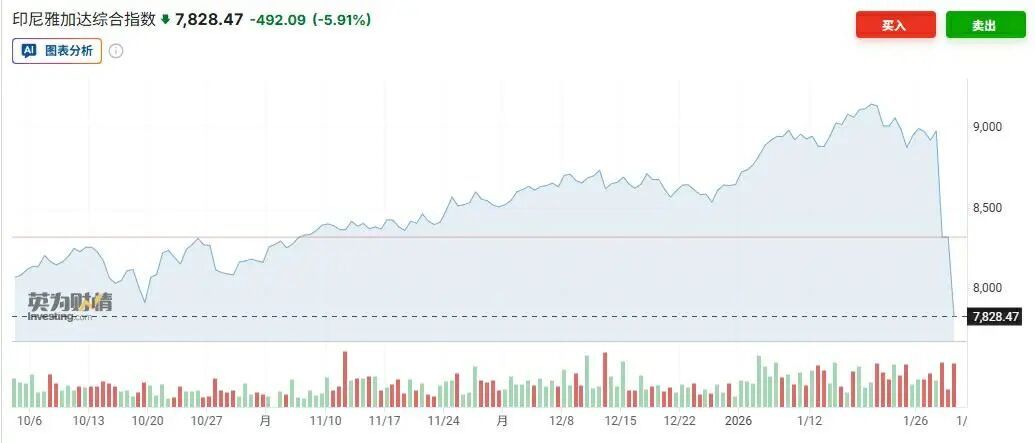
印尼股市创30年来最大两日跌幅
第一财经· 2026-01-29 07:16
Core Viewpoint - The Indonesian stock market is experiencing its worst two-day decline in 30 years, driven by concerns raised by MSCI regarding the market's investability and transparency [3][6]. Market Performance - On January 29, the Jakarta Composite Index fell by as much as 10%, triggering a trading halt, while it had previously dropped over 8% on January 27, leading to another trading suspension [6][8]. - If the downward trend continues, the index may enter a technical bear market [6]. MSCI Concerns - MSCI has raised alarms about the low free float of stocks in Indonesia, with over 200 components having a free float ratio below 15%, which distorts the index and poses manipulation risks [7][10]. - MSCI has paused index adjustments and frozen new component stocks until regulatory issues regarding concentrated ownership are addressed [6][7]. Investor Sentiment - Following MSCI's warning, foreign investors have become increasingly cautious, with net sales of Indonesian stocks reaching $1.92 million for the week ending January 23, marking the first outflow in 16 weeks [8][9]. - On January 27, foreign investors sold a record net amount of 6.2 trillion Indonesian rupiah (approximately $3.71 million) in a single day [9]. Regulatory Response - The Indonesian Stock Exchange has acknowledged MSCI's feedback and is committed to enhancing market data transparency and reliability [9][10]. - Plans are underway to increase the minimum free float ratio from 7.5% to between 10% and 15%, with a long-term goal of 25% [10]. Future Outlook - Goldman Sachs and UBS have downgraded their ratings for the Jakarta Composite Index, with Goldman Sachs warning of potential capital outflows exceeding $13 billion under extreme conditions [6][9]. - The Indonesian financial authorities are preparing stricter rules for small business listings to improve market conditions [10].

印尼股市大跌逾8% MSCI将暂停指数调整并敦促监管解决股权集中问题
Xin Lang Cai Jing· 2026-01-28 08:00
Core Viewpoint - The Indonesian stock market experienced a significant drop, with the Jakarta Composite Index falling by 8.82%, the largest decline in over nine months, following MSCI Inc.'s announcement to suspend certain index adjustments until regulatory issues regarding concentrated ownership in listed companies are addressed [1][4]. Group 1: Market Reaction - The Jakarta Composite Index triggered a 30-minute trading halt due to the steep decline [1]. - MSCI's decision to freeze the addition of new index constituents and limit the number of stocks available for investment was based on ongoing concerns about "fundamental investment feasibility" and potential price manipulation [1][4]. Group 2: Regulatory Concerns - MSCI indicated that if Indonesia fails to improve transparency by May, it will reassess the country's market investability, which could lead to a reduction in the weight of Indonesian companies in the MSCI Emerging Markets Index or even a downgrade to frontier market status [1][4]. - The Indonesian Stock Exchange expressed opposition to MSCI's actions and committed to meeting the transparency requirements set by MSCI, including publishing free float data on its official website [1][4]. Group 3: Investor Sentiment - Concerns regarding free float definitions have become a catalyst for investor disappointment in Indonesia's $976 billion stock market, where trading is perceived to be dominated by a few wealthy individuals [2][5]. - Analysts noted that the potential downgrade to frontier market status could significantly impact passive fund flows into Indonesia, especially as foreign investor participation has already decreased due to macroeconomic and policy concerns [6]. Group 4: Analyst Insights - Analysts believe that the likelihood of Indonesia being downgraded to frontier market status is low due to the presence of a substantial number of foreign investors and good liquidity [6]. - There is a consensus that while risks exist, the market's reaction should not be viewed as a capitulation event, and the MSCI's freeze on index adjustments serves as a warning rather than a final decision [7].