
MSCI新兴市场指数

Search documents
MSCI中国指数2月调整结果公布 新纳入33只A股、4只港股标的
Shang Hai Zheng Quan Bao· 2026-02-11 17:54
Group 1 - MSCI announced the results of its February index review, adding 37 stocks to the MSCI China Index, including notable A-shares and Hong Kong stocks [1] - The MSCI China Index is significant as it is part of the MSCI Global Standard Index series, which means stocks included will attract substantial passive fund tracking [1] - The adjustments are based on objective quantitative indicators such as market capitalization and liquidity, with four annual reviews scheduled [1] Group 2 - The MSCI Global Standard Index added 63 stocks and removed 61, with the largest new additions being AST SpaceMobile, Coherent Corp, and FTAI Aviation [2] - Adjustments will take effect after the market closes on February 27, 2026, with passive funds likely to adjust their positions at the end of the trading day to minimize tracking error [2] - Historical data shows that newly added A-shares to the MSCI China Index typically achieve stable excess returns between the announcement and the effective date of the adjustments [2] Group 3 - Institutions expect international funds to further increase their holdings in Chinese assets in 2026, with a slight increase in the overweight level of Asian investment funds towards Chinese stocks [3] - UBS identified that 143 out of 800 tracked active overseas funds had no exposure to Chinese stocks as of Q4 2025, indicating potential inflows of $16 billion if these funds reallocate to benchmark weights [3] - Active foreign institutional investors are selectively buying sectors such as internet, insurance, renewable energy, and industrials, while showing caution towards automotive and healthcare sectors [3]





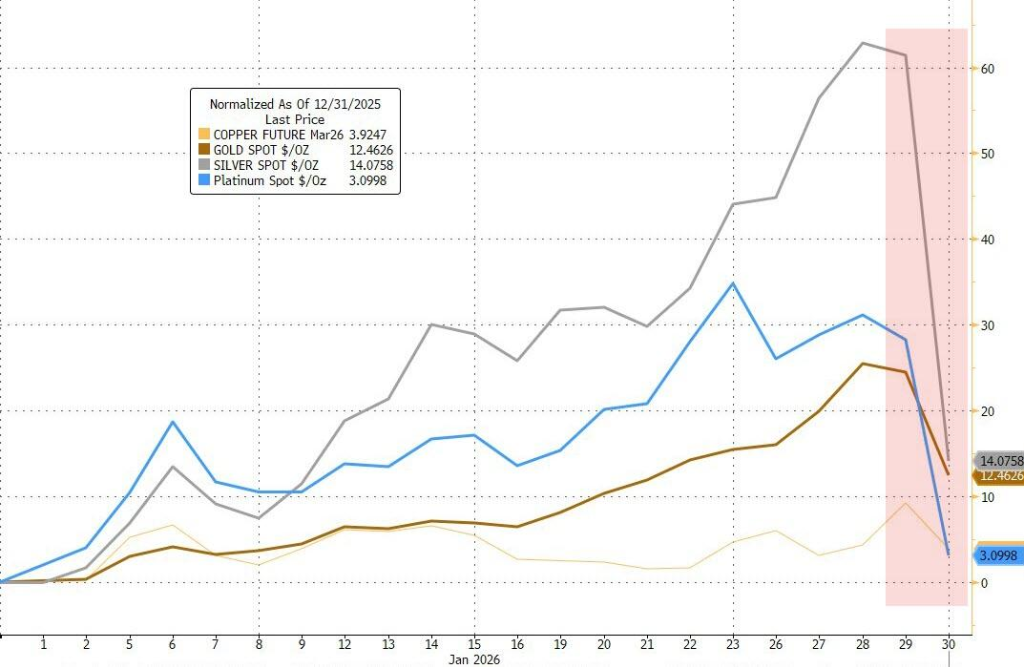
暴涨、火爆、崩盘--金银领衔主演,2026的市场“开年大戏”格外精彩
Hua Er Jie Jian Wen· 2026-01-31 02:04
Core Viewpoint - The recent market volatility highlights the fragility of consensus, as extreme trading positions can lead to significant price swings even with minor fluctuations [1]. Group 1: Market Dynamics - The market experienced a dramatic sell-off in precious metals, with gold dropping 10% and erasing $5 trillion in market value over two days [1]. - Silver saw a sharp decline of 37%, while platinum fell over 16%, and copper reversed all gains from the previous day [1]. - The market is characterized by crowded long positions and record levels of bullish options, creating a potential for "gamma squeeze" [3]. Group 2: Investor Sentiment - A Bank of America survey indicated that being long on gold is currently the most crowded trade globally, with gold prices exceeding long-term trend lines by 44%, a level not seen since 1980 [4]. - The silver sentiment index reached its highest level since 1998, indicating extreme bullish sentiment among investors [4]. Group 3: Broader Market Implications - The dollar index experienced its largest single-day gain since May, negatively impacting investors who were short on the dollar [3]. - Emerging market equities have underperformed relative to U.S. stocks, marking the worst performance since 2022 [3]. - The recent volatility in precious metals serves as a warning for other crowded trades across various markets [10]. Group 4: Investment Strategies - The current market environment raises questions about the viability of contrarian investors, as momentum-driven trading dominates [11]. - Some investors, like Rich Weiss, have maintained a contrarian stance, favoring U.S. equities over international markets despite recent underperformance [11]. - Concerns are growing among investors about whether the recent market fluctuations signal an early warning for exiting crowded trades [11].

印尼股市暴跌,再度熔断
第一财经· 2026-01-29 04:19
Core Viewpoint - The Indonesian stock market experienced a significant decline, with the index dropping over 8% and triggering a trading halt due to concerns raised by MSCI regarding the market's investability [1][5]. Group 1: Market Performance - On January 29, the Indonesian Composite Index fell over 8% during trading, leading to a 30-minute trading suspension [1]. - After the resumption of trading, the index continued to decline, eventually dropping over 10% at one point and closing down 7.35% [2][4]. Group 2: MSCI Concerns - MSCI expressed concerns about the investability of the Indonesian stock market, citing issues such as excessive concentration of ownership among listed companies [5]. - MSCI announced an immediate suspension of certain index adjustments and froze the addition of new constituent stocks until regulatory issues are addressed [6]. - MSCI warned that if Indonesia does not make sufficient progress in transparency by May, it will reassess the market's access status, which could lead to a reduction in the weight of Indonesian stocks in the MSCI Emerging Markets Index or even a downgrade risk [7][8].


印尼股市熔断,恢复交易继续暴跌近10%
2 1 Shi Ji Jing Ji Bao Dao· 2026-01-29 03:22
Core Viewpoint - The Jakarta Composite Index in Indonesia experienced a significant drop, triggering a trading halt due to concerns raised by MSCI regarding the investability of the Indonesian stock market [1] Group 1: Market Performance - The Jakarta Composite Index fell over 8% during early trading on January 29, leading to a 30-minute trading suspension [1] - After resuming trading, the index continued to decline, ultimately falling by approximately 10% [1] - On the previous trading day, January 28, the index closed at 8320.56 points, reflecting a decrease of 7.35% from the prior day [1] Group 2: MSCI Concerns - MSCI expressed concerns about the investability of the Indonesian stock market, leading to the immediate suspension of certain index adjustments and freezing of new constituent stocks [1] - MSCI warned that if Indonesia does not achieve sufficient progress in information transparency by May, it will reassess the market's access status [1] - A potential downgrade in the weight of Indonesian stocks in the MSCI Emerging Markets Index could occur, posing a risk of overall market downgrade [1]
印尼股市熔断,恢复交易继续暴跌近10%
21世纪经济报道· 2026-01-29 03:18
Group 1 - The core point of the article is the significant drop in Indonesia's benchmark stock index, the Jakarta Composite Index, which fell over 10% after triggering a trading halt due to concerns raised by MSCI regarding the investability of the Indonesian stock market [1] - On January 28, the Jakarta Composite Index closed at 8320.56 points, reflecting a decline of 7.35% from the previous trading day [1] - MSCI has expressed concerns about excessive concentration of ownership in listed companies and has decided to suspend certain index adjustments and freeze new constituent stocks until regulatory issues are addressed [1] Group 2 - MSCI warned that if Indonesia does not make sufficient progress in information transparency by May, it will reassess the market's access status, which could lead to a reduction in the weight of Indonesian stocks in the MSCI Emerging Markets Index or even a downgrade risk [1]

印尼股市大跌逾8% MSCI将暂停指数调整并敦促监管解决股权集中问题
Xin Lang Cai Jing· 2026-01-28 08:00
Core Viewpoint - The Indonesian stock market experienced a significant drop, with the Jakarta Composite Index falling by 8.82%, the largest decline in over nine months, following MSCI Inc.'s announcement to suspend certain index adjustments until regulatory issues regarding concentrated ownership in listed companies are addressed [1][4]. Group 1: Market Reaction - The Jakarta Composite Index triggered a 30-minute trading halt due to the steep decline [1]. - MSCI's decision to freeze the addition of new index constituents and limit the number of stocks available for investment was based on ongoing concerns about "fundamental investment feasibility" and potential price manipulation [1][4]. Group 2: Regulatory Concerns - MSCI indicated that if Indonesia fails to improve transparency by May, it will reassess the country's market investability, which could lead to a reduction in the weight of Indonesian companies in the MSCI Emerging Markets Index or even a downgrade to frontier market status [1][4]. - The Indonesian Stock Exchange expressed opposition to MSCI's actions and committed to meeting the transparency requirements set by MSCI, including publishing free float data on its official website [1][4]. Group 3: Investor Sentiment - Concerns regarding free float definitions have become a catalyst for investor disappointment in Indonesia's $976 billion stock market, where trading is perceived to be dominated by a few wealthy individuals [2][5]. - Analysts noted that the potential downgrade to frontier market status could significantly impact passive fund flows into Indonesia, especially as foreign investor participation has already decreased due to macroeconomic and policy concerns [6]. Group 4: Analyst Insights - Analysts believe that the likelihood of Indonesia being downgraded to frontier market status is low due to the presence of a substantial number of foreign investors and good liquidity [6]. - There is a consensus that while risks exist, the market's reaction should not be viewed as a capitulation event, and the MSCI's freeze on index adjustments serves as a warning rather than a final decision [7].
看好A股,外资巨头集体发声
Zhong Guo Zheng Quan Bao· 2025-10-01 04:57
Group 1 - Foreign investment in Chinese assets is increasing, with major international banks like Goldman Sachs and HSBC recommending an "overweight" position on A-shares [1][2] - A recent survey by HSBC indicates that over half of the respondents are optimistic about the A-share market, a significant increase from about one-third in June [1][2] - Goldman Sachs raised its 12-month target for the MSCI Emerging Markets Index from 1370 to 1480 points, suggesting a potential upside of approximately 10% [1] Group 2 - As of the end of Q2, northbound capital's total market value reached 2.29 trillion yuan, an increase of over 2% from the end of Q1 [2] - In the first half of the year, foreign investors net increased their holdings in domestic stocks and funds by $10.1 billion, with significant inflows in May and June totaling $18.8 billion [2] Group 3 - Multiple factors are boosting investor confidence, including policy support and a favorable economic outlook [3] - China's economic fundamentals remain strong, with rapid advancements in industries such as renewable energy, artificial intelligence, and biomedicine [3] Group 4 - Long-term capital inflows are a key reason for foreign optimism towards Chinese assets, supported by domestic institutions like insurance and pension funds [4] - The weakening of the US dollar is expected to further attract funds into Asian markets [4] Group 5 - Investor interest in the A-share market has significantly increased, driven by ample liquidity and accelerated technological innovation [5] - With households holding substantial additional savings (5% of GDP), there is potential for further revaluation in innovative sectors like robotics [5] Group 6 - The ongoing capital market reforms and opening up are crucial for attracting foreign investment in Chinese assets [6][7] - The China Securities Regulatory Commission plans to expedite key measures for capital market openness by 2025, including optimizing the QFII system [6][7]


每日投行/机构观点梳理(2025-09-25)
Jin Shi Shu Ju· 2025-09-25 10:56
Group 1: Currency and Economic Outlook - Barclays reports that despite recent negative events, the US dollar has remained resilient, with no significant decline observed since May, even amid weak economic data and challenges to the Federal Reserve's credibility [1] - Goldman Sachs predicts that the US economy will recover in the coming months, which may support the dollar's continued strength [1] Group 2: Oil and Emerging Markets - Goldman Sachs states that a complete ban on Russian oil imports by the EU is unlikely due to reliance from certain member states like Hungary and Slovakia, and any potential ban would only redistribute oil flows rather than reduce global supply [2] - Goldman Sachs expects emerging market stocks and currencies to rise by the end of the year, raising the MSCI Emerging Markets Index target from 1,370 to 1,480 points, indicating a potential 10% upside [2] Group 3: Domestic Market Insights - Dongfang Jincheng forecasts stable and ample market liquidity by year-end, with potential for a new round of reserve requirement ratio cuts and government bond purchases [4] - CITIC Securities highlights the long video industry benefiting from favorable policies, which may enhance production capacity and efficiency for content creators [6][10] - CITIC Securities notes a recovery in the restaurant industry, with August seeing a year-on-year increase in dining revenue, suggesting structural opportunities for leading companies with strong compliance and quality [8] Group 4: Sector-Specific Developments - CITIC Securities indicates that the carbon fiber industry is in a recovery phase, with strong demand in wind energy and aerospace sectors, recommending attention to high-quality companies with international exposure [9] - China Galaxy Securities observes a slight increase in cement prices due to seasonal demand, with expectations for further price support from rising coal prices [11][12] - China Galaxy Securities also reports positive signals in panel procurement ahead of the overseas promotional season, indicating a potential peak in TV demand [13] Group 5: Electronic Materials - Huatai Securities emphasizes the importance of electronic cloth in the PCB-CCL supply chain, predicting a supply shortage for various specialty electronic cloth products until 2026, and recommends companies with rapid capacity expansion [14][15]
摩根大通:预期的美联储降息将加速美元走弱,MSCI新兴市场指数正突破原先目标1250点,迈向乐观情境目标1350点!建议超配印度韩国巴西等
Sou Hu Cai Jing· 2025-09-04 02:48
Core Insights - Morgan Stanley's strategy report indicates that the MSCI Emerging Markets Index has surpassed the previously set benchmark target of 1250 points and is moving towards the optimistic target of 1350 points, driven by the anticipated easing cycle of the Federal Reserve [1] Group 1 - The initial prediction in June was for a single rate cut of 25 basis points by the Federal Reserve in December, but the forecast has now been revised to a total of 75 basis points in cuts by year-end, starting from September 17 [1] - The expected rate cuts are anticipated to weaken the US dollar and strengthen emerging market currencies, providing room for emerging market central banks to initiate, extend, or resume their own rate-cutting cycles [1] - The report recommends an overweight position in emerging markets, specifically in India, South Korea, Brazil, the Philippines, and South Africa [1]

新兴市场股市升至2022年以来最高
news flash· 2025-06-09 22:59
Group 1 - The MSCI Emerging Markets Index rose by 0.9%, reaching its highest level since early 2022 [1] - The Vanguard FTSE Emerging Markets ETF, valued at $87 billion, increased by 0.7% [1] - An index measuring the currencies of developing countries also saw an increase, with the Polish zloty and Hungarian forint leading the gains [1]