前沿市场

Search documents
印尼股市跌去800亿美元后,监管当局紧急稳市:推行三项改革、交易所主席辞职
智通财经网· 2026-01-30 09:05
Core Viewpoint - Indonesia's Chief Economic Minister Airlangga Hartarto has committed to enhancing financial market transparency and improving corporate governance following a significant stock market crash, which led to the resignation of the chairman of the Indonesia Stock Exchange [1][2] Group 1: Government Actions and Reforms - Proposed reforms include increasing the free float of stocks from 7.5% to 15%, allowing pension and insurance funds to raise their capital market investment limit from 8% to 20%, and reviewing the relationships of shareholders with stakes below 5% [1] - The government aims to protect investor rights through good corporate governance and transparency [1] Group 2: Market Reactions and Ratings - Following MSCI's warning about potentially downgrading Indonesia's market rating to "frontier market," UBS downgraded Indonesia's stock market rating to neutral, while Goldman Sachs lowered it to "underweight," predicting potential capital outflows of several billion dollars [2] - The Jakarta Composite Index fell over 8% in two days but rebounded by 1.18% after the announcement of measures to address MSCI's concerns [2] Group 3: Investor Sentiment and Foreign Investment - Foreign investors net sold approximately $645 million in stocks during the two-day sell-off, with a total of $1 billion expected to be sold by 2025 [3] - Concerns over President Prabowo Subianto's fiscal policies and increased government intervention in financial markets have led to rising foreign capital outflows [3]
印尼股市大跌逾8% MSCI将暂停指数调整并敦促监管解决股权集中问题
Xin Lang Cai Jing· 2026-01-28 08:00
Core Viewpoint - The Indonesian stock market experienced a significant drop, with the Jakarta Composite Index falling by 8.82%, the largest decline in over nine months, following MSCI Inc.'s announcement to suspend certain index adjustments until regulatory issues regarding concentrated ownership in listed companies are addressed [1][4]. Group 1: Market Reaction - The Jakarta Composite Index triggered a 30-minute trading halt due to the steep decline [1]. - MSCI's decision to freeze the addition of new index constituents and limit the number of stocks available for investment was based on ongoing concerns about "fundamental investment feasibility" and potential price manipulation [1][4]. Group 2: Regulatory Concerns - MSCI indicated that if Indonesia fails to improve transparency by May, it will reassess the country's market investability, which could lead to a reduction in the weight of Indonesian companies in the MSCI Emerging Markets Index or even a downgrade to frontier market status [1][4]. - The Indonesian Stock Exchange expressed opposition to MSCI's actions and committed to meeting the transparency requirements set by MSCI, including publishing free float data on its official website [1][4]. Group 3: Investor Sentiment - Concerns regarding free float definitions have become a catalyst for investor disappointment in Indonesia's $976 billion stock market, where trading is perceived to be dominated by a few wealthy individuals [2][5]. - Analysts noted that the potential downgrade to frontier market status could significantly impact passive fund flows into Indonesia, especially as foreign investor participation has already decreased due to macroeconomic and policy concerns [6]. Group 4: Analyst Insights - Analysts believe that the likelihood of Indonesia being downgraded to frontier market status is low due to the presence of a substantial number of foreign investors and good liquidity [6]. - There is a consensus that while risks exist, the market's reaction should not be viewed as a capitulation event, and the MSCI's freeze on index adjustments serves as a warning rather than a final decision [7].
新兴市场在2025年逆风翻盘,分析师预计明年优势还将继续
Feng Huang Wang· 2025-12-09 09:40
Group 1 - Emerging market assets have performed strongly this year, with the MSCI Emerging Markets Index rising nearly 30% as of November 28, compared to a 17% increase in the MSCI Global Index, driven by favorable macroeconomic conditions and improving investor sentiment [1] - Fund management company Asia Frontier is investing in stocks from Sri Lanka and Bangladesh, indicating that these countries are in the early stages of economic restructuring and governance improvement [1] - Aberdeen sees potential for bond price increases in Argentina, Ghana, and Ecuador, while Federated Hermes is increasing investments in frontier market bonds, particularly favoring Nigeria, Sri Lanka, Pakistan, and Ecuador [1] Group 2 - Frontier markets, which are less developed than emerging markets, have also gained popularity, with the MSCI Frontier Markets Index up 43% this year, potentially marking its best performance since 2005 [2] - Some previously debt-laden economies have become favored by investors due to their perceived immunity to trade tensions and geopolitical risks, contrasting with the fiscal challenges faced by major developed countries [2] - Federated Hermes highlights that frontier market bonds offer high yield returns and capital appreciation potential, with lower correlation to overall risk markets [2] Group 3 - The robust performance of the US economy and a weakening dollar create ideal conditions for emerging and frontier market stocks, while China's economic resilience boosts investor confidence in these markets [3] - Emerging markets provide opportunities to invest in world-class companies with cutting-edge technological innovations, with emerging market tech stocks trading at a price-to-earnings ratio of 18, compared to 31 for US tech stocks, raising concerns of a bubble in the latter [3]
“升入”富时罗素新兴市场指数,越南股指创出历史新高
Hua Er Jie Jian Wen· 2025-10-08 06:40
Group 1 - FTSE Russell's decision to upgrade Vietnam from a frontier market to an emerging market is expected to attract billions of dollars in foreign investment and boost its capital markets, marking significant international recognition for Vietnam's market-friendly reforms [1][2] - Following the announcement, Vietnam's benchmark stock index reached a historic high of 1,735 points, reflecting a 2% increase during early trading, and has risen by one-third this year, outperforming other Southeast Asian markets [1][2] Group 2 - The upgrade is projected to unlock approximately $6 billion in net capital inflows into Vietnam's market, although the official change will take effect on September 21, 2026, with a mid-term review scheduled for March next year [3] - The upgrade is particularly important in the context of current global trade challenges, as Vietnam faces potential export reductions to the U.S. due to a 20% tariff on imports, making it one of the most affected Southeast Asian economies [4] - The upgrade sends a strong signal to global investors that Vietnam, as an export-driven economy, can withstand recent trade headwinds, thereby enhancing investor confidence amid trade uncertainties [4]
地缘政治风险消退 小摩力荐前沿市场债券
智通财经网· 2025-06-27 13:24
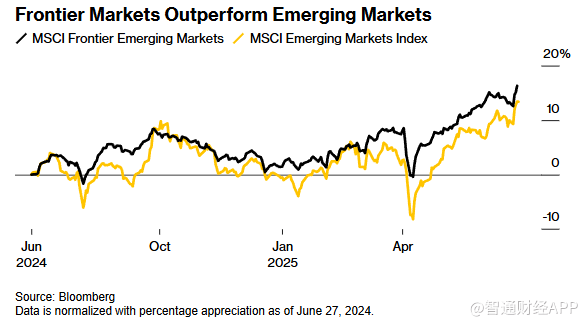
Core Viewpoint - JPMorgan strategists believe that frontier market bonds are expected to yield substantial returns in the upcoming quarter due to the easing of geopolitical risks, a weakening dollar, and rising gold prices [1]. Group 1: Frontier Market Bonds - Frontier markets, which lie between the least developed countries and emerging markets, have shown resilience during geopolitical tensions, with no significant sell-off in local currency bonds [1]. - The performance of frontier markets is anticipated to surpass that of emerging markets, particularly in a relatively calm summer [1]. Group 2: Economic Conditions and Interest Rates - Despite uncertainties in U.S. trade policies, developed countries' interest rate cuts and a weaker dollar are expected to provide room for interest rate reductions in frontier economies [1]. - Countries like Ghana, Egypt, and Nigeria are projected to benefit from potential interest rate cuts of 600 basis points, 400 basis points, and 200 basis points respectively in the remaining part of the year [1]. Group 3: Nigeria's Bond Market - Nigerian naira bonds are highlighted as a preferred investment by JPMorgan, with the bank re-establishing long positions in Nigerian Open Market Operations (OMO) securities due to expectations of oil prices remaining above $60 per barrel [1]. - This oil price stability is expected to help Nigeria maintain a current account surplus and accelerate reserve accumulation in the second half of the year, with Nigerian bonds likely benefiting from interest rate cuts [1]. Group 4: Impact of Oil and Gold Prices - While oil prices above $60 per barrel are advantageous for oil-exporting frontier countries, they are not detrimental to oil-importing nations like Pakistan [2]. - Countries such as Ghana and Uzbekistan are benefiting from rising gold prices, a trend that is expected to continue throughout the year [2].