
雪上龙舟

Search documents
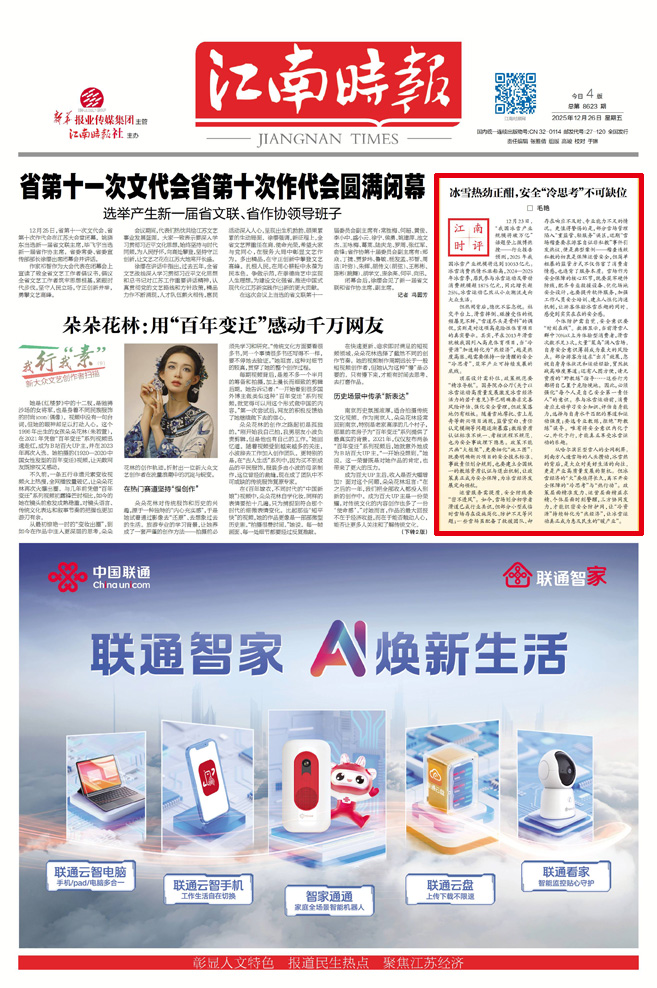
冰雪热劲正酣,安全“冷思考”不可缺位
Jiang Nan Shi Bao· 2025-12-25 14:09
Core Viewpoint - The ice and snow industry in China is projected to exceed 1 trillion yuan by 2025, with a significant increase in consumer participation and spending, but safety concerns must be addressed to ensure sustainable growth [5]. Industry Overview - The ice and snow industry is expected to reach a scale of 1,005.3 billion yuan by 2025, with consumer spending during the 2024-2025 season projected to exceed 187.5 billion yuan, reflecting a year-on-year growth of over 25% [5]. - Ice and snow sports are transitioning from niche activities to mainstream participation, indicating a growing trend in consumer interest [5]. Safety Concerns - The rise in popularity of ice sports has led to an increase in safety incidents, with social media highlighting injuries and accidents, emphasizing the need for a focus on safety [5]. - Ice sports have been classified as high-risk activities since 2013, necessitating a balance between industry growth and safety measures [5]. Policy Recommendations - The government has called for improved risk assessment and safety management in the ice and snow industry, but implementation remains lacking [6]. - There is a need for detailed regulations that address emerging sports, safety standards, and a unified certification system for coaches to enhance safety [6]. Operational Improvements - While many ski resorts have adopted beginner-friendly slopes, smaller or temporary venues often lack adequate safety measures and professional rescue teams [7]. - The focus on regulation over service quality has led to negative consumer experiences, highlighting the need for better service and safety protocols at ski resorts [7]. Individual Responsibility - Over 70% of skiers are inexperienced, which increases safety risks; consumers must take personal responsibility for their safety by understanding their limits and choosing appropriate challenges [8]. - It is crucial for participants to seek qualified instructors and prioritize safety knowledge to enjoy ice sports safely [8]. Conclusion - The growth of the ice and snow economy is tied to effective safety measures and consumer awareness, requiring collaboration between policy, operations, and individual responsibility to ensure long-term sustainability [8].

滑雪相撞谁取证?北京延庆法院发布涉冰雪典型案例和法律风险提示
Xin Jing Bao· 2025-12-03 11:53
Core Viewpoint - The Beijing Yanqing District People's Court has established a "Snow Shield" judicial service team to address legal issues in the ice and snow industry, having handled 47 ice and snow-related cases over the past three years, with a significant increase in cases in 2025 [1] Group 1: Judicial Service and Case Handling - The Yanqing Court has processed 47 ice and snow-related cases in the last three years, with 7 cases in 2023, 10 in 2024, and 30 in the first ten months of 2025 [1] - The establishment of the "Snow Shield" judicial service team aims to create an integrated organizational support system and a professional dispute resolution chain to meet the judicial needs of the ice and snow industry [1] Group 2: Legal Responsibilities of Operators - In a case involving a tourist injury at an ice and snow project, the court ruled that internal agreements between operators do not exempt them from liability to third parties, emphasizing that both companies involved must share compensation responsibilities [2] - The court highlighted that operators must carefully select partners when outsourcing operations and fulfill safety obligations to avoid legal disputes [2] Group 3: Liability in High-Risk Activities - In a collision case between two snowboarders, the court ruled that the plaintiff failed to prove the defendant's fault, reinforcing the principle that participants in high-risk sports assume certain risks and must provide evidence of negligence to claim damages [3][4] - The court noted that the snow sports industry is governed by the "self-assumed risk" rule, where participants are generally not entitled to compensation unless there is evidence of intentional wrongdoing or gross negligence by another participant [4] Group 4: Recommendations for Risk Management - The Yanqing Court advised ice and snow industry operators to ensure compliance in contracts, marketing, and safety measures to mitigate risks and avoid disputes [5] - Operators are encouraged to maintain safety standards, conduct regular inspections, and provide clear risk information to consumers, especially for vulnerable groups like minors [5] Group 5: Guidance for Participants - Ice and snow sports participants are urged to recognize their limits, adhere to safety rules, and ensure proper supervision of minors during activities [6] - The court emphasized that guardians of minors must take primary responsibility for any injuries or damages caused by inadequate supervision, particularly for children under eight years old [6]