非粮生物基材料

Search documents
全国非粮生物基材料产业创新发展典型案例公布 山东9案例入选,数量全国第一
Da Zhong Ri Bao· 2026-02-07 01:02
Core Viewpoint - The Ministry of Industry and Information Technology and the Ministry of Agriculture and Rural Affairs have jointly announced typical cases of innovative development in the non-grain bio-based materials industry, with 35 cases selected nationwide, highlighting the importance of technological innovation and application expansion in this sector [1] Group 1: Industry Overview - The selection of typical cases focuses on three main directions: key technological innovation, application scenario expansion, and the cultivation of characteristic bases [1] - The initiative aims to accelerate the promotion and application of key technologies and high-quality products in the non-grain bio-based materials industry, fostering advanced industrial clusters [1] Group 2: Regional Highlights - Shandong province leads the nation with 9 selected cases, attributed to its status as a major agricultural province with high and widely distributed annual usable quantities of non-grain biomass such as corn cobs, straw, furfural residue, and lignin [1] - The province has a mature collection and transportation system and continues to strengthen the dual drive of chemical and biological manufacturing [1] Group 3: Applications and Impact - Related materials from this sector are widely used in tires, footwear, biodegradable packaging, battery anodes, and engineering plastics [1] - The industry has formed a model of "resource recycling - technological innovation - industrial agglomeration - green value addition" [1]
学习贯彻党的二十届四中全会精神·权威访谈丨奋力开创高质量发展高效能治理新局面——访濮阳市委书记万正峰
He Nan Ri Bao· 2025-11-04 00:01
Group 1: Economic Development and Industrial Strategy - Puyang City aims to strengthen its manufacturing backbone and solidify the foundation for high-quality development, focusing on the chemical new materials industry with 185 large-scale industrial enterprises and an output value of 85 billion yuan [1] - The city plans to enhance its green chemical and new materials industry to achieve an output value exceeding 200 billion yuan during the 14th Five-Year Plan, establishing itself as a leading domestic base for chemical new materials [1] - Puyang will also upgrade its modern home furnishings, down products, and apparel industries while developing emerging sectors like biomanufacturing and high-end equipment, and will accelerate the layout of future industries such as hydrogen energy and artificial intelligence [1] Group 2: Market Integration and Infrastructure Development - Puyang City will actively integrate into the national unified market, leveraging its geographical advantages to enhance connectivity and drive economic circulation [2] - The city is committed to improving the business environment through six major actions, including market expansion and infrastructure connectivity, while focusing on the construction of key transportation corridors like the Xiongshan and Anpu-Henan high-speed railways [2] - Puyang aims to serve as a hub for both domestic and international market dual circulation, contributing to the national unified market [2] Group 3: Social Governance and Environmental Protection - Puyang City will enhance social governance by promoting efficient grassroots governance and utilizing a model that combines party building, grid management, and big data [3] - The city will focus on improving public welfare and addressing urgent issues faced by the populace, ensuring a high quality of life [2] - Puyang is committed to ecological protection, aiming to enhance the storage capacity of the Central Plains gas storage cluster to approximately 16 billion cubic meters and promote the development of non-grain bio-based materials [2]
2024年安徽农作物秸秆综合利用量超4600万吨 利用率达95%
Zhong Guo Xin Wen Wang· 2025-10-31 11:28
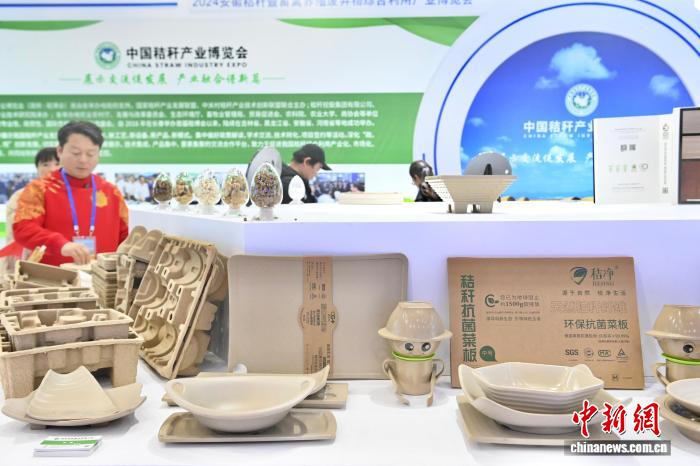
Core Insights - In 2024, Anhui Province's comprehensive utilization of agricultural straw exceeds 46 million tons, achieving a utilization rate of 95% [1][3] - Nearly 2,300 enterprises utilize over 1,000 tons of straw annually [1] Group 1: Industry Development - Anhui has established a "two-utilization" industry system focusing on the comprehensive utilization of straw and livestock waste, with an annual output value exceeding 45 billion RMB [3] - The province's annual collection capacity of agricultural straw is approximately 49 million tons [3] - The comprehensive utilization models include the production of liquefied biogas, organic fertilizers, and non-food bio-based materials [3] Group 2: Environmental Impact - The province emphasizes a green agricultural model that combines planting and breeding to reduce agricultural waste's impact on rural water environments [3] - The livestock waste management follows a "source reduction, process control, end utilization" approach, implementing a "3+N" model for effective waste treatment [4] - The annual production of commercial organic fertilizers exceeds 2.8 million tons, and biogas generation reaches 10.83 million kilowatt-hours [3][4]

七部门再发文!发展非粮生物基材料、生物化工产业
合成生物学与绿色生物制造· 2025-10-16 10:08
Core Viewpoint - The article discusses the recent policy developments in the petrochemical industry in China, emphasizing the shift towards high-end and green transformation, particularly focusing on non-grain biomass utilization and bio-based materials as new growth areas [2][5][6]. Group 1: Policy Developments - On September 25, 2023, seven Chinese government departments released a work plan aimed at stabilizing and optimizing the petrochemical industry from 2025 to 2026, addressing challenges such as intensified competition in organic raw materials and slowing domestic demand [2]. - The work plan encourages the development of emerging fields like bio-based chemicals and non-grain biomass utilization, providing new momentum for the industry's green transformation [2][4]. Group 2: Focus on Bio-based Materials - The policy has shifted from "technology transformation" to "supply and demand quality improvement," indicating a maturation of industry technology and a focus on enhancing the quality of bio-based materials [5][6]. - The emphasis on non-grain bio-based materials has evolved from "industrial demonstration" to "typical case collection and promotion," suggesting that some bio-based materials can achieve a replicable business model [6]. Group 3: Growth in Bio-chemicals - The new work plan introduces a focus on "bio-chemicals," highlighting the rapid growth of synthetic biology in the chemical sector due to its green and efficient characteristics [7]. - Multiple government departments have issued documents supporting the development of bio-based and bio-manufacturing sectors throughout 2023, indicating a strong governmental push towards these industries [8][10].