高度盒子

Search documents
IDEA大会在深举行 多项低空前沿成果发布
Nan Fang Ri Bao Wang Luo Ban· 2025-11-24 08:46
Core Insights - The IDEA Conference held in Shenzhen on November 22 showcased advancements in the low-altitude economy, including the release of the OpenSILAS 2.0 system and the Low Altitude Economic Development White Paper 4.0 [1][2] Group 1: OpenSILAS 2.0 System - The OpenSILAS 2.0 system was introduced as a comprehensive management and service solution for low-altitude operations, addressing the complexities of urban environments and airspace [1] - The system enables full-cycle management and services across planning, operation, regulation, and service [1] Group 2: Low Altitude Economic Development White Paper 4.0 - The white paper discusses the technological development directions for communication, navigation, and monitoring in the low-altitude economy [1] - It recommends the establishment of a wide-area universal communication, navigation, and monitoring network to support the scalable operation of low-altitude flights [1] Group 3: Low Altitude Products - The conference featured innovative low-altitude products, including the "Height Box," which integrates multiple sensors for real-time data collection and cloud uploading [2] - The low-altitude integrated machine combines the core OpenSILAS system with various flight management and monitoring functions, allowing for independent deployment in secure network environments [2]
智能演进迈向物理世界,沈向洋:AI渴望从理解走向改变
Nan Fang Du Shi Bao· 2025-11-23 10:37
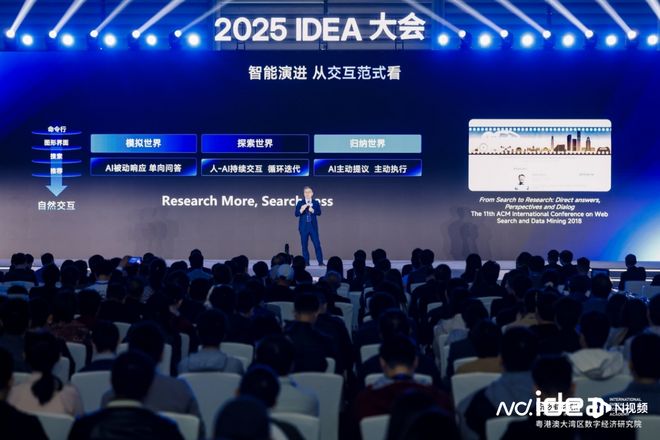
Core Insights - The AI industry in 2025 requires a focus on practical applications rather than just algorithms, emphasizing the transition from virtual to physical interactions [1] - The concept of "embodied intelligence" is highlighted as a bridge between digital and real-world applications, with dexterous hands being a significant technical challenge [3] - The low-altitude economy is evolving from observation to action, with advancements in management capabilities for aerial systems [6] Group 1: AI Industry Trends - The 2025 IDEA Conference in Shenzhen marks a shift in focus from language models to world models and embodied models, driven by the desire for AI to change the world [1] - The "Five-Dimensional Thinking" framework proposed by Shen Xiangyang includes algorithm paradigms, intelligent carriers, interaction paradigms, computing architectures, and data [1] Group 2: Embodied Intelligence - Dexterous hands represent the pinnacle of complexity in embodied intelligence, as evidenced by Tesla's challenges with humanoid robot hand development [3] - A recent competition showcased the practical applications of dexterous hands in real-world scenarios, emphasizing the need for robots to perform complex tasks autonomously [5] Group 3: Low-Altitude Economy - The IDEA Institute's white papers indicate a shift in focus from "cognition" to "action" in the low-altitude economy, with the OpenSILAS system evolving to manage the entire flight process [6][8] - Shenzhen's low-altitude economy is supported by a robust ecosystem, with over 2,000 companies and a significant share of the global drone market [8] Group 4: Regional Innovation - The Guangdong-Hong Kong-Macao Greater Bay Area is uniquely positioned with both electromechanical and AI technologies, creating opportunities for embodied intelligence development [9] - The DataArc project, focused on synthetic data technology, exemplifies the rapid innovation and funding in Shenzhen's AI infrastructure [9] Group 5: Institutional Developments - The establishment of the International Advanced Technology Application Promotion Center and the Shenzhen-Hong Kong Advanced Research Exchange Center aims to promote industrialization in AI and low-altitude technologies [10] - The IDEA Institute's initiatives reflect Shenzhen's commitment to innovation and practical applications in the evolving landscape of the low-altitude economy [10]