高速USB 3.0系列产品

Search documents
中资半导体出海再遇“国家安全”壁垒:FTDI事件背后的全球产业博弈
Huan Qiu Wang· 2025-12-27 12:39
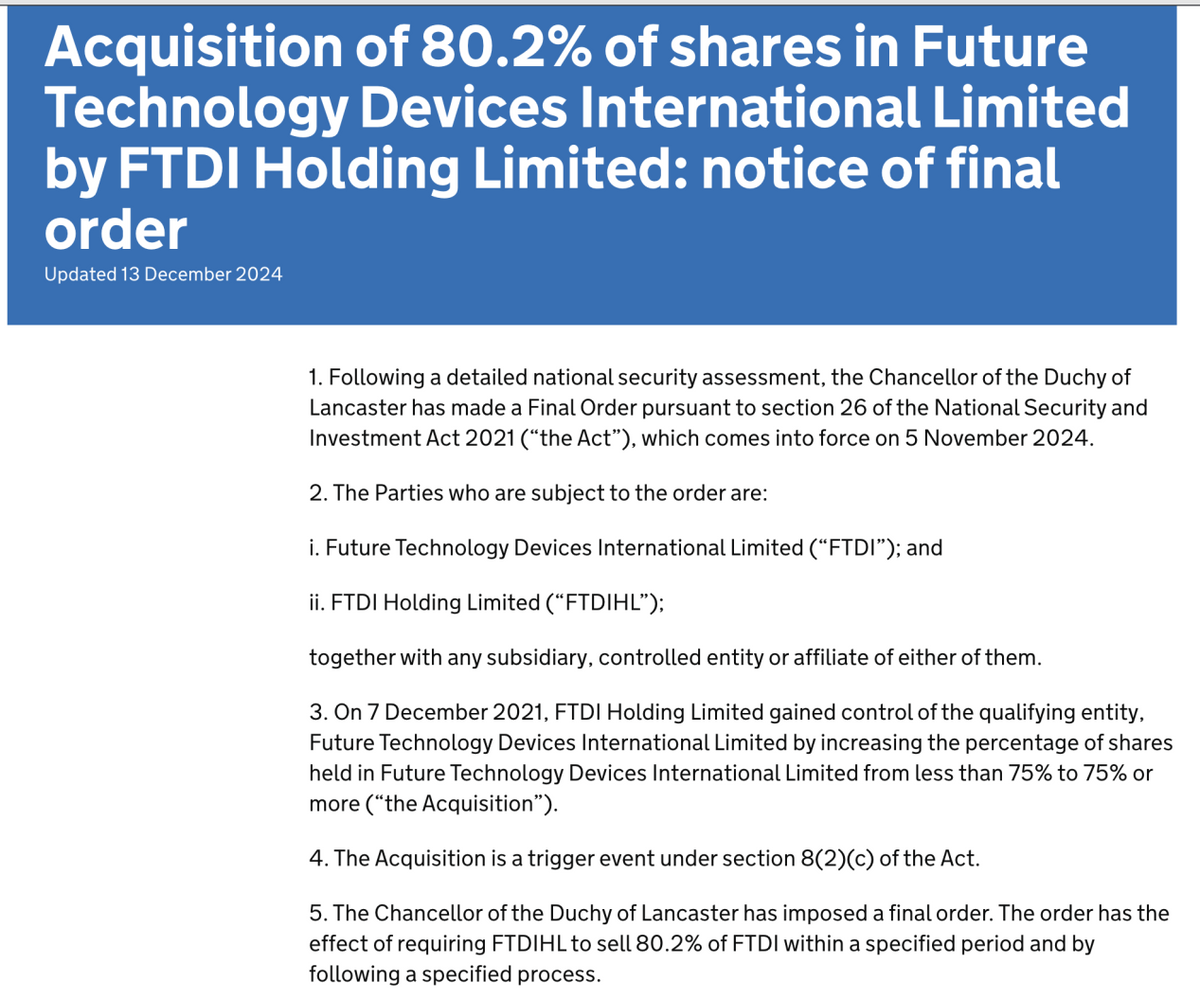
Core Viewpoint - The forced divestment of FTDI by the UK government highlights the increasing fragmentation and geopolitical tensions within the global semiconductor industry, particularly affecting Chinese investments in high-end technology sectors [1][5][7]. Group 1: Acquisition Details - In December 2021, Jian Guang Asset acquired 80.2% of FTDI for $414 million, marking a strategic move into the high-end analog chip sector by Chinese capital [1][3]. - FTDI, established in 1992, is a leading company in the USB bridge chip market with nearly 20% market share, crucial for various applications including automotive electronics and IoT [3][4]. - The acquisition was intended to integrate FTDI into the Chinese semiconductor ecosystem, addressing long-standing technological gaps [3][4]. Group 2: Regulatory Actions - The UK government initiated a security review under the National Security and Investment Act, classifying the acquisition as a "trigger event" [4][5]. - On November 5, 2024, the UK government mandated the sale of FTDI due to concerns over potential misuse of technology and threats to critical infrastructure, setting a deadline for divestment by December 2025 [1][4]. - Despite legal challenges from the Chinese entity, the UK High Court upheld the government's decision, removing legal obstacles to the forced sale [4][6]. Group 3: Implications for the Semiconductor Industry - The case reflects a broader trend of Western nations using "national security" as a rationale to restrict foreign investments, potentially leading to increased scrutiny of any Chinese semiconductor investments [5][6]. - The forced divestment of FTDI may undermine global supply chain stability and efficiency, as the semiconductor industry relies on international collaboration [7]. - The situation raises concerns about the potential for further fragmentation of the semiconductor market, which could exacerbate global chip shortages and price volatility [7]. Group 4: Future Considerations - The FTDI incident serves as a catalyst for reevaluating semiconductor governance rules, emphasizing the need for transparent and non-discriminatory international regulations [7]. - China advocates for open cooperation and fair competition in the semiconductor sector, contrasting with the political motivations observed in some Western countries [7].


“安世困境”再上演!中资半导体收购,频陷海外干预漩涡
是说芯语· 2025-12-17 04:27
Core Viewpoint - The article discusses the forced divestment of Chinese investment firm Jian Guang Asset's stake in FTDI, a leading global USB bridge chip company, by the UK government under the pretext of national security, highlighting geopolitical challenges faced by Chinese semiconductor investments abroad [1][5]. Group 1: Investment Context - Jian Guang Asset acquired 80.2% of FTDI for $414 million in December 2021, targeting FTDI's unique value in the global semiconductor industry [3]. - FTDI, established in 1992 and headquartered in Glasgow, is a hidden champion in the USB bridge chip sector, holding nearly 20% market share and competing with major players like Texas Instruments and Infineon [3][4]. Group 2: Strategic Importance - FTDI's integrated "chip + software + standards" advantage is crucial for addressing China's shortcomings in high-end analog and mixed-signal chips, making the acquisition a key part of China's semiconductor "supply chain strengthening" strategy [4]. - The acquisition aimed to enhance China's integrated circuit industry by introducing advanced technology and industry ecosystems from FTDI, supporting national industrial upgrades [4]. Group 3: Geopolitical Implications - The UK government's intervention is seen as a violation of legal principles, as the acquisition occurred before the enforcement of the UK's National Security and Investment Act, raising concerns about selective enforcement driven by geopolitical motives [5]. - The forced sale not only risks a significant financial loss for Jian Guang Asset but also represents a missed opportunity for China to acquire critical technology and improve its semiconductor supply chain [5]. - This incident, alongside the previous case of Nexperia, illustrates a systemic geopolitical blockade faced by Chinese firms in acquiring core semiconductor assets overseas [5].