
高铁动车

Search documents
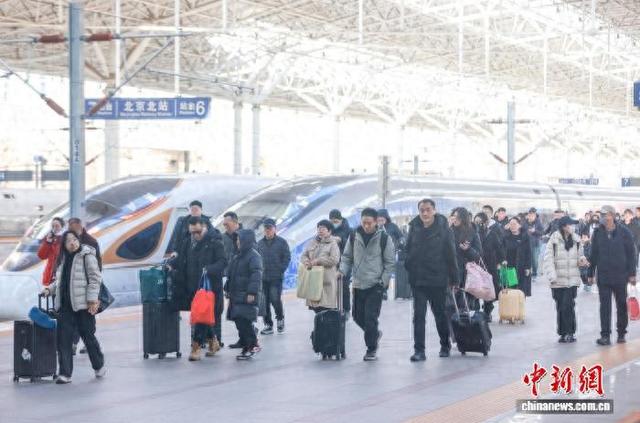
国铁北京局春节前夕开行夜间高铁扩容运力
Xin Lang Cai Jing· 2026-02-12 11:16
Group 1 - The core point of the news is that the China Railway Beijing Bureau Group Company anticipates sending 1.34 million passengers on February 12, with 806,000 expected to depart from Beijing and 381,000 arriving [1] - The bureau plans to increase train services by adding 197 passenger trains to various destinations including Harbin, Changchun, Shenyang, Zhengzhou, Wuhan, Changsha, Taiyuan, and Xi'an [1] - The addition includes 68 pairs of night high-speed trains and 9 pairs of sleeper trains, aimed at alleviating peak travel pressure and enhancing convenience for travelers [1] Group 2 - From February 10 to 12, various cultural activities were held at stations under the jurisdiction of the China Railway Beijing Bureau to warm the journey home for travelers [2] - On February 11, Beijing North Station collaborated with the Beijing Railway Society to host a calligraphy public welfare event titled "National Style Sending Blessings, Warm Journey," where calligraphers created Spring Festival couplets and characters [2] - The G365 high-speed train service has introduced a themed cultural experience called "Beijing Rhythm Chang'an: Intangible Cultural Heritage Together," providing an immersive experience for travelers and promoting cultural exchange [5]

彭曦:打通堵点扩大制度型开放
Jing Ji Ri Bao· 2025-11-11 00:10
Core Insights - The article emphasizes the importance of institutional openness in China's economic reform, focusing on areas such as property rights protection, industrial policy, environmental standards, labor protection, government procurement, e-commerce, and service industry openness [1][2] Group 1: Institutional Openness - Institutional openness is a key focus for China's economic reform during the "14th Five-Year Plan" period, with nearly 110 innovative measures implemented in trade, investment, and intellectual property [1] - The Shanghai Lingang area has been a pioneer in implementing high-standard digital trade rules, establishing pilot scenarios for digital trade and exploring new business models such as offshore data processing and storage [1] Group 2: Service Industry Reform - The service industry, including finance, education, and healthcare, faces challenges such as slow approval processes and a lack of enthusiasm for reform among some stakeholders [2] - The Free Trade Pilot Zones have not yet established a systematic guarantee system for early trials, and mechanisms for corporate participation in international standard-setting need improvement [2] Group 3: Innovation and Integration - There is a need to strengthen integrated innovation across the entire industrial chain by breaking down barriers between different levels, departments, and entities [3] - The focus should be on aligning with the highest international trade rules to promote new economic models and ensuring that enterprises feel tangible benefits from these reforms [3] Group 4: Digital Trade and AI - To adapt to the needs of artificial intelligence development, it is essential to align with international high-standard trade rules regarding data localization, cross-border data flow, and digital intellectual property protection [3] - More bilateral and multilateral digital trade agreements should be signed to facilitate the international expansion of domestic AI companies [3] Group 5: Standardization and Competitiveness - There is a push to enhance the international influence of Chinese standards, particularly in industries where China has technological advantages, such as new energy vehicles and high-speed rail [4] - The transition from merely exporting low-cost products to providing a full industrial chain system is necessary for improving international competitiveness [4]