128线车载激光雷达

Search documents
【大涨解读】无人驾驶:上海发文剑指L4级自动驾驶目标,马斯克旗下自动驾驶软件也有大动作,行业规模化落地加速
Xuan Gu Bao· 2026-01-15 02:58
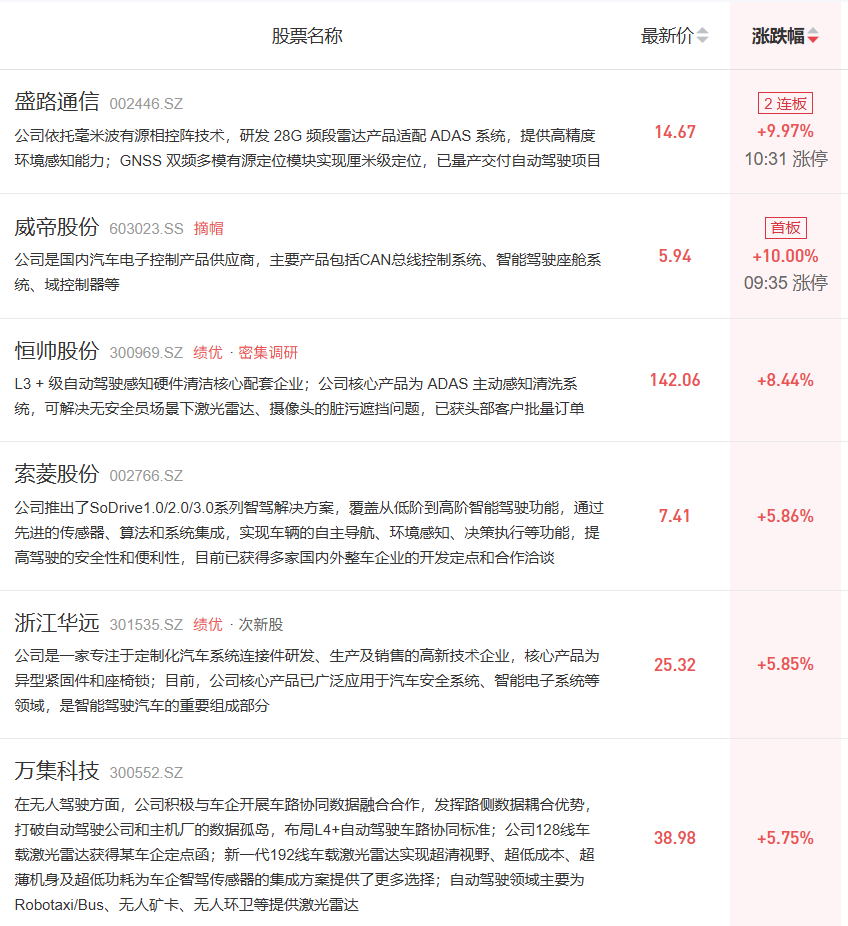
Market Performance - On January 15, the autonomous driving sector showed strong performance, with companies like Weidi Co., Suoling Co., and others hitting the daily limit up [1] - Notable stock movements included Shenglu Communication (+9.97%), Weidi Co. (+10.00%), Hengshuai Co. (+8.44%), and others showing significant gains [2] Events - On January 14, Shanghai's Economic and Information Commission, Transportation Commission, and Public Security Bureau jointly issued the "Shanghai High-Level Autonomous Driving Leading Area 'Mosu Zhixing' Action Plan," aiming for L4 autonomous driving applications by 2027, targeting over 6 million passengers and 800,000 standard containers, with a designated area of 2,000 square kilometers [3] - Tesla CEO Elon Musk announced that starting February 14, the global market will stop selling the one-time purchase version of FSD (Full Self-Driving) capability, transitioning to a monthly subscription model [3] - On January 5, NVIDIA released the Alpamayo series of open-source AI models and simulation tools, introducing the industry's first open large-scale inference VLA model to support L4 autonomous driving [4] Institutional Insights - The combination of L3 access and L4 scenario expansion is catalyzing the industry towards a critical phase of large-scale implementation, with Shanghai's plan providing a clear policy path for commercialization [5] - The intelligent driving industry chain has formed a closed-loop collaboration from perception to execution, with a rapid increase in penetration rates expected to drive market expansion [5] - The global ADAS market is projected to grow from $34.65 billion in 2024 to $66.56 billion by 2030, with an annual growth rate of 12.2% [6] - The automotive sensor market is expected to increase from $30.8 billion in 2023 to $62.2 billion by 2028, indicating strong growth potential for domestic supply chains in perception hardware and domain control platforms [6]

智能驾驶细分龙头月内涨超95% 梳理产业链激光雷达等环节市占率居前A股名单
Xin Lang Cai Jing· 2025-12-28 02:08
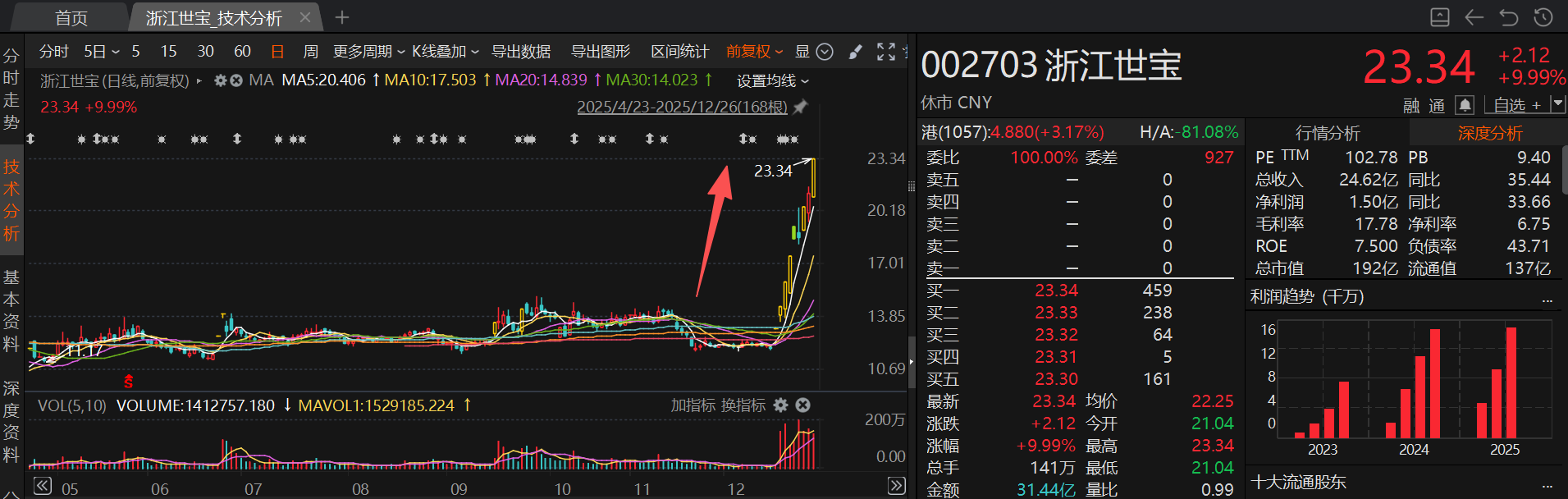
Core Viewpoint - The intelligent driving industry is entering a commercialized era, with the approval of L3-level autonomous driving marking a shift from technical validation to commercial application, enhancing expectations for policy, industry, and performance transmission [1] Industry Developments - Recent key policy breakthroughs and industry advancements in intelligent driving include the approval of China's first L3-level autonomous driving vehicles and Tesla's initiation of unmanned Robotaxi road tests, indicating a transition to large-scale application [1] - The intelligent driving sector is becoming a core engine for the transformation and upgrading of the automotive industry, fostering a collaborative ecosystem across the entire industry chain [1] Market Performance - In the secondary market, Zhejiang Shibao, focusing on steer-by-wire technology, recorded a maximum increase of 96.8% within the month, while Wanji Technology, focusing on lidar technology, saw a maximum increase of 52.7% [1] Company Insights - **Wanji Technology**: The company’s 128-line lidar has received approval from a major passenger vehicle manufacturer, and its 192-line lidar has passed validation from multiple mainstream automakers. The lidar products are being applied in leading commercial vehicles like Robobus [8] - **Zhejiang Shibao**: As a leader in electric power steering systems, the company has established long-term partnerships with several domestic traditional and new energy vehicle manufacturers, indicating a robust order book and normal operations [6][7] - **Bertley**: A leader in the automotive brake sector, the company holds a 12.59% market share in electronic parking brake systems in China and has received awards for its innovative small-diameter caliper technology, which enhances vehicle performance [7] - **Yongxin Optical**: The company specializes in lidar optical components and is expected to ship nearly one million units by the first half of 2025, with strong partnerships with leading lidar manufacturers [8]