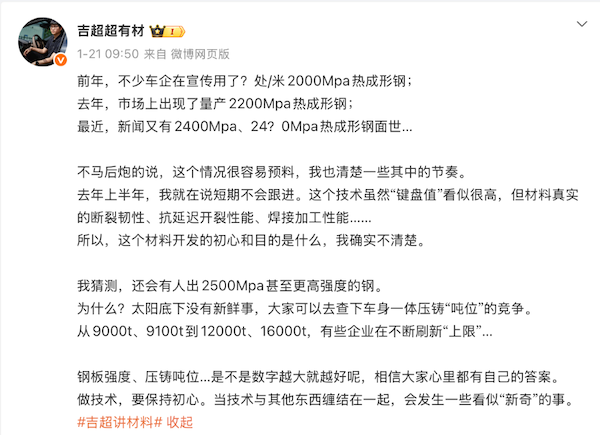
2420MPa超强钢

Search documents
车用钢板硬度已超坦克?专家称强度不等于安全
第一财经· 2026-01-26 09:49
Core Viewpoint - The automotive industry is experiencing a competitive race in steel strength, with companies promoting increasingly high values for steel used in vehicles, raising questions about the actual safety implications of these numbers [1][3]. Group 1: Steel Strength Competition - Chery Automobile and Hebei Steel Group have introduced ultra-high-strength 2400MPa hot-formed steel, while a new player has reportedly launched 2420MPa steel, which is claimed to be twice as strong as tank armor [1][3]. - The debate centers on whether the reported steel strength refers to yield strength or tensile strength, and whether higher numbers genuinely enhance vehicle safety [1][3]. Group 2: Consumer Perception and Marketing - Many automotive companies emphasize higher steel strength values in marketing to suggest enhanced safety, exploiting consumer knowledge gaps [5][6]. - Consumers often misunderstand the difference between yield strength and tensile strength, leading to confusion in vehicle safety assessments [5][6]. Group 3: Technical Definitions - Yield strength is the stress at which a material begins to deform plastically, while tensile strength is the maximum stress a material can withstand before failure [6][7]. - Generally, tensile strength values are higher than yield strength, but the industry has shifted towards using tensile strength for marketing purposes, which can mislead consumers [7][8]. Group 4: Industry Standards and Practices - There are very few models with yield strengths exceeding 2000MPa, while many models boast tensile strengths above this threshold [8][9]. - Companies often create marketing terms like "super high-strength steel" without standardized definitions, leading to potential consumer deception [8][9]. Group 5: Comprehensive Safety Considerations - Automotive safety is a complex system that involves more than just steel strength; factors like body structure, welding processes, and material durability are equally important [9][10]. - The use of high-strength steel can lead to issues like hydrogen embrittlement, which may cause delayed fractures, emphasizing the need for a holistic approach to vehicle safety [10][11]. Group 6: Cost and Production Implications - The cost of using high-strength steel is significantly higher, with production costs increasing by approximately 60% compared to regular steel [11]. - The proportion of high-strength steel used in vehicles directly affects production costs and safety ratings, necessitating careful consideration by manufacturers [10][11].

车用钢板硬度已超坦克?专家称强度不等于安全
Di Yi Cai Jing· 2026-01-26 06:42
Core Viewpoint - The automotive industry is entering a new phase of competition focused on the strength of steel used in vehicles, with companies increasingly emphasizing higher strength values to market safety, despite the complexities involved in material properties and overall vehicle safety [1][6]. Group 1: Steel Strength Competition - Chery Automobile and Hebei Steel Group have introduced ultra-high strength 2400MPa hot-formed steel, while a new player has reportedly launched 2420MPa steel, leading to discussions about the implications of these strength values [1][2]. - The debate centers on whether the reported strength values refer to yield strength or tensile strength, and whether higher numbers genuinely correlate with improved vehicle safety [1][3]. Group 2: Consumer Perception and Marketing - Many consumers lack the technical knowledge to understand the differences between yield strength and tensile strength, allowing companies to exploit this gap in marketing their vehicles as safer based on higher strength numbers [2][4]. - Companies often highlight the more favorable tensile strength figures in their marketing, which can mislead consumers regarding the actual safety of the vehicles [4][5]. Group 3: Technical Definitions and Industry Standards - Yield strength is defined as the stress at which a material begins to deform plastically, while tensile strength is the maximum stress a material can withstand before failure [3][6]. - The automotive industry generally prioritizes yield strength for safety considerations, as it indicates the point at which a vehicle will deform in a collision [3][6]. Group 4: Systemic Safety Considerations - Automotive safety is a complex system that involves not just steel strength but also factors like body structure, welding techniques, and material durability [6][7]. - The use of high-strength steel must be balanced with considerations of production costs and the overall vehicle design, as higher strength materials can increase manufacturing expenses significantly [7][8]. Group 5: Future Trends and Predictions - There is speculation that manufacturers may continue to push the boundaries of steel strength, potentially introducing even higher strength materials in the future [8].